
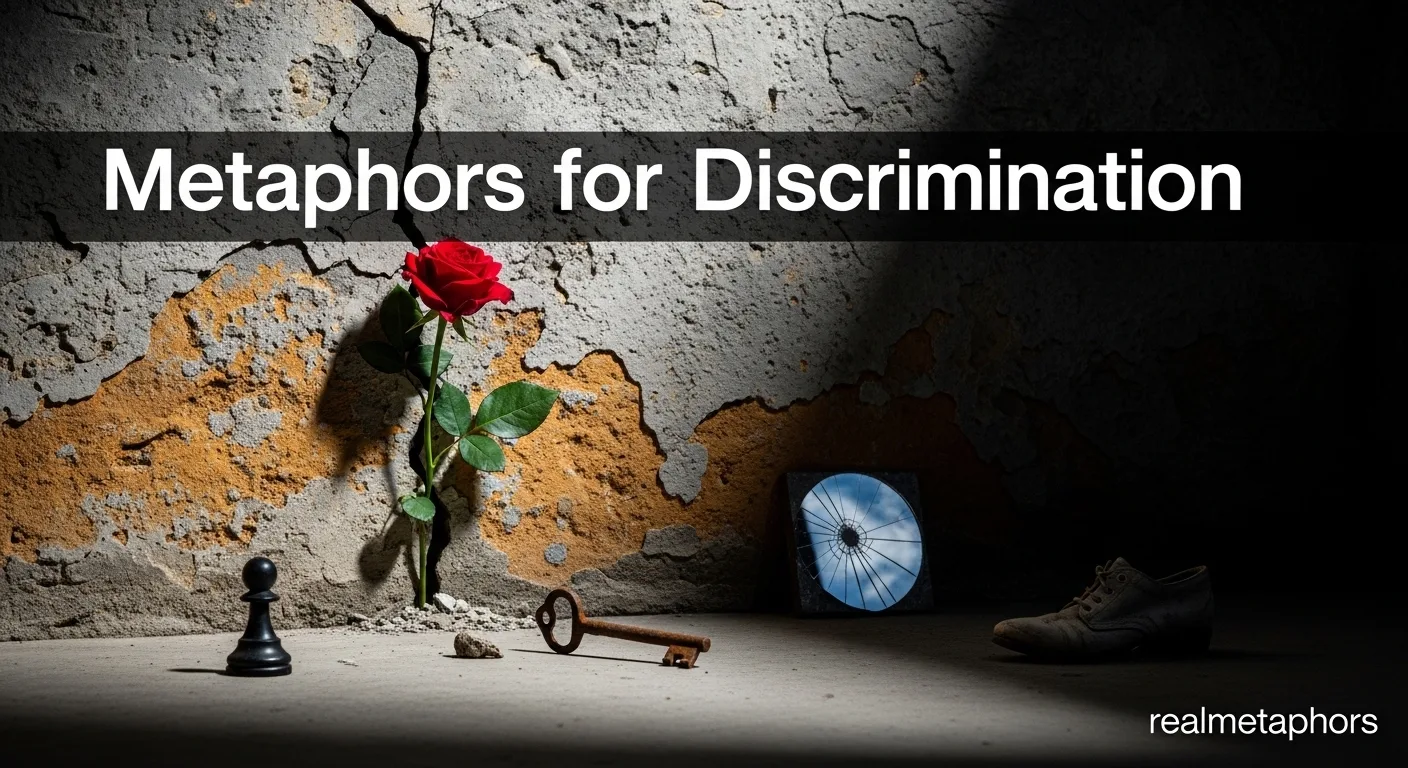
Imagine walking into a room full of people, feeling invisible, as if you were a shadow stretching across the floor. You speak, but your voice is swallowed. You try to join a conversation, but an invisible wall keeps you out. This is the reality of discrimination—a force that isolates, diminishes, and sometimes scars. Yet, writers, speakers, and artists have found ways to capture this experience through metaphors—figurative language that paints the emotional and social impact of discrimination in vivid colors.
Using metaphors for discrimination is more than a literary tool. They help us understand complex social dynamics, express empathy, and communicate experiences that are hard to put into plain words. Whether you are writing a story, crafting a social media post, or reflecting on personal experiences, metaphors make your message memorable, emotional, and relatable.
In this article, we explore 25 powerful metaphors for discrimination, their meanings, example usages, alternatives, and creative exercises. By the end, you will have a toolbox of figurative expressions that can make your writing and conversations more vivid, sensitive, and impactful.
1. Discrimination as a Wall
Meaning: Discrimination separates people, keeping some in and others out.
Example: “The unspoken rules at the office were a wall, keeping her talent from rising.”
Alternatives: barrier, fence, glass ceiling
Sensory/Emotional Details: Imagine touching a cold brick wall that blocks your path. The texture is rough, the edge is sharp.
Exercise: Write a paragraph describing a personal or fictional situation where someone faces a “wall” of discrimination.
2. Discrimination as Chains
Meaning: Discrimination restricts freedom and opportunities, like chains binding someone.
Example: “His dreams were shackled by discrimination that judged his skin color before his skills.”
Alternatives: shackles, handcuffs, ropes
Emotional Details: Chains rattle with frustration and heaviness, echoing the struggle to break free.
Exercise: Describe a scenario where someone “breaks the chains” of social bias.
3. Discrimination as a Shadow
Meaning: It follows people silently, affecting them everywhere they go.
Example: “Even in her happiest moments, the shadow of prejudice loomed over her.”
Alternatives: dark cloud, specter, haunting presence
Exercise: Write a short dialogue between a character and their “shadow” of discrimination.
4. Discrimination as Poison
Meaning: Discrimination slowly harms individuals or communities, often invisibly.
Example: “The toxic gossip poisoned the workplace, leaving some feeling isolated.”
Alternatives: venom, toxin, infection
Sensory Details: Imagine a bitter taste lingering in your mouth, sharp and unwanted.
Exercise: Create a short story where discrimination “poisons” relationships but someone finds a cure.
5. Discrimination as Ice

Meaning: It makes interactions cold, distant, and unwelcoming.
Example: “Her colleague’s icy stare said more than words ever could.”
Alternatives: frost, blizzard, winter chill
Sensory Details: Feel the chill in your bones, the bite of cold air—emotions frozen in fear or judgment.
Exercise: Describe a workplace or school setting where discrimination is the “ice” everyone avoids touching.
6. Discrimination as a Storm
Meaning: It comes suddenly, violently, and affects everyone in its path.
Example: “The storm of prejudice swept through the town after the newcomer arrived.”
Alternatives: hurricane, tempest, whirlwind
Sensory Details: Hear howling wind, feel the rain sting—chaos and fear overwhelm.
Exercise: Write a paragraph showing how someone navigates through the “storm” of bias.
7. Discrimination as a Cage
Meaning: It traps people, preventing growth or freedom.
Example: “She felt caged by stereotypes that defined her before she could speak.”
Alternatives: prison, enclosure, pen
Sensory Details: Metal bars, cold shadows, and limited space—a confined life.
Exercise: Imagine someone finding the key to their “cage” of discrimination and describe the moment.
8. Discrimination as Fire
Meaning: It burns and destroys, sometimes uncontrollably.
Example: “His career was set ablaze by discrimination that spread like wildfire.”
Alternatives: blaze, inferno, wildfire
Sensory Details: Heat on your skin, smoke in your eyes, the scent of burning—pain and fear.
Exercise: Describe a community or workplace “fire” caused by prejudice and how it can be extinguished.
9. Discrimination as a Blindfold
Meaning: It prevents people from seeing the real value in others.
Example: “The manager wore a blindfold, ignoring her talent because of her accent.”
Alternatives: mask, visor, opaque lens
Sensory Details: Darkness, confusion, the inability to navigate freely.
Exercise: Write a short paragraph where someone removes the “blindfold” and sees true merit.
10. Discrimination as a Thorn
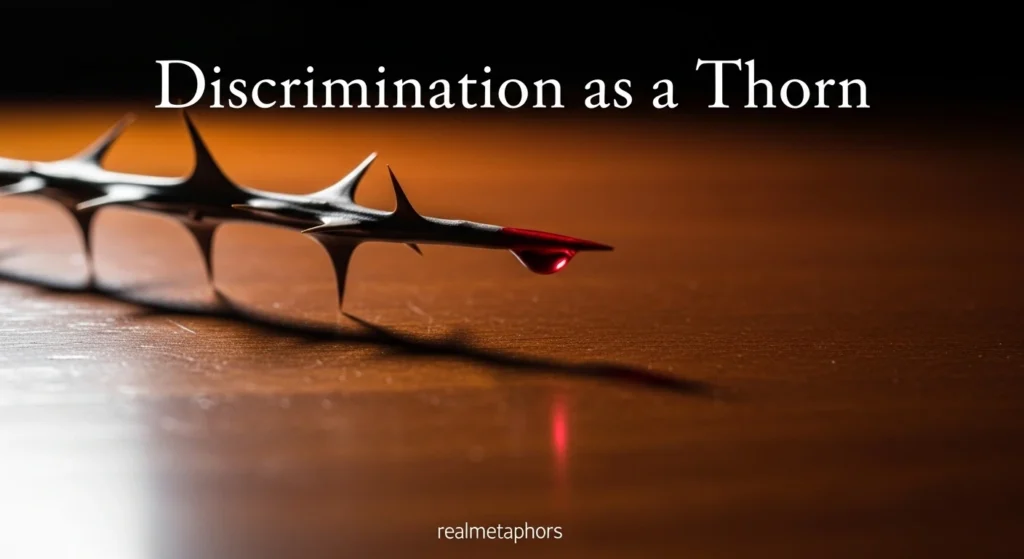
Meaning: It causes pain and discomfort, often small but persistent.
Example: “Every offhand remark was a thorn in his confidence.”
Alternatives: splinter, prick, needle
Sensory Details: Sharp, stabbing pain, constant irritation, difficult to ignore.
Exercise: Think of a personal or fictional scenario where small acts of discrimination are “thorns” in someone’s life.
11. Discrimination as a Mirror
Meaning: It reflects society’s prejudices back to individuals.
Example: “The mirror of public opinion showed her worth only through bias.”
Alternatives: lens, reflection, echo
Sensory Details: Cold glass reflecting distorted images of self, amplifying insecurities.
Exercise: Write a dialogue where someone confronts the “mirror” of society’s bias.
12. Discrimination as a Fog
Meaning: It obscures clarity, making fairness hard to see.
Example: “A fog of prejudice clouded the hiring process.”
Alternatives: haze, mist, smog
Sensory Details: Visibility low, voices muffled, direction uncertain.
Exercise: Describe a journey through a “fog” of discrimination and the first sign of light breaking through.
13. Discrimination as a Cage of Glass
Meaning: It looks invisible or harmless but is still restrictive.
Example: “The company’s policies were a glass cage, subtle but trapping underrepresented employees.”
Alternatives: invisible barrier, see-through wall
Sensory Details: Transparent, fragile, yet confining; you can see freedom but can’t reach it.
Exercise: Write a scene where a character discovers the invisible “glass cage” in their daily life.
14. Discrimination as a Poisoned Garden
Meaning: It corrupts an environment meant to grow talent or relationships.
Example: “The poisoned garden of the office culture choked innovation.”
Alternatives: toxic soil, contaminated land
Sensory Details: Wilted plants, foul smell, rotting leaves—a beautiful place ruined.
Exercise: Describe a “garden” in your life or imagination where discrimination prevents growth.
15. Discrimination as a Heavy Backpack
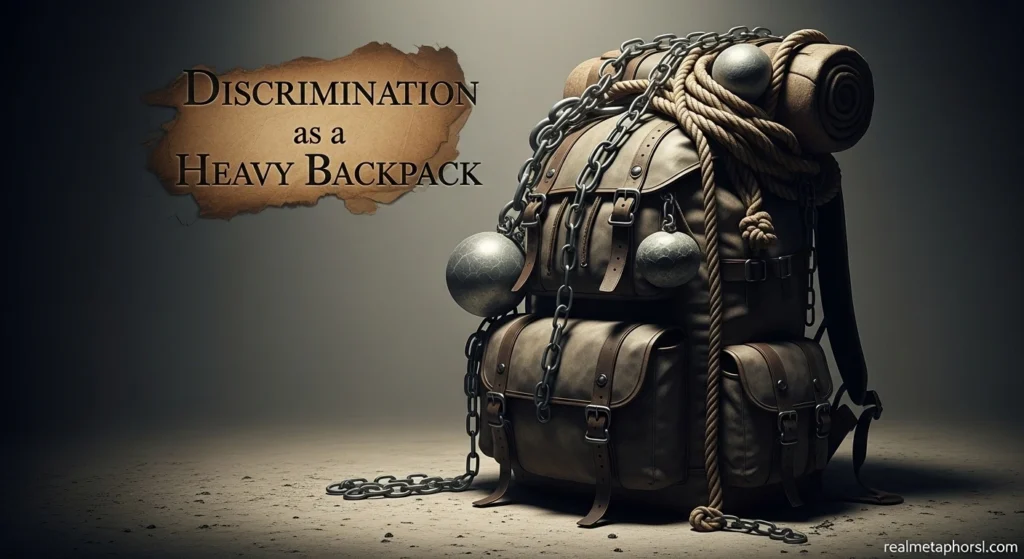
Meaning: It weighs people down with extra burdens.
Example: “He carried a heavy backpack of bias wherever he went.”
Alternatives: load, burden, weight
Sensory Details: Strain on shoulders, aching muscles, slow steps—constant fatigue.
Exercise: Write a paragraph showing how someone lightens their “backpack” by fighting discrimination.
16. Discrimination as a Leaky Roof
Meaning: Small, repeated acts of bias can slowly erode comfort and security.
Example: “Every slur and slight was like a leaky roof drenching her confidence.”
Alternatives: dripping ceiling, constant leak
Sensory Details: Rain on your head, damp clothes, cold shivers—minor annoyances accumulate.
Exercise: Describe how someone “repairs” their roof to shield themselves from bias.
17. Discrimination as Chains of Ice
Meaning: It freezes progress and personal growth.
Example: “Chains of ice held back her promotion, even though she deserved it.”
Alternatives: frozen shackles, frost-bound chains
Sensory Details: Numb fingers, brittle metal, slipping on ice—motion blocked.
Exercise: Imagine someone melting the ice with courage or solidarity.
18. Discrimination as a Thorny Path
Meaning: Life becomes difficult and painful due to bias.
Example: “His journey through education was a thorny path, littered with prejudice.”
Alternatives: rocky road, jagged trail
Sensory Details: Sharp thorns tearing shoes, scraped knees, constant vigilance.
Exercise: Write a mini-story of a character overcoming the “thorny path” in life.
19. Discrimination as a Cage of Opinion
Meaning: Societal judgments trap people, limiting their choices.
Example: “He felt trapped in a cage of opinion, judged before being known.”
Alternatives: judgment cell, opinion bars
Sensory Details: Voices pressing, unseen walls, suffocating judgments.
Exercise: Reflect on an experience where you were trapped by others’ opinions.
20. Discrimination as Rust
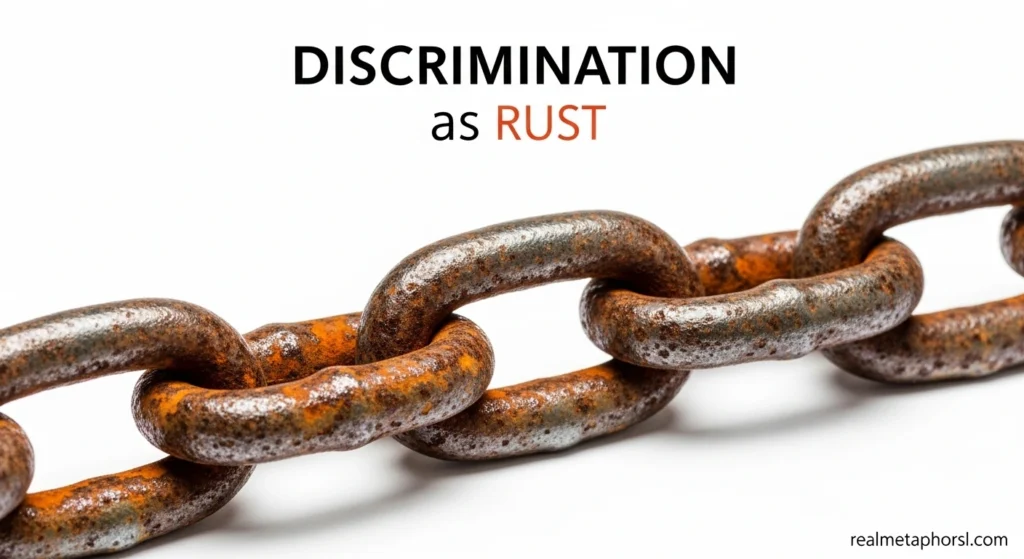
Meaning: It slowly corrodes confidence, relationships, and opportunities.
Example: “Years of bias left rust on her spirit.”
Alternatives: corrosion, decay, oxidation
Sensory Details: Flaking metal, rough texture, silent destruction.
Exercise: Write about how someone “cleans the rust” in their life.
21. Discrimination as a Locked Door
Meaning: It denies access to opportunities, communities, or resources.
Example: “Every application felt like a locked door, opening only for some.”
Alternatives: barrier, closed gate, sealed entry
Sensory Details: Cold doorknob, polished wood, no key in sight.
Exercise: Describe the moment someone finds a key to a locked door of bias.
22. Discrimination as a Dark Room
Meaning: It isolates and hides people from recognition or understanding.
Example: “His talent stayed in a dark room while others received the spotlight.”
Alternatives: shadow chamber, cellar, closet
Sensory Details: Darkness, muffled sounds, cold and quiet—unseen, unheard.
Exercise: Write a story where someone lights up their dark room.
23. Discrimination as a Thorny Crown
Meaning: Bias may superficially recognize someone but at a cost of pain and burden.
Example: “She wore a thorny crown of expectations and prejudice at work.”
Alternatives: painful crown, spiked recognition
Sensory Details: Prickling head, weight on neck, constant discomfort.
Exercise: Describe how a character removes their “thorny crown” and feels relief.
24. Discrimination as Sand in the Gears
Meaning: It disrupts progress, making life and work inefficient and painful.
Example: “Bias was sand in the gears of his promotion.”
Alternatives: grit in machinery, obstruction, friction
Sensory Details: Squeaking metal, slowed movement, grinding frustration.
Exercise: Write a paragraph showing how someone clears the “sand” to move forward.
25. Discrimination as a Closed Book

Meaning: It prevents people from being seen or understood for who they truly are.
Example: “Society treated him like a closed book, judging without reading.”
Alternatives: locked diary, sealed manuscript
Sensory Details: Cover tight, pages inaccessible, stories untold.
Exercise: Write a scene where someone opens a “closed book” and finally shares their story.
Bonus Tips for Using Metaphors Effectively
- Be vivid, but simple: Readers connect to metaphors they can imagine or feel.
- Use emotions and senses: Sight, sound, touch, taste, and smell make metaphors powerful.
- Mix literal and figurative: A sentence that combines reality and metaphor hits harder.
- Adapt for social media: Short, strong metaphors work well as captions or tweets.
- Experiment in storytelling: Use a metaphor to show, not just tell, the impact of discrimination.
Conclusion
Metaphors transform abstract experiences of discrimination into vivid, relatable imagery. From walls and chains to storms and shadows, each metaphor allows writers, speakers, and thinkers to communicate feelings that are otherwise hard to express. By practicing these metaphors, reflecting on personal experiences, and experimenting in writing or conversation, anyone can develop a more empathetic, imaginative, and impactful way to talk about social issues. Use them creatively, share them thoughtfully, and watch your communication become alive with meaning.
FAQs
Q1: Why use metaphors for discrimination?
Metaphors make abstract concepts like bias and prejudice understandable and relatable, showing emotional and social impact in a way plain language often cannot.
Q2: How can I create my own metaphors?
Think about physical sensations, natural phenomena, or objects that reflect the feeling of discrimination. Compare them creatively—e.g., “prejudice is a shadow that follows me.”
Q3: Can metaphors for discrimination be used in everyday conversation?
Absolutely. Phrases like “a wall of bias” or “chains of expectation” can communicate experiences vividly without being confrontational.
Q4: How do I avoid overusing metaphors?
Use metaphors sparingly and purposefully. Mix with literal statements, and ensure each metaphor adds new meaning or emotion.
Q5: Are some metaphors better for writing than speaking?
Yes. Visual metaphors (e.g., poisoned garden, thorny path) work well in writing, while simple, relatable ones (e.g., wall, shadow) are better for conversation or social media.
Write