The old farmer stood in his field, rubbing dry soil between his fingers. “The rains used to arrive like a guest who never missed dinner,” he said quietly. “Now, they come like a stranger who forgot the address.” The sky above him stretched wide and uncertain, clouds gathering but offering no promise. Birds circled lower than usual, as if searching for answers hidden in the dust. In that moment, the farmer wasn’t speaking about weather alone — he was describing climate change in a language deeper than science, statistics, or charts. He was speaking through metaphor.
Climate change can feel overwhelming because it is complex, global, and sometimes invisible in daily life. Metaphors help translate this vast environmental shift into images and feelings we can easily understand. They turn scientific facts into relatable stories, making communication clearer and more emotionally powerful. Writers, educators, students, and everyday communicators use metaphors to explain climate change in ways that stick in people’s minds and hearts.
This article explores vivid and meaningful metaphors for climate change, explains their meanings, and shows how you can use them creatively in writing, communication, and daily conversation.
Why Metaphors Help Explain Climate Change
Climate change involves rising temperatures, shifting weather patterns, melting ice caps, and ecological disruption. While these ideas are scientifically measurable, they can feel abstract or distant. Metaphors act like bridges between facts and human understanding.
They help by:
- Making complex science easier to grasp
- Creating emotional connection and urgency
- Enhancing storytelling and creative writing
- Improving communication in education and awareness campaigns
When we say “the planet has a fever,” we instantly understand danger and the need for care — even without scientific numbers.
Examples of Metaphors for Climate Change
Below are carefully explained metaphors, each with meanings, examples, alternative expressions, and sensory or emotional details.
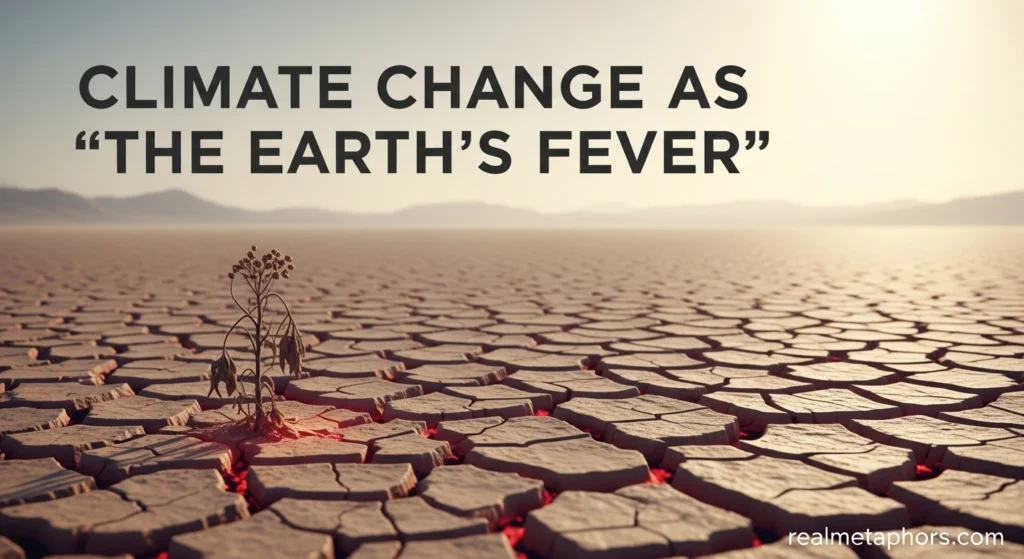
1. Climate Change as “The Earth’s Fever”
Meaning / Explanation
This metaphor compares global warming to a human body experiencing fever. Just like fever signals illness, rising global temperatures signal environmental imbalance.
Example Sentence
“The rising global temperature is the Earth’s fever warning us that something is deeply wrong.”
Alternative Ways to Express It
- The planet running a high temperature
- Nature’s overheating alarm
- The world burning with illness
Sensory / Emotional Details
Imagine touching a forehead that feels too warm — the discomfort, worry, and urgency to fix the problem.
Mini Storytelling
A teacher once asked her students to imagine the Earth lying in bed, sweating under thick blankets of pollution. Suddenly, the students began discussing climate change with empathy instead of confusion.
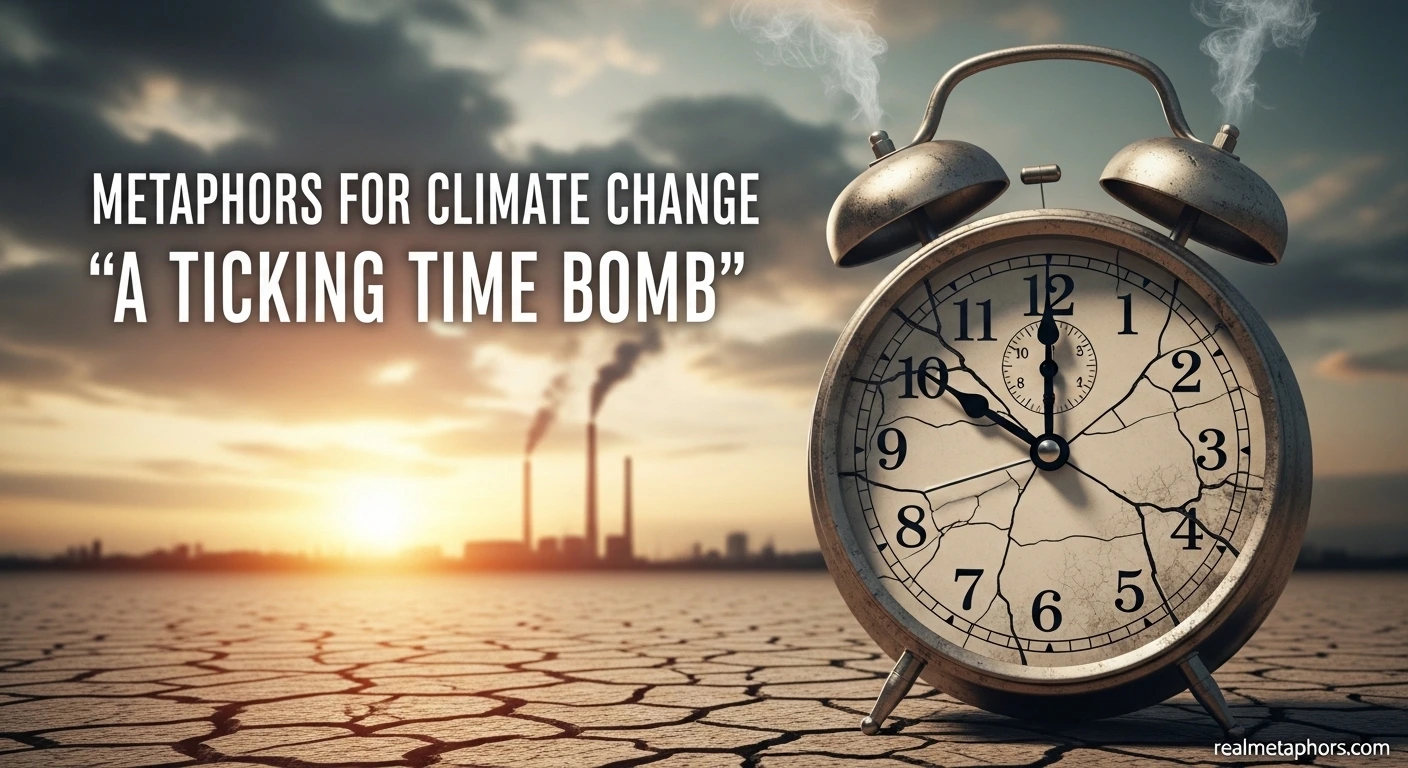
2. Climate Change as “A Ticking Time Bomb”
Meaning / Explanation
This metaphor emphasizes urgency and potential disaster if action is delayed.
Example Sentence
“Unchecked carbon emissions have become a ticking time bomb for future generations.”
Alternative Expressions
- A countdown to disaster
- A silent clock running out
- An environmental alarm about to ring
Emotional Details
This metaphor creates tension, urgency, and fear of consequences.
Real-Life Reference
Scientists often warn about tipping points — moments when climate damage becomes irreversible, much like a bomb that cannot be defused after a certain point.
3. Climate Change as “A Slow-Moving Storm”
Meaning / Explanation
Climate change does not always strike suddenly. Instead, it builds gradually but becomes destructive over time.
Example Sentence
“Climate change is a slow-moving storm gathering strength across decades.”
Alternative Expressions
- A creeping hurricane
- A gathering environmental thunder
- A silent flood rising
Sensory Details
Darkening skies, rising winds, and distant thunder create a feeling of approaching danger.
4. Climate Change as “Nature’s Cry for Help”
Meaning
Suggests that environmental disasters are warning signals from the planet.
Example
“Melting glaciers and burning forests are nature’s cry for help.”
Alternatives
- Earth’s distress signal
- The planet calling for rescue
- A wounded world speaking out
Emotional Impact
Creates sympathy and encourages responsibility.
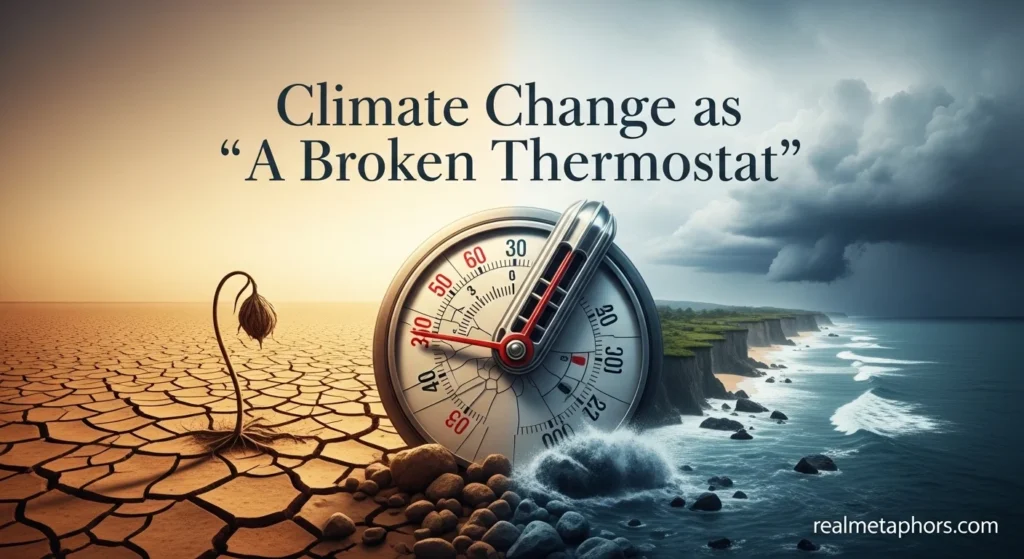
5. Climate Change as “A Broken Thermostat”
Meaning
Suggests the natural temperature regulation of Earth is failing.
Example
“The planet’s climate system is like a broken thermostat stuck on high heat.”
Alternatives
- A malfunctioning weather control
- A damaged climate regulator
6. Climate Change as “A Runaway Train”
Meaning
Shows climate change accelerating and becoming harder to stop.
Example
“If emissions continue rising, climate change will become a runaway train beyond control.”
Alternatives
- A speeding environmental train
- A vehicle with failed brakes
7. Climate Change as “A Fading Painting”
Meaning
Highlights biodiversity loss and environmental degradation.
Example
“Climate change is slowly turning Earth’s vibrant painting into faded colors.”
Alternatives
- A masterpiece losing its shades
- A canvas being erased
8. Climate Change as “An Unbalanced Scale”
Meaning
Shows disruption of natural ecological balance.
Example
“The climate crisis has tipped the scale of nature toward chaos.”
Alternatives
- A tilted environmental balance
- A collapsing natural equilibrium
9. Climate Change as “A Leaking Boat”
Meaning
Represents a growing crisis requiring urgent repair.
Example
“Our planet is like a leaking boat — ignoring the holes only speeds sinking.”
Alternatives
- A cracked environmental vessel
- A ship taking on water
10. Climate Change as “A Domino Effect”
Meaning
Shows how one environmental problem triggers others.
Example
“Melting ice caps create a domino effect leading to rising sea levels.”
Alternatives
- A chain reaction of environmental damage
- A falling line of natural disasters
11. Climate Change as “The Planet Losing Its Rhythm”
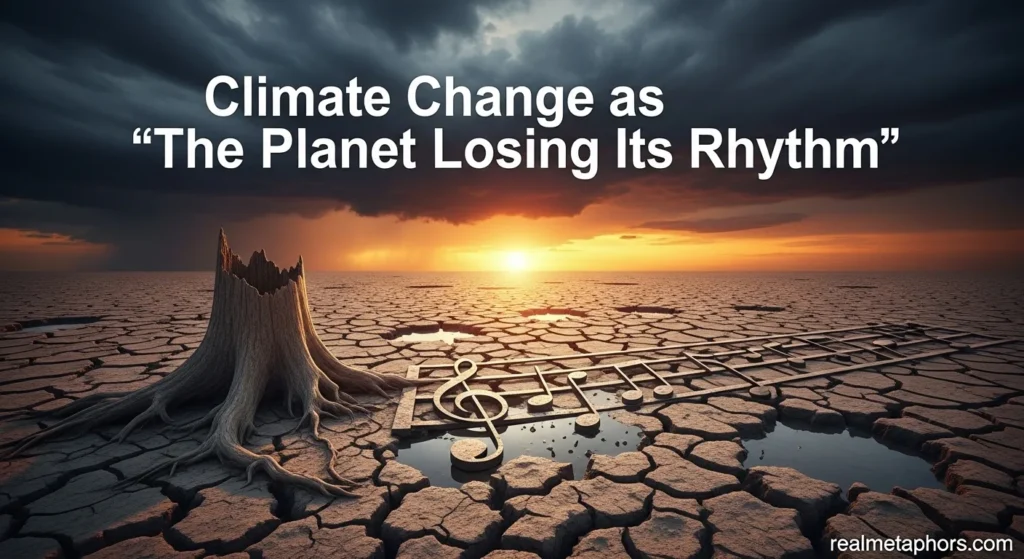
Meaning
Represents disruption in seasonal cycles.
Example
“Climate change is causing Earth to lose its natural rhythm.”
Alternatives
- Nature missing its musical beat
- The seasons dancing out of sync
12. Climate Change as “A Blanket Getting Too Thick”
Meaning
Describes greenhouse gases trapping heat around Earth.
Example
“Carbon emissions are like blankets trapping heat around the planet.”
Alternatives
- An overheating coat around Earth
- A suffocating atmospheric cover
13. Climate Change as “A Hungry Fire”
Meaning
Represents wildfires and increasing heat.
Example
“Climate change is feeding a hungry fire across forests worldwide.”
14. Climate Change as “A Cracking Mirror”
Meaning
Shows fragile environmental systems breaking.
Example
“The climate crisis is like a mirror cracking across ecosystems.”
15. Climate Change as “The Ocean Climbing the Stairs”
Meaning
Represents rising sea levels.
Example
“The ocean is climbing the stairs of coastal cities.”
16. Climate Change as “A Puzzle Missing Pieces”
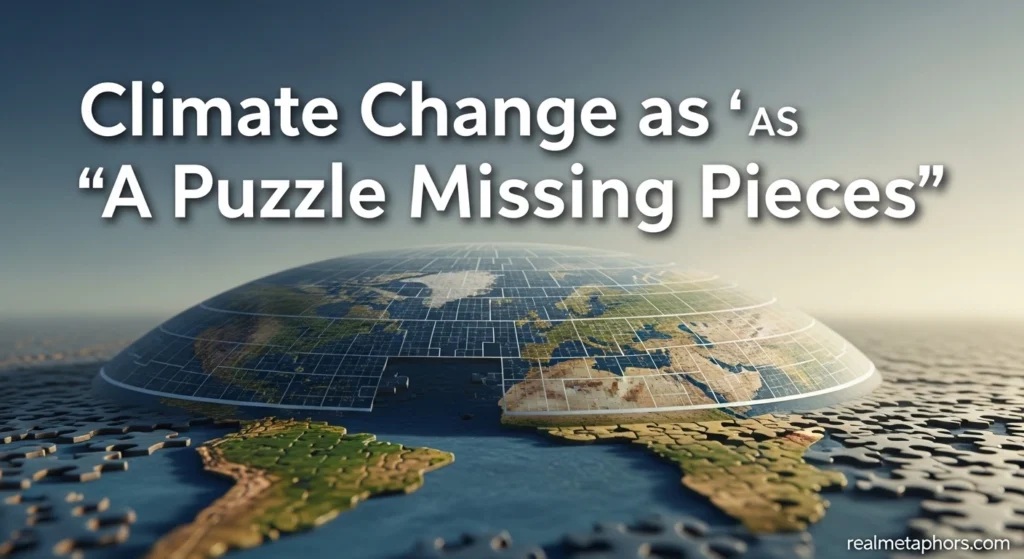
Meaning
Shows biodiversity loss.
17. Climate Change as “The Earth Running Out of Breath”
Meaning
Represents pollution and oxygen loss.
18. Climate Change as “A Library Burning Slowly”
Meaning
Represents loss of environmental knowledge stored in ecosystems.
19. Climate Change as “A Fever Dream of Weather”
Meaning
Highlights unpredictable climate patterns.
20. Climate Change as “The Sky Carrying Heavy Luggage”
Meaning
Represents excess greenhouse gases.
21. Climate Change as “A Garden Forgotten”
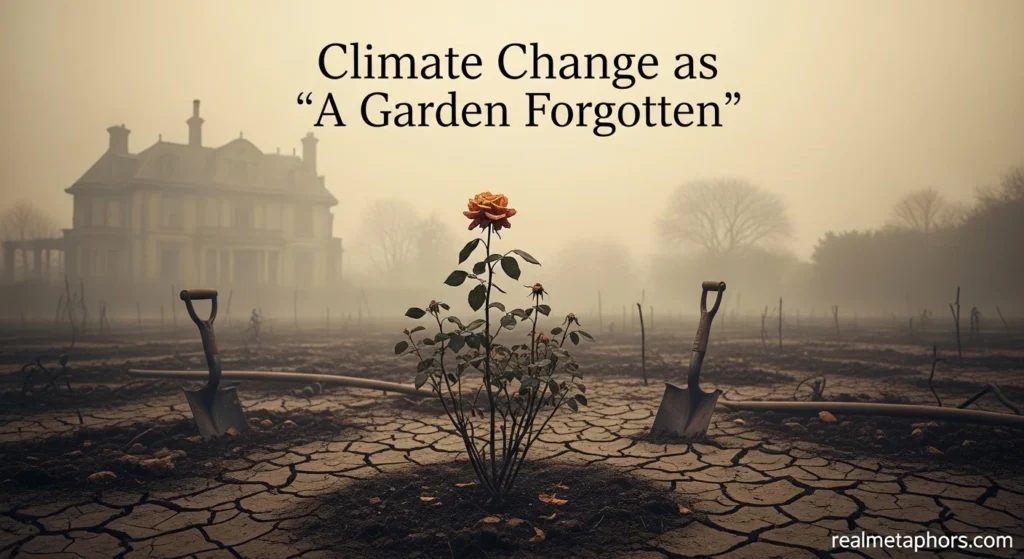
Meaning
Shows neglect of environmental care.
22. Climate Change as “A Clock Without Hands”
Meaning
Shows uncertainty about environmental future.
23. Climate Change as “The Earth Changing Its Mood”
Meaning
Represents unstable weather systems.
24. Climate Change as “A Song Losing Its Melody”
Meaning
Shows harmony loss between nature and humanity.
25. Climate Change as “A Story Written in Melting Ice”
Meaning
Represents scientific evidence found in glaciers.
Tips for Using Climate Change Metaphors Effectively
1. Choose Relatable Imagery
Use familiar experiences like illness, weather, or household objects to make metaphors easy to understand.
2. Match Tone to Audience
Serious metaphors suit scientific communication, while poetic ones work well in storytelling or literature.
3. Avoid Overcomplicating
Simple metaphors are often stronger and clearer.
Mini Storytelling Example Using Metaphors
A young boy once asked his grandmother why winters felt shorter. She smiled sadly and said, “The Earth is like an old clock losing time. The hands still move, but not as they once did.” The boy later used that metaphor in a school speech, helping classmates understand climate change emotionally rather than academically.
Interactive Exercises for Readers
Exercise 1: Create Your Own Climate Metaphor
Think of climate change as:
- A person
- An object
- A natural event
Write one metaphor describing it.
Exercise 2: Expand a Metaphor
Choose one metaphor from this article and write:
- A short story
- A poem
- A social media caption
Exercise 3: Compare Two Metaphors
Pick two metaphors and explain:
- Which is more emotional?
- Which is clearer?
- Which would persuade people more?
Bonus Tips for Using Metaphors in Writing and Daily Life
- Use metaphors in speeches or awareness campaigns
- Add emotional details to make writing memorable
- Use social media captions with metaphorical phrases
- Combine metaphors with real facts for stronger impact
Conclusion
Climate change is one of the greatest challenges humanity faces, yet its complexity can make it difficult to understand and communicate. Metaphors transform scientific data into emotional and relatable language. They help people see climate change not just as numbers, but as stories, warnings, and shared experiences.
When we describe climate change as a fever, a storm, or a fading painting, we make the invisible visible. We turn knowledge into connection and facts into feelings. Through creative language, we not only understand climate change better — we inspire action, awareness, and hope for a healthier planet.
By learning and using metaphors thoughtfully, we can communicate environmental challenges in ways that encourage people to listen, care, and respond before the story of our planet reaches an irreversible ending.