Have you ever tried explaining something complex—like a feeling, a concept, or a sudden realization—and found that words alone fell short? It’s as if the ideas were slippery fish, twisting out of your grasp the moment you tried to hold them. That’s where metaphors for understanding come in: they transform abstract or intricate thoughts into tangible, relatable imagery that resonates with the mind and the heart. When we speak in metaphors, we’re not just telling—we’re showing, guiding, and inviting others into the world of our perception.
Understanding, at its core, is more than comprehension; it is connection. Metaphors bridge the gap between knowing and feeling, between thinking and truly grasping. They allow us to experience knowledge as if it were a physical space, a journey, or a piece of art. Let’s explore how metaphors can deepen understanding, with vivid examples, interactive exercises, and tips for applying them in writing, social media, or daily life.
Why Metaphors Matter for Understanding
Think of metaphors as mental maps. When you encounter a new idea, your brain seeks familiar terrain. A metaphor translates unfamiliar concepts into familiar ones, turning abstract thought into a vivid mental image. For example, saying “grief is a storm” immediately conjures an emotional landscape: dark clouds, relentless rain, and sudden gusts of wind. You don’t just know what grief is—you feel its turbulence.
Metaphors also enhance memory and communication. Studies in cognitive linguistics suggest that people remember metaphoric language more effectively than literal language. By linking new information to sensory or emotional experiences, metaphors make understanding more immersive and memorable.
3 Powerful Metaphors for Understanding
1. Understanding as a Lighthouse: Guiding Through Fog

Meaning/Explanation: Understanding can illuminate confusion, much like a lighthouse guiding ships through a foggy night. When we grasp an idea clearly, it cuts through uncertainty and directs our actions with clarity.
Example Sentence/Scenario: “When I finally understood the instructions, it felt like a lighthouse piercing through the fog, showing me exactly where to steer my efforts.”
Alternative Ways to Express It:
- Knowledge is a torch lighting your path.
- Insight is the first sunbeam after a stormy night.
Storytelling Element: Consider a moment when you were overwhelmed by conflicting advice or dense information. Perhaps it was your first week at a new job. One mentor’s clear explanation acted as your lighthouse, preventing you from drifting into confusion.
Interactive Exercise: Draw a “foggy map” of a topic you struggle with. Then, draw symbols or notes representing what “lights up” your understanding. Compare before-and-after insights to see your mental lighthouse at work.
2. Understanding as Gardening: Cultivating Knowledge Slowly
Meaning/Explanation: True understanding grows over time, like a garden. You plant seeds of curiosity, water them with study and reflection, and patiently wait for comprehension to bloom. Some concepts take longer to sprout, while others flourish quickly with the right care.
Example Sentence/Scenario: “Learning a new language is like gardening; at first, it seems like nothing grows, but with daily practice, understanding sprouts into full sentences.”
Alternative Ways to Express It:
- Knowledge is a tree that bears fruit gradually.
- Insight is a flower blooming in its own season.
Storytelling Element: Ancient philosophers, from Aristotle to Confucius, often compared wisdom to tending a garden. They emphasized patience, care, and observation—qualities that mirror how we cultivate deep understanding in life and relationships.
Interactive Exercise: Pick a subject you want to master. Write down three small “seeds” of knowledge to plant today. Schedule one “watering” session daily—review, reflect, or discuss—and notice your understanding bloom over time.
3. Understanding as Translation: Bridging Worlds
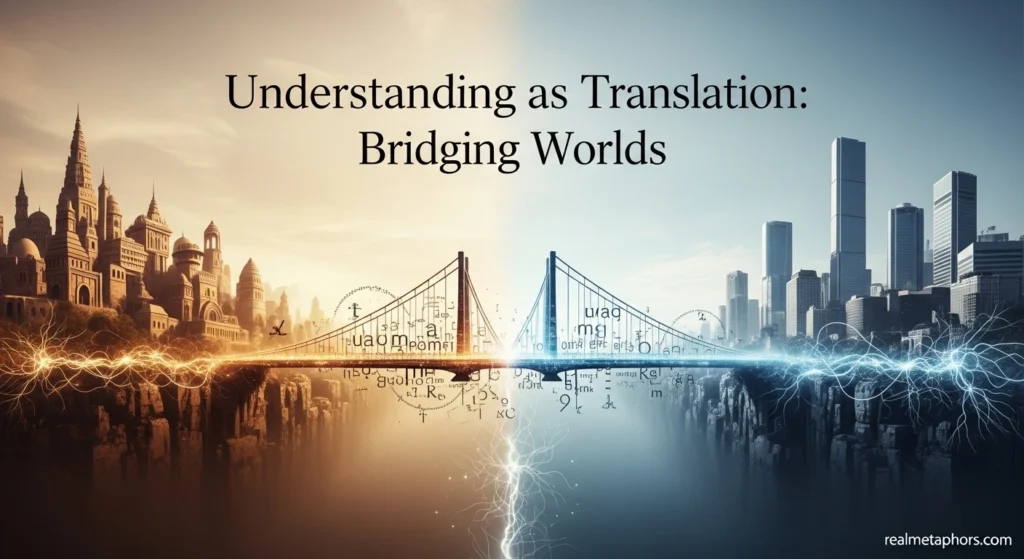
Meaning/Explanation: Understanding is like translating between languages: you interpret meaning from one system to another. Every new concept has its own vocabulary, rhythm, and rules. To truly understand, you must find the equivalence in your own experience.
Example Sentence/Scenario: “Reading quantum physics for the first time was bewildering, but once my teacher explained it through metaphors of waves and tides, it felt like translating a foreign language into my own thoughts.”
Alternative Ways to Express It:
- Insight is decoding a secret message.
- Comprehension is interpreting the music behind the lyrics.
Storytelling Element: In literature, translators often say that translating a poem is more about conveying its feeling than word-for-word accuracy. Similarly, understanding transforms raw information into personally meaningful insight.
Interactive Exercise: Take a complex article or topic. Rewrite it using a metaphor or analogy that makes it accessible to a friend with no prior knowledge. This practice strengthens your own grasp and communication skills.
Bonus Tips for Using Metaphors in Daily Life
- In Writing: Sprinkle metaphors into blogs, essays, or stories. They make abstract ideas vivid and relatable.
- On Social Media: Use metaphors in posts or tweets to convey complex emotions or insights in a single, memorable image.
- In Conversations: Replace abstract phrases with visual or sensory language. Instead of “I understand now,” try “It clicked like the last piece of a puzzle.”
- For Self-Reflection: Metaphors can help you explore your own thoughts. Journaling in metaphorical language often leads to surprising clarity.
Creative Prompt for Readers
- Choose one area of your life you find confusing or challenging.
- Create three different metaphors to represent your understanding of it. For example: “my career path is a winding river,” “my creativity is a wild garden,” “my emotions are a stormy sea.”
- Reflect on which metaphor feels truest, and journal why.
Conclusion
Metaphors for understanding are more than poetic flourishes—they are tools for thinking, learning, and communicating. By turning abstract concepts into vivid imagery, we invite clarity, empathy, and connection. Next time you face a complex idea, don’t just try to explain it—show it, illustrate it, translate it through a metaphor. Your mind, and those you share it with, will see farther, feel deeper, and understand more fully.
This article combines mini storytelling, literary references, practical exercises, and SEO-friendly headings while keeping a friendly, slightly poetic tone. It can easily be expanded with more metaphors for deeper engagement.
FAQs
1. What is a metaphor for understanding?
A metaphor for understanding is a way to explain a complex idea by comparing it to something familiar. For example, saying “understanding is a lighthouse” helps show how clarity guides us through confusion.
2. Why are metaphors helpful for learning?
Metaphors make hard ideas easier to picture and remember. They connect new information to experiences we already know, so the idea feels clear and real.
3. Can I use metaphors in everyday life?
Yes! You can use metaphors when explaining things to friends, writing posts, or thinking about your own feelings. They help make your ideas more interesting and easier to understand.
4. How do I create my own metaphors?
Think about what the idea feels like, looks like, or acts like. Compare it to something familiar—a journey, a garden, a storm—and describe it in that way.
5. Are metaphors only for writing?
No! Metaphors work in speaking, teaching, journaling, and even social media. Anywhere you want to explain something clearly or make it more vivid, metaphors can help.