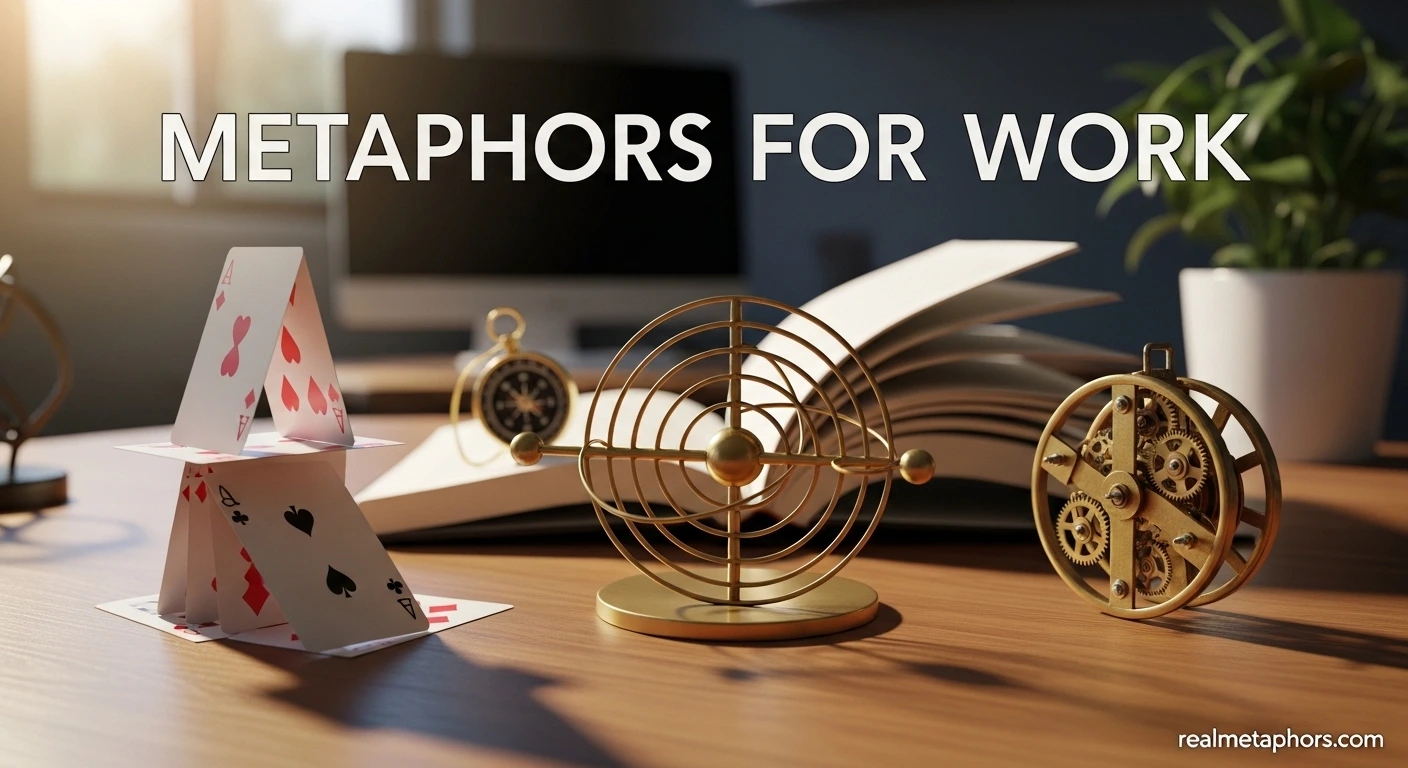
Picture this: It’s Monday morning, and Emma sits at her desk staring at her overflowing to-do list. The tasks seem endless, her coffee cup is half-empty, and her motivation is hiding under the pile of papers. In that moment, “work” isn’t just work—it’s a maze, a mountain, a battlefield. That’s the power of metaphors: they help us see abstract ideas like work in ways we can feel, imagine, and understand.
Work is something everyone experiences, but describing it in a vivid, relatable way can make writing, storytelling, or even social media posts much more engaging. Metaphors turn the ordinary into something memorable.
Here are 25+ easy metaphors for work, explained clearly with examples, alternative expressions, and little details to help you picture them.
1. Work is a Mountain
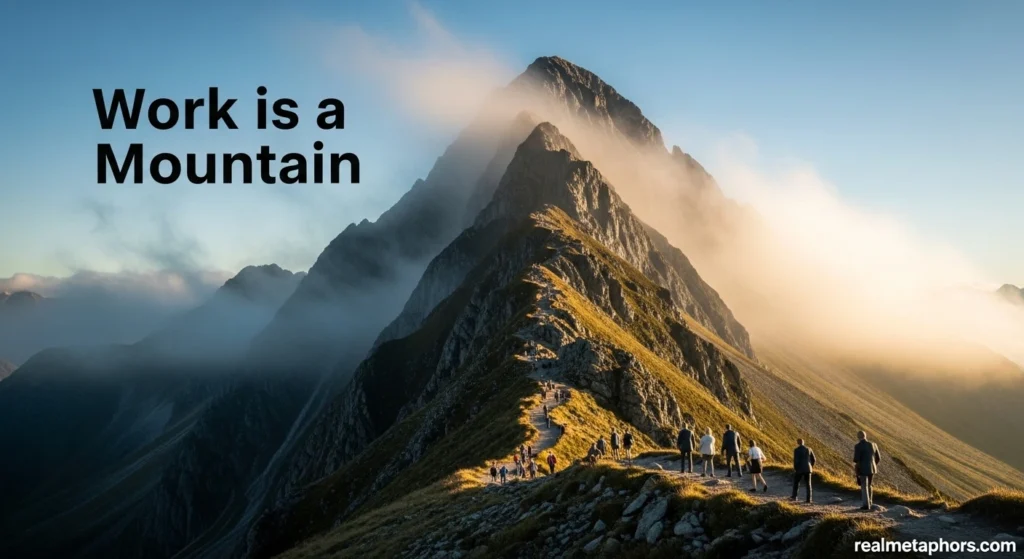
Meaning: Tasks feel huge and challenging.
Example: “Climbing the marketing project felt like scaling a mountain, one email at a time.”
Another way to say it: Work is an uphill climb.
Imagery: Imagine your tasks as boulders stacked high—you have to push each one slowly to reach the top.
2. Work is a Maze
Meaning: Work can be confusing, with unexpected turns.
Example: “Trying to fix the software bug was like wandering through a maze with no map.”
Alternative: Work is a puzzle.
Details: Picture dead ends and winding paths; each solution feels like finding the correct exit.
3. Work is a Battlefield
Meaning: Work involves struggle or competition.
Example: “The office during budget season turns into a battlefield of spreadsheets and deadlines.” Alternative: Work is a war zone.
Imagery: Think of clashing ideas, strategies, and the thrill of “winning” your tasks.
4. Work is a Garden
Meaning: Effort leads to growth and results over time.
Example: “I’ve been planting small ideas all year, and now my project is blooming—work is truly a garden.” Alternative: Work is cultivation.
Details: You water it daily, remove weeds, and eventually see flowers or fruits.
5. Work is a Machine
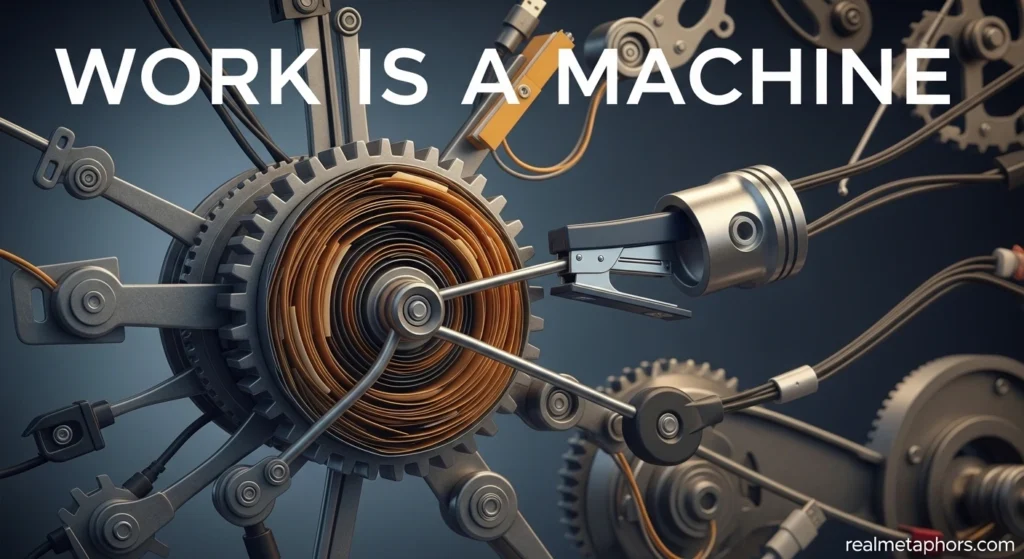
Meaning: Work can be systematic and repetitive.
Example: “Filing reports every week felt like being a cog in a giant machine.”
Alternative: Work is a clockwork.
Imagery: Each task is a gear turning perfectly in sync, keeping the engine moving.
6. Work is a Race
Meaning: You have deadlines to meet and competitors.
Example: “Launching the product was a race against time, and we barely crossed the finish line.”
Alternative: Work is a sprint or marathon.
Details: Imagine the adrenaline and the clock ticking, pushing you forward.
7. Work is a Puzzle
Meaning: Work involves solving problems piece by piece.
Example: “Every client request was a piece of the puzzle, and we had to fit them together perfectly.” Alternative: Work is a jigsaw.
Imagery: Each task is a colorful piece you need to place just right.
8. Work is a Ship
Meaning: Work is a journey requiring navigation.
Example: “Leading this team is like steering a ship through stormy seas.”
Alternative: Work is sailing.
Details: The waves represent challenges, and your decisions are the rudder.
9. Work is a Ladder
Meaning: Progress requires climbing step by step.
Example: “He’s moving up the corporate ladder one promotion at a time.”
Alternative: Work is a staircase. Imagery: Each rung represents a small achievement toward the top.
10. Work is a Fire
Meaning: Work can be intense and consuming.
Example: “The new project lit a fire under the team, and everyone worked with energy.”
Alternative: Work is a flame.
Details: Sparks of creativity, the heat of deadlines, and the need to keep it burning.
11. Work is a River
Meaning: Work flows continuously and changes direction.
Example: “The workflow is like a river; sometimes calm, sometimes full of rapids.”
Alternative: Work is a stream.
Imagery: Picture currents, eddies, and obstacles to navigate.
12. Work is a Chess Game
Meaning: Work requires strategy and planning.
Example: “Managing this project felt like playing chess, thinking three steps ahead.”
Alternative: Work is a strategic game.
Details: Every move matters; a single wrong step can cost time or resources.
13. Work is a Marathon
Meaning: Work requires endurance over time.
Example: “Completing the annual report felt like running a marathon—exhausting but rewarding.” Alternative: Work is long-distance running.
Imagery: Steady pace, stamina, and the finish line in sight.
14. Work is a Dance
Meaning: Work involves coordination with others.
Example: “The team worked together like a perfectly choreographed dance.”
Alternative: Work is synchronized movement.
Details: Imagine everyone moving smoothly, anticipating each other’s steps.
15. Work is a Ladder of Dominos
Meaning: One task affects the next.
Example: “Missing that email started a chain reaction—work is a ladder of dominos.”
Alternative: Work is cause-and-effect.
Imagery: Picture dominos falling perfectly in line.
16. Work is a Jungle
Meaning: Work is wild, complex, and full of surprises.
Example: “Navigating office politics can feel like hacking through a jungle.”
Alternative: Work is a wild terrain.
Details: Thorny problems, hidden opportunities, and constant challenges.
17. Work is a Story
Meaning: Work has a beginning, middle, and end.
Example: “Our project’s journey felt like a story, full of conflicts, climaxes, and resolutions.”
Alternative: Work is a narrative.
Imagery: Each task is a chapter leading to the conclusion.
18. Work is a Storm
Meaning: Work can be chaotic and overwhelming.
Example: “During the audit, it was a storm of emails and phone calls.”
Alternative: Work is turbulence.
Details: Winds of stress, rain of tasks, and lightning deadlines.
19. Work is a Theater
Meaning: Work involves roles, performances, and presentations.
Example: “Each meeting felt like stepping onto a stage where everyone had a role to play.”
Alternative: Work is acting.
Imagery: Spotlights, scripts, and audience attention.
20. Work is a Toolbox
Meaning: Work gives you tools to solve problems.
Example: “He approached the project like a carpenter with a toolbox, ready for anything.”
Alternative: Work is a kit of solutions.
Details: Wrenches for fixing, hammers for tackling big problems, and screwdrivers for details.
21. Work is a Bridge
Meaning: Work connects ideas, people, or projects.
Example: “Our team’s effort built a bridge between research and product development.”
Alternative: Work is a connection.
Imagery: Picture a sturdy structure linking two cliffs over a river.
22. Work is a Lab
Meaning: Work is experimental and creative.
Example: “Designing the app felt like being in a lab, testing ideas constantly.”
Alternative: Work is experimentation.
Details: Beakers of ideas, trial and error, unexpected discoveries.
23. Work is a Wave
Meaning: Work comes in surges.
Example: “The last week of the project hit like a wave, and we had to ride it carefully.”
Alternative: Work is a tide.
Imagery: Highs and lows, crests of activity, and moments of calm.
24. Work is a Game of Tetris
Meaning: Tasks must fit together efficiently.
Example: “Managing overlapping deadlines was like playing Tetris—each task had its perfect place.” Alternative: Work is puzzle stacking.
Details: Blocks of varying shapes, fitting in tight spaces.
25. Work is a Seed
Meaning: Effort grows into results.
Example: “Every small action planted a seed that eventually grew into a successful campaign.”
Alternative: Work is planting potential.
Imagery: Soil, sunlight, and patience leading to blooming ideas.
26. Work is a Marathon of Coffee
Meaning: Work often relies on energy and perseverance.
Example: “This project has been a marathon of coffee and late nights.”
Alternative: Work is fueled by caffeine.
Details: Cups stacked high, early mornings, and the smell of roasted beans.
Fun Exercises to Practice Work Metaphors
- Metaphor Match: Take a list of work tasks and describe each with a metaphor from the list above.
- Story Challenge: Write a short story where work is described as three different metaphors.
- Social Media Prompt: Post about your day at work using a metaphor. “Today felt like a jungle…”
- Daily Reflection: At the end of the day, pick a metaphor that best describes how your work went.
- Draw Your Metaphor: Sketch a visual representation of your work metaphor—it can make abstract ideas tangible.
Extra Tips:
- Mix metaphors for variety. “Work is a stormy mountain” is vivid and unique.
- Use sensory details: sight, smell, sound, touch, and taste make metaphors come alive.
- Be creative: everyday experiences, pop culture, and personal stories can inspire fresh metaphors.
FAQs
Q1: Why are metaphors for work useful?
They make abstract concepts easier to understand and remember, and they make writing more engaging.
Q2: How do I create my own metaphors?
Think of what work feels like—stress, teamwork, growth, obstacles—and find a visual or tangible comparison.
Q3: Can metaphors be used in emails or social media?
Yes! Short, vivid metaphors catch attention and make your message relatable.
Q4: What are common mistakes with metaphors?
- Mixing too many unrelated metaphors.
- Using clichés without adding fresh details.
- Making metaphors too complex for the audience to understand.
Q5: How do I choose the right metaphor?
Pick one that fits the emotion, tone, or situation of your work. Consider your audience and context.
Q6: Can metaphors improve storytelling?
Absolutely. They create imagery, evoke emotions, and make the story more memorable.
Q7: Are some metaphors better for certain types of work?
Yes. Creative work might suit metaphors like “lab” or “garden,” while corporate tasks could be “machine” or “ladder.”
Metaphors transform the everyday grind into something you can see, feel, and even enjoy. Next time you describe your work, try a few of these—and watch your writing come alive.