
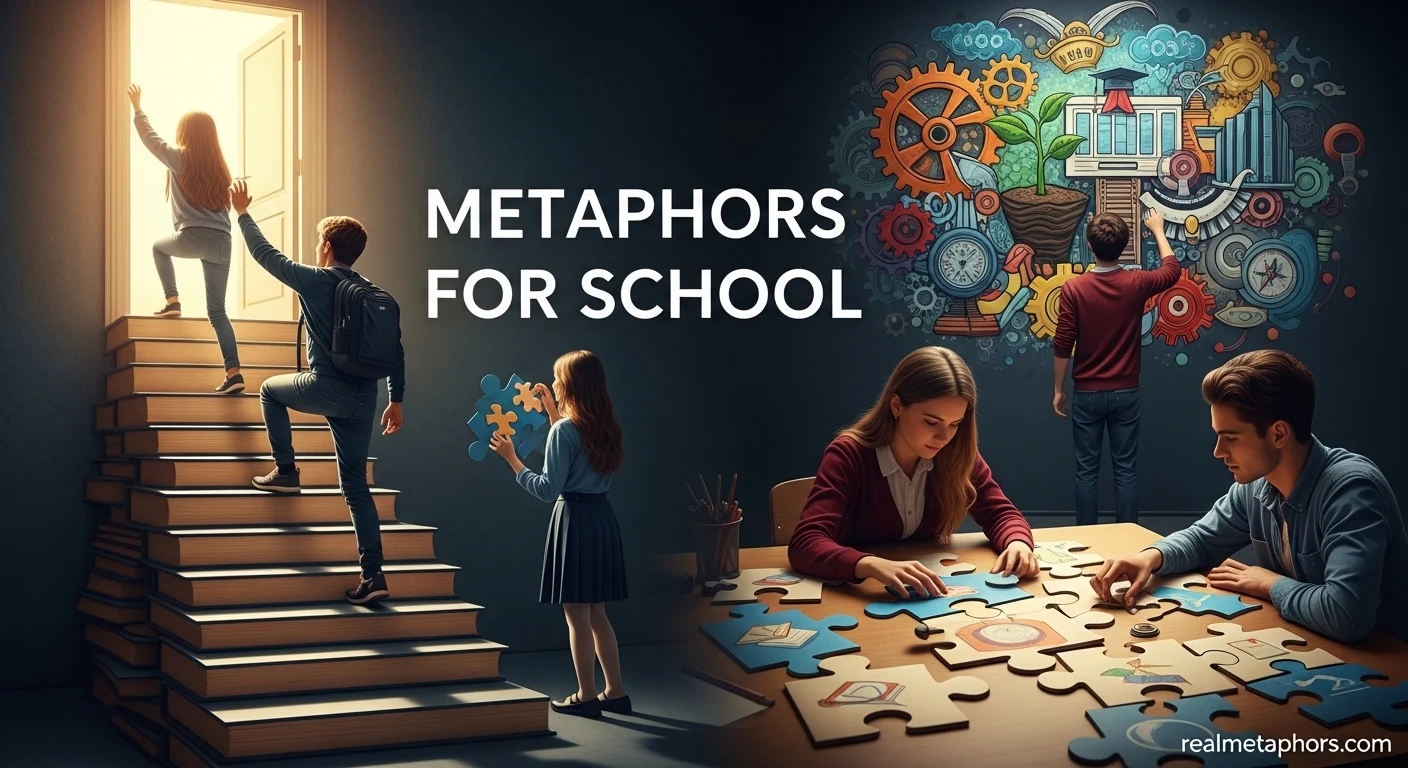
Imagine walking into a school for the first time. The hallways echo with laughter, the smell of books fills the air, and every classroom holds a world of possibilities. School isn’t just a building where we learn—it’s an adventure, a challenge, a stage, and sometimes even a battlefield. That’s the beauty of metaphors: they help us see familiar things in new ways. In this article, we’ll explore 25+ metaphors for school, what they mean, and how you can use them in writing, storytelling, or everyday conversations.
1. School is a Garden
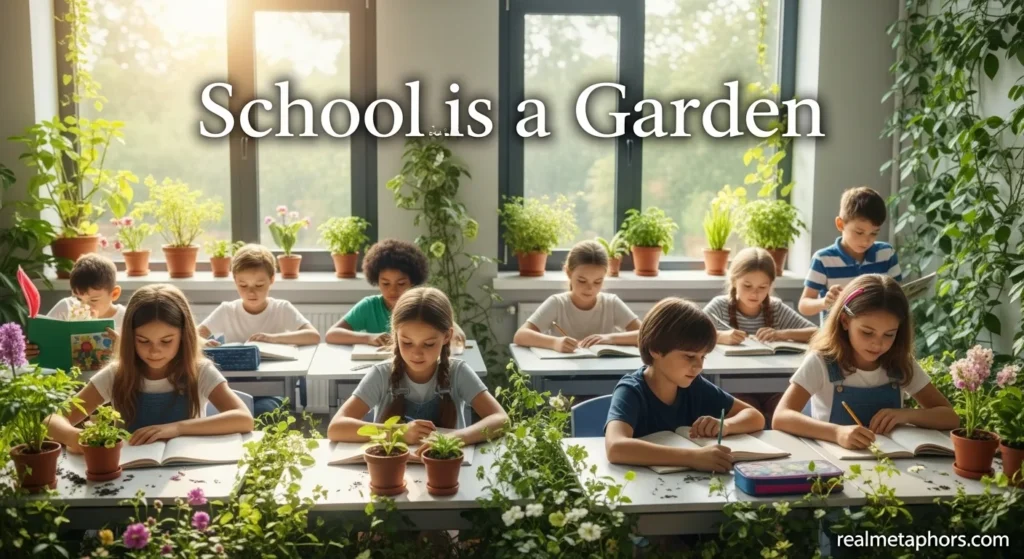
Meaning: A place where students grow like plants.
Example: “School is a garden where young minds bloom.”
Another Way to Say It: A place of growth.
Detail: Just as gardeners water and care for plants, teachers nurture students’ curiosity and skills.
2. School is a Stage
Meaning: A place to perform and show your talents.
Example: “Every student on stage, learning to shine under the spotlight of school.”
Another Way to Say It: A place to showcase yourself.
Detail: Class presentations, plays, and debates are all mini-performances.
3. School is a Battlefield
Meaning: A place of struggle, challenges, and learning to overcome obstacles.
Example: “Each exam felt like a battle I had to win.”
Another Way to Say It: A place of challenges.
Detail: Grades, tests, and competitions are the “weapons” we use to succeed.
4. School is a Bridge
Meaning: Connects students to their future.
Example: “School is the bridge between childhood and adulthood.”
Another Way to Say It: A path to opportunity.
Detail: Every lesson learned is like a plank that strengthens the bridge.
5. School is a Ship

Meaning: A journey full of learning and exploration.
Example: “We set sail on the school ship, navigating subjects and friendships.”
Another Way to Say It: A voyage of knowledge.
Detail: Teachers are captains, guiding students through rough seas and calm waters.
6. School is a Playground
Meaning: A place to have fun and explore.
Example: “In art class, school became a playground for imagination.”
Another Way to Say It: A space for creativity.
Detail: Not every lesson is strict; some let kids learn through play.
7. School is a Factory
Meaning: A place where knowledge is “produced.”
Example: “The school factory shaped students into skilled thinkers.”
Another Way to Say It: A training ground.
Detail: Each subject is a machine adding a new skill to the final product: a capable student.
8. School is a Library
Meaning: A treasure house of knowledge.
Example: “School is a library full of lessons waiting to be discovered.”
Another Way to Say It: A knowledge store.
Detail: Every book, teacher, and lesson is like a key unlocking a new idea.
9. School is a Puzzle
Meaning: Learning is like solving pieces of a bigger picture.
Example: “Every math problem was a puzzle I needed to complete.”
Another Way to Say It: A challenge to solve.
Detail: Sometimes frustrating, but rewarding when completed.
10. School is a Stagecoach
Meaning: Takes students on a journey through time and knowledge.
Example: “The school stagecoach rolled through history lessons and science experiments.”
Another Way to Say It: A vehicle for learning.
Detail: Students hop on with curiosity and hop off with wisdom.
11. School is a Treasure Chest
Meaning: A place full of valuable knowledge and experiences.
Example: “Every day in school unlocked another treasure of understanding.”
Another Way to Say It: A store of hidden gems.
Detail: Grades aren’t the only treasure; friendships and memories are too.
12. School is a Factory of Dreams
Meaning: Helps students shape their future.
Example: “School is a factory of dreams, turning ideas into plans.”
Another Way to Say It: A workshop for aspirations.
Detail: Each subject molds students’ talents like skilled craftsmen.
13. School is a Lighthouse
Meaning: Guides students through confusion and darkness.
Example: “Teachers act as lighthouses, showing us the path.”
Another Way to Say It: A guide in life.
Detail: Even on tough days, school provides direction and safety.
14. School is a Canvas
Meaning: A space to express creativity.
Example: “In art class, the school became a canvas for our imagination.”
Another Way to Say It: A place to paint your ideas.
Detail: Each project or assignment is a brushstroke in learning.
15. School is a Stage of Life
Meaning: Prepares students for real-world experiences.
Example: “Every challenge in school was a rehearsal for life.”
Another Way to Say It: A practice ground.
Detail: Social skills, discipline, and lessons learned here shape adulthood.
16. School is a Laboratory
Meaning: A place to experiment and discover.
Example: “School was a laboratory where curiosity became experiments.”
Another Way to Say It: A testing ground.
Detail: Mistakes aren’t failures—they’re part of the experiment.
17. School is a Mountain
Meaning: Represents challenges and achievements.
Example: “Climbing the mountain of schoolwork was tiring but rewarding.”
Another Way to Say It: A journey of effort.
Detail: Every exam or project is like a step closer to the peak.
18. School is a Maze
Meaning: Full of twists, turns, and discoveries.
Example: “Finding the right answer in school often felt like navigating a maze.”
Another Way to Say It: A puzzle of life.
Detail: Some paths are confusing, but perseverance leads to the exit.
19. School is a Stage for Friendship
Meaning: A place to meet and bond with others.
Example: “School was a stage where friendships acted out stories of laughter.”
Another Way to Say It: A meeting place.
Detail: Lunch breaks, group projects, and sports strengthen social skills.
20. School is a Training Ground
Meaning: Prepares students for real-life challenges.
Example: “Every test was training for the future.”
Another Way to Say It: A place to practice life skills.
Detail: From public speaking to teamwork, skills learned here last a lifetime.
21. School is a Bridge to Knowledge
Meaning: Connects students to learning opportunities.
Example: “School built a bridge to every subject I wanted to explore.”
Another Way to Say It: A pathway to learning.
Detail: Teachers are engineers, constructing strong paths to wisdom.
22. School is a Compass
Meaning: Helps students find direction in life.
Example: “School acted as a compass, guiding me toward my dreams.”
Another Way to Say It: A guide for decision-making.
Detail: Career guidance and advice point students toward their strengths.
23. School is a Spark
Meaning: Ignites curiosity and creativity.
Example: “The science fair was a spark that lit my love for chemistry.”
Another Way to Say It: A source of inspiration.
Detail: Even small ideas in school can grow into big passions.
24. School is a Mirror
Meaning: Reflects students’ strengths, weaknesses, and growth.
Example: “Exams are mirrors showing what I need to improve.”
Another Way to Say It: A reflection of learning.
Detail: Self-awareness grows as we see what we know and what we must learn.
25. School is a Journey
Meaning: A process of learning and growing over time.
Example: “School is a journey, and every grade is a milestone.”
Another Way to Say It: A path through life.
Detail: Experiences, friends, successes, and mistakes make the journey memorable.
Fun Exercises and Prompts
- Create Your Own Metaphor:
- Pick an aspect of school—like recess, homework, or a favorite subject—and compare it to something in nature, art, or life.
- Story Challenge:
- Write a short story using at least 3 metaphors for school.
- Social Media Game:
- Post a metaphor for school and ask friends to guess its meaning.
- Draw It Out:
- Illustrate one of your favorite metaphors to visualize it.
- Daily Life Practice:
- Try describing your school day with a metaphor each evening.
Extra Tip:
Metaphors work best when they connect emotionally or visually. Use them to make your writing more vivid and memorable.
FAQs
Q1: What is a metaphor?
A: A metaphor compares two things without using “like” or “as.” It shows one thing in terms of another.
Q2: Why are metaphors useful for school?
A: They make learning, experiences, and writing more interesting and relatable.
Q3: How can I create a school metaphor?
A: Think about what school reminds you of—a journey, a game, or even a treasure—and describe it as that.
Q4: Can metaphors be funny?
A: Yes! You can compare school to something silly or playful to make people laugh.
Q5: What mistakes should I avoid?
A: Don’t mix too many ideas in one metaphor. Keep it simple and clear.
Q6: How can I use metaphors in writing or life?
A: Use them in essays, stories, captions, speeches, or even when explaining your day to friends.
Q7: Can metaphors change depending on culture?
A: Absolutely. Some metaphors may make more sense in certain cultures, so think about your audience.
Conclusion
School is more than classrooms and textbooks—it’s a place full of stories, growth, and adventure. By using metaphors, we can capture its magic and make our descriptions, essays, and conversations more colorful.