One day, a young woman stood in front of her closet before a big event. She tried on one outfit, then another. With each change, she felt slightly different—more confident, more serious, more playful. Finally, she paused and wondered, “Which one is really me?”
That simple question points to something deeper: identity.
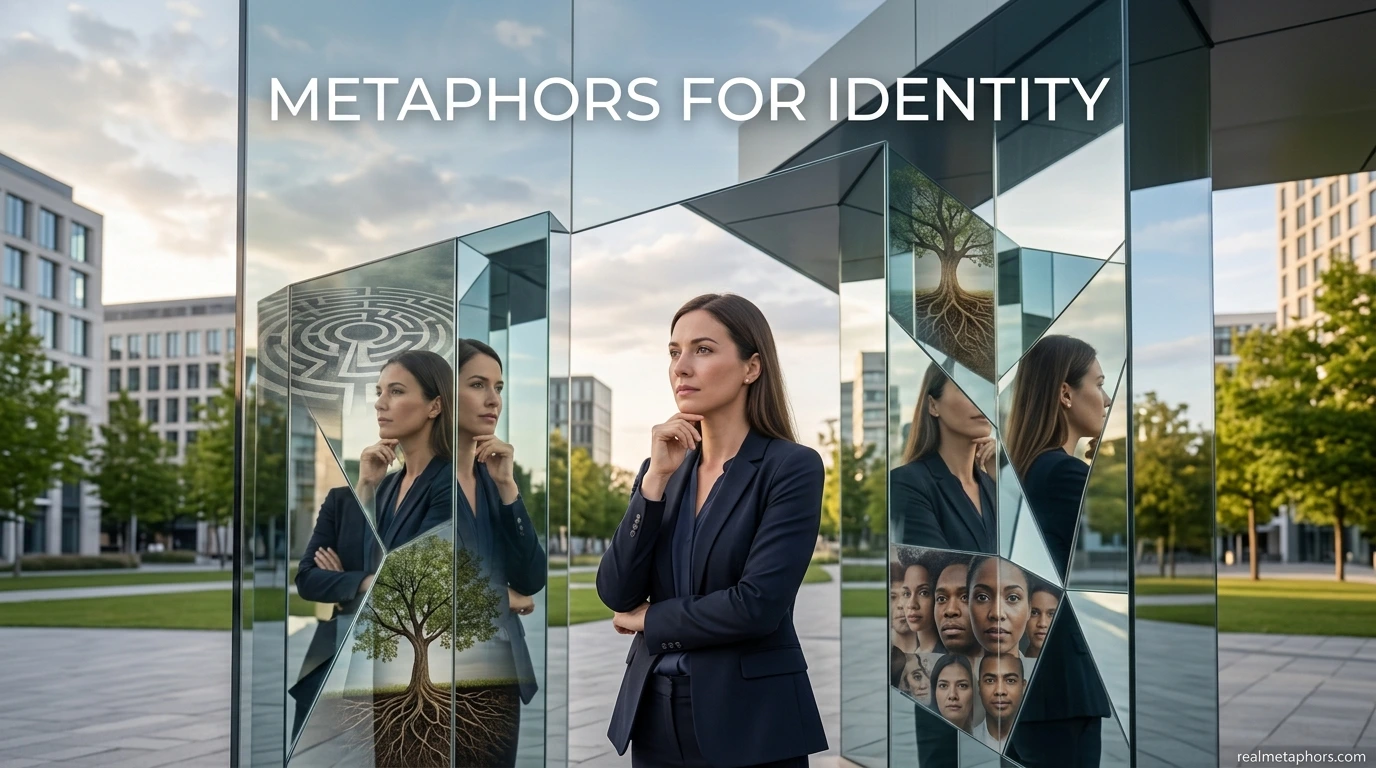
Identity is who you are. It includes your personality, values, culture, beliefs, memories, dreams, and roles in life. It’s how you see yourself and how others see you. But identity can be hard to explain in plain words. That’s why metaphors for identity are so powerful. They turn abstract ideas into clear, visual images.
In this article, you’ll discover 25+ easy metaphors for identity, each explained with meanings, examples, alternative phrases, and small details to help you imagine them clearly. Let’s explore who we are—through pictures made of words.
1. Identity Is a Mirror
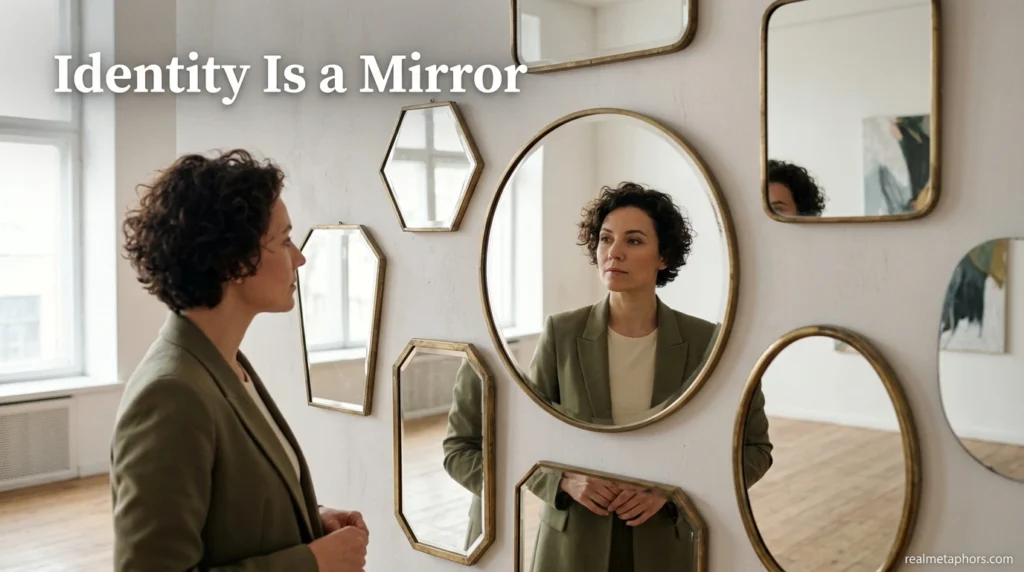
What it means: Your identity reflects who you truly are—your inner self.
Example: “When I journal every night, it feels like looking into a mirror of my soul.”
Another way to say it: Identity is your reflection.
Imagine this: A quiet room. A large mirror. You look in and see not just your face, but your fears, dreams, and strengths staring back.
2. Identity Is a Puzzle
What it means: You are made of many small pieces—family, culture, experiences, talents.
Example: “Moving to a new country added a new piece to the puzzle of my identity.”
Another way to say it: Identity is made of many parts.
Imagine this: Colorful puzzle pieces scattered on a table. Some are bright. Some are dark. Together, they create a full picture.
3. Identity Is a Journey
What it means: Who you are changes and grows over time.
Example: “College was an important stop on my identity journey.”
Another way to say it: Identity is a path, not a destination.
Imagine this: A winding road through mountains and valleys. You don’t stay in one place—you travel forward.
4. Identity Is a Tree
What it means: Your roots are your past. Your branches are your future.
Example: “My culture is the root that keeps my identity strong.”
Another way to say it: Identity grows like a tree.
Imagine this: Deep roots underground. Strong trunk in the middle. Branches reaching for sunlight.
5. Identity Is a Mask
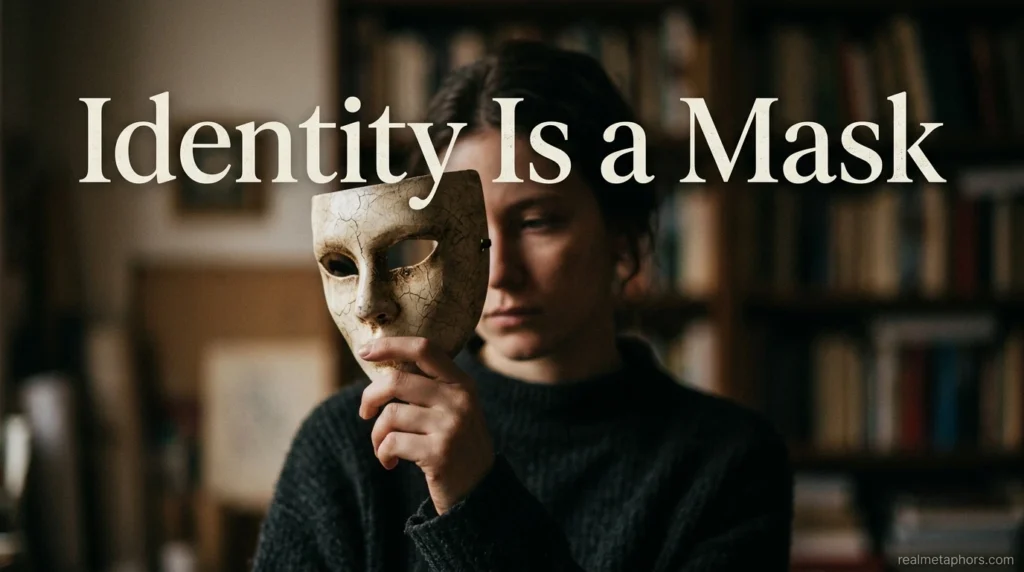
What it means: Sometimes people hide their true selves behind a social role.
Example: “At work, I wear a professional mask.”
Another way to say it: Identity can be a disguise.
Imagine this: A stage actor switching masks depending on the scene.
6. Identity Is a Storybook
What it means: Your life experiences create chapters in your identity.
Example: “That difficult year was a dark chapter in my story.”
Another way to say it: Identity is your life story.
Imagine this: A thick book filled with colorful, emotional chapters.
7. Identity Is a Fingerprint
What it means: You are completely unique.
Example: “My personality is my fingerprint—no one else has it.”
Another way to say it: Identity is one of a kind.
Imagine this: Swirling lines forming a pattern that exists nowhere else in the world.
8. Identity Is a Mosaic
What it means: Different pieces of culture, personality, and history form a beautiful whole.
Example: “My bilingual background is part of my identity mosaic.”
Another way to say it: Identity is made of colorful fragments.
Imagine this: Tiny glass pieces shining together to create art.
9. Identity Is a Compass
What it means: It guides your decisions and values.
Example: “My faith acts as a compass for my identity.”
Another way to say it: Identity guides you.
Imagine this: A small compass in your pocket helping you choose the right direction.
10. Identity Is a Shadow
What it means: It follows you everywhere.
Example: “No matter where I go, my background is my shadow.”
Another way to say it: Identity is always with you.
Imagine this: A shadow stretching beside you in sunlight.
11. Identity Is a Garden
Meaning: It needs care and growth. Example: “Reading new books helped my identity garden grow.” Another way: Identity needs nurturing. Imagine: Watering plants, pulling weeds of doubt.
12. Identity Is a Flame
Meaning: It can burn bright or fade. Example: “My passion keeps my identity flame alive.” Another way: Identity is inner fire. Imagine: A candle glowing in the dark.
13. Identity Is a Bridge
Meaning: It connects your past and future. Example: “Language is a bridge in my identity.” Another way: Identity connects worlds. Imagine: A bridge over a river linking two lands.
14. Identity Is a Tapestry
Meaning: Woven from many threads. Example: “My family traditions are threads in my tapestry.” Another way: Identity is woven together. Imagine: A richly patterned cloth.
15. Identity Is a Song
Meaning: It has rhythm and tone. Example: “My identity sings in my native accent.” Another way: Identity has a unique melody. Imagine: Music only you can create.
16. Identity Is a River
Meaning: Always flowing and changing. Example: “After becoming a parent, my identity flowed in a new direction.” Another way: Identity evolves. Imagine: A river carving new paths.
17. Identity Is a Map
Meaning: It shows where you’ve been. Example: “My scars are landmarks on my identity map.” Another way: Identity tracks your history. Imagine: A map filled with highlighted places.
18. Identity Is a Key
Meaning: It unlocks belonging. Example: “Knowing my heritage gave me the key to confidence.” Another way: Identity opens doors. Imagine: Turning a key in a golden lock.
19. Identity Is a Costume
Meaning: Roles you wear in life. Example: “As a teacher, I wear a different costume.” Another way: Identity shifts by role. Imagine: A wardrobe full of outfits.
20. Identity Is a Lighthouse
Meaning: It shines in darkness. Example: “My values are the lighthouse of my identity.” Another way: Identity gives clarity. Imagine: A beam of light over a stormy sea.
21. Identity Is a Seed
Meaning: It holds potential. Example: “Encouragement helped my identity seed grow.” Another way: Identity develops over time. Imagine: A tiny seed breaking through soil.
22. Identity Is a Home
Meaning: A place of belonging. Example: “Speaking my language feels like coming home to my identity.” Another way: Identity is comfort. Imagine: Warm lights in a window at night.
23. Identity Is a Brand
Meaning: How others recognize you. Example: “Honesty is my personal brand.” Another way: Identity is your reputation. Imagine: A logo that represents you.
24. Identity Is a Kaleidoscope
Meaning: Ever-changing patterns. Example: “My identity shifts depending on who I’m with.” Another way: Identity has many angles. Imagine: Twisting colors forming new shapes.
25. Identity Is a Backpack
Meaning: You carry experiences with you. Example: “My childhood memories are in my identity backpack.” Another way: Identity carries your past. Imagine: A worn backpack full of souvenirs.
26. Identity Is a Star
Meaning: It shines uniquely. Example: “Even in a crowd, her identity shines like a star.” Another way: Identity stands out. Imagine: One bright star in a dark sky.
Fun Exercises: Practice Using Metaphors for Identity
1. Finish the Sentence
- My identity is like a ______ because ______.
2. Write a Mini Story
Describe your life as a journey or river. What changed the direction?
3. Social Media Challenge
Post: “Today my identity feels like a ___.” Add a short explanation.
4. Draw It
Sketch your identity as a tree, puzzle, or map.
Extra Tips for Using Identity Metaphors
- Keep images simple and visual.
- Connect the metaphor to emotions.
- Avoid mixing too many metaphors in one sentence.
- Use them in essays, speeches, journaling, or storytelling.
- Choose metaphors that match your audience.
FAQs
1. What is identity in simple words?
Identity is who you are—your personality, beliefs, culture, and experiences.
2. Why are metaphors for identity useful?
They make abstract ideas easier to understand and more emotional.
3. How can I create my own identity metaphor?
Think about something that grows, changes, or represents uniqueness. Then compare it to yourself.
4. Can identity change over time?
Yes. Like a river or journey, identity evolves.
5. What is a common mistake when using metaphors?
Mixing too many images at once. Keep it clear and focused.
6. Can I use identity metaphors in essays?
Yes. They make writing stronger and more memorable.
7. Are metaphors only for creative writing?
No. You can use them in speeches, therapy, journaling, and daily conversation.
Final Thoughts
Understanding metaphors for identity helps you understand yourself. Whether you see identity as a mirror, a journey, a puzzle, or a star, each image adds clarity.