
Two friends were laughing at a café. Then one joke went too far. The air changed. Smiles faded. Words sharpened. What was once warm and easy suddenly felt heavy and cold.
That feeling—tight in the chest, hot in the face, hard in the voice—is what we call hate.
Hate is a strong feeling of deep dislike or anger toward someone or something. It can grow from hurt, fear, jealousy, or misunderstanding. Because hate is such a powerful emotion, writers often use metaphors for hate to describe it in vivid, unforgettable ways.
In this article, you’ll explore 25+ easy metaphors for hate, with meanings, examples, and creative ideas to help you use them in stories, essays, and daily life.
1. Hate Is a Fire
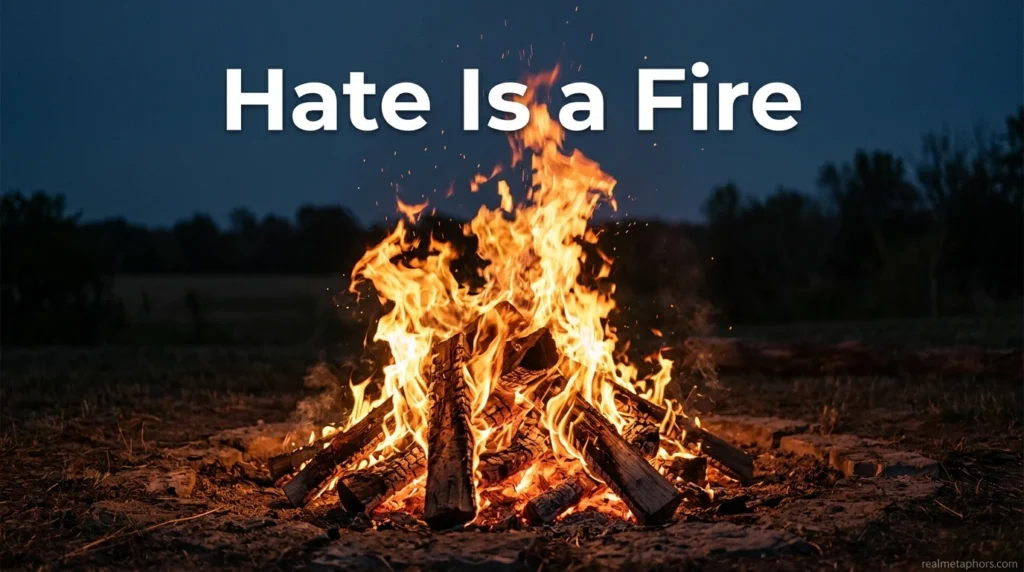
Meaning: Hate burns inside you and can spread quickly.
Example: “His hate was a fire that consumed every happy memory.”
Another way to say it: Hate is a flame in the heart.
Details: Imagine sparks jumping from dry wood. One angry thought becomes many.
2. Hate Is Poison
Meaning: Hate slowly harms the person who holds it.
Example: “She drank the poison of hate every day.”
Another way to say it: Hate is toxic.
Details: Like bitter liquid in a cup, it damages from the inside.
3. Hate Is a Storm
Meaning: Hate is loud, violent, and hard to control.
Example: “A storm of hate crashed through the room.”
Another way to say it: Hate is a raging thunderstorm.
Details: Dark clouds, thunder, lightning—everything shaking.
4. Hate Is Ice
Meaning: Hate can feel cold and emotionless.
Example: “Her voice was ice when she spoke to him.”
Another way to say it: Hate freezes the heart.
Details: Picture frost forming over warm ground.
5. Hate Is a Chain
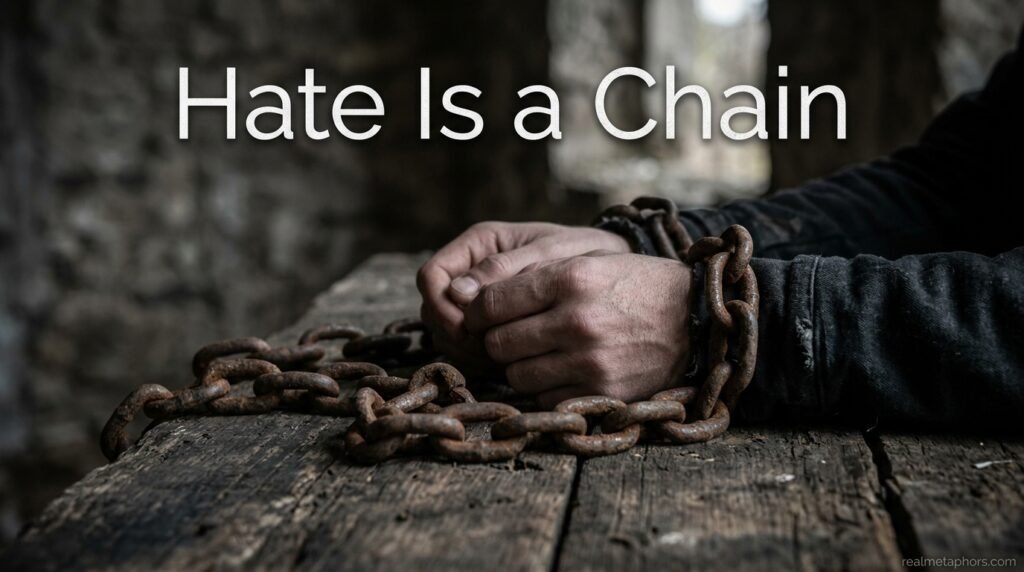
Meaning: Hate traps and restricts you.
Example: “He was chained by his hate.”
Another way to say it: Hate is a prison.
Details: Heavy metal links holding someone in place.
6. Hate Is a Shadow
Meaning: Hate follows you everywhere.
Example: “The shadow of hate trailed behind him.”
Another way to say it: Hate is darkness that lingers.
Details: A dark shape stretching long at sunset.
7. Hate Is a Volcano
Meaning: Hate builds up quietly, then explodes.
Example: “Years of anger erupted like a volcano.”
Another way to say it: Hate is lava beneath the surface.
Details: Silent mountain. Sudden explosion. Burning lava everywhere.
8. Hate Is a Weed
Meaning: Hate grows if you don’t remove it.
Example: “Hate spread like weeds in his mind.”
Another way to say it: Hate takes root.
Details: Tiny green shoots turning into a tangled mess.
9. Hate Is a Blade
Meaning: Hate cuts deeply.
Example: “Her hateful words were sharp blades.”
Another way to say it: Hate is a knife.
Details: Cold steel slicing through trust.
10. Hate Is a Cage
Meaning: Hate traps you mentally and emotionally.
Example: “He lived inside a cage of hate.”
Another way to say it: Hate locks you in.
Details: Bars casting shadows on the floor.
11. Hate Is Smoke
Meaning: Hate clouds your thinking.
Example: “Smoke from his hate blurred his judgment.”
Another way to say it: Hate fogs the mind.
Details: Thick gray smoke filling a room.
12. Hate Is a Heavy Stone
Meaning: Hate weighs you down.
Example: “She carried hate like a heavy stone in her pocket.”
Another way to say it: Hate is a burden.
Details: A rock dragging in your coat pocket.
13. Hate Is Acid
Meaning: Hate slowly destroys what it touches.
Example: “Acidic hate ate away their friendship.”
Another way to say it: Hate corrodes relationships.
Details: Metal slowly dissolving under drops of acid.
14. Hate Is a Wild Animal
Meaning: Hate is dangerous and hard to control.
Example: “A wild animal of hate growled inside him.”
Another way to say it: Hate is a beast.
Details: Sharp claws, restless pacing, low growls.
15. Hate Is a Virus
Meaning: Hate spreads from person to person.
Example: “The virus of hate infected the whole group.”
Another way to say it: Hate is contagious.
Details: One whisper becomes a crowd shouting.
16. Hate Is Rust
Meaning: Hate slowly damages over time.
Example: “Rust of hate weakened their bond.”
Another way to say it: Hate eats away slowly.
Details: Orange flakes forming on old metal.
17. Hate Is a Mirror
Meaning: Hate often reflects inner pain.
Example: “His hate was a mirror of his insecurity.”
Another way to say it: Hate reflects hidden wounds.
Details: A cracked mirror showing broken pieces.
18. Hate Is a Thorn
Meaning: Hate causes constant pain.
Example: “A thorn of hate stayed in her heart.”
Another way to say it: Hate pricks the soul.
Details: Small but sharp, impossible to ignore.
19. Hate Is a Wall
Meaning: Hate blocks connection.
Example: “A wall of hate stood between them.”
Another way to say it: Hate creates distance.
Details: Tall bricks separating two people.
20. Hate Is a Black Hole
Meaning: Hate pulls everything into darkness.
Example: “His hate became a black hole, swallowing joy.”
Another way to say it: Hate consumes everything.
Details: Light disappearing into endless darkness.
21. Hate Is a Spark in Dry Grass
Meaning: Hate can start from something small.
Example: “One insult was a spark in dry grass.”
Another way to say it: Hate ignites easily.
Details: A tiny flame spreading across a field.
22. Hate Is a Bitter Taste
Meaning: Hate leaves a bad feeling behind.
Example: “Bitterness of hate stayed on her tongue.”
Another way to say it: Hate tastes sour.
Details: Like biting into a lemon unexpectedly.
23. Hate Is a Ticking Bomb
Meaning: Hate builds tension and may explode.
Example: “His silence was a ticking bomb of hate.”
Another way to say it: Hate is ready to explode.
Details: Clock ticking louder and louder.
24. Hate Is a Fog
Meaning: Hate makes things unclear.
Example: “Fog of hate hid the truth.”
Another way to say it: Hate clouds perception.
Details: Trying to drive when you can barely see.
25. Hate Is a Scar
Meaning: Hate often comes from past wounds.
Example: “The scar of hate reminded her of betrayal.”
Another way to say it: Hate marks the heart.
Details: A faded line that still tells a story.
26. Hate Is a Broken Record
Meaning: Hate repeats the same thoughts.
Example: “His mind played a broken record of hate.”
Another way to say it: Hate repeats old anger.
Details: Same harsh words spinning again and again.
Fun Exercises and Writing Challenges
1. The Switch Exercise
Take a sentence like: “I hate him.” Turn it into a metaphor: “My hate is a locked door I refuse to open.”
2. Emotion Mix
Combine hate with another feeling. Example: “Hate is fire mixed with fear.”
3. Social Media Challenge
Write a short post using one hate metaphor: “Don’t let hate be the rust that weakens your heart.”
4. Story Starter
Begin a story with this line: “Hate arrived like a storm on a quiet afternoon.”
5. Daily Life Practice
Think about a small irritation (traffic, noise). Describe it using a metaphor instead of saying “I hate it.”
Extra Tips for Using Metaphors for Hate
- Keep it simple and visual.
- Don’t mix too many metaphors in one sentence.
- Match the metaphor to the mood (fire = intense, ice = cold).
- Use sensory details (heat, weight, sound).
- In essays, use metaphors to explain emotions clearly.
Metaphors make strong emotions easier to understand. They also make writing more powerful and memorable.
FAQs
1. What is hate?
Hate is a strong feeling of deep anger or dislike toward someone or something.
2. Why use metaphors for hate?
Metaphors make emotions easier to picture and understand. They add color and power to writing.
3. How do I create my own metaphor for hate?
Ask: What does hate feel like? Hot? Cold? Heavy? Then compare it to something similar.
4. Can metaphors help in real life?
Yes. They help you express feelings clearly and understand emotions better.
5. What is a common mistake when using metaphors?
Mixing too many metaphors at once. For example: “Hate is a fire that froze like ice.” That confuses readers.
6. Are metaphors only for stories?
No. You can use them in speeches, essays, social media posts, and even daily conversations.
7. Can hate ever be positive?
Sometimes people say they “hate injustice.” In that case, hate means strong opposition, not personal harm.
Conclusion
Hate is a powerful emotion. But when you describe it with strong, clear metaphors, you gain control over how it is understood. Instead of letting hate be a wildfire, you can turn it into a lesson, a story, or even a path toward healing.