
Imagine you’re about to send an important message. Your fingers hover over the screen. Your stomach feels tight, like it’s tied in knots. Nothing bad has happened—but your body acts like danger is near.
That feeling is anxiety.
Anxiety is a natural response to stress or fear. It’s your mind and body trying to protect you. But sometimes it becomes too loud, too strong, or shows up when there’s no real threat. That’s when it feels overwhelming.
Metaphors for anxiety help us describe this invisible feeling in ways we can see, hear, and imagine. They turn emotions into pictures. And pictures are easier to understand—and share.
Below are 25+ easy metaphors for anxiety, each explained in simple words, with examples and creative twists you can use in daily life or writing.
1. Anxiety Is a Storm in the Mind
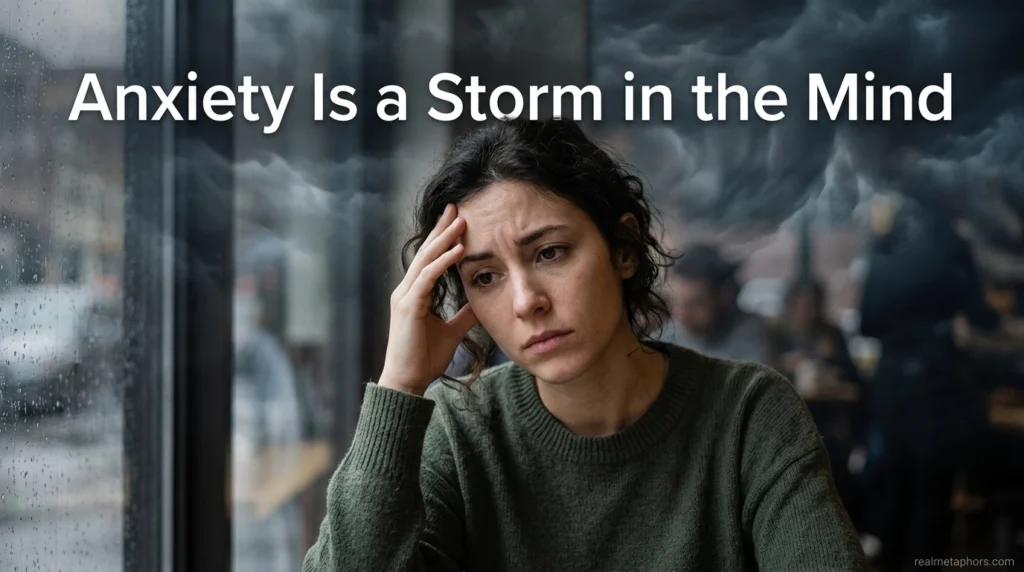
Meaning: Anxiety feels chaotic, loud, and hard to control.
Example: “Before the exam, a storm raged inside my head.”
Another way to say it: A mental thunderstorm.
Imagine: Dark clouds rolling across your thoughts, lightning flashing with every “what if?”
2. Anxiety Is a Smoke Alarm That Won’t Turn Off
Meaning: Anxiety warns you of danger—even when there isn’t any.
Example: “My brain’s smoke alarm goes off over small mistakes.”
Another way: An overactive alarm system.
Detail: Toast burns, the alarm screams, and you wave a towel helplessly.
3. Anxiety Is a Tightrope Walk
Meaning: You feel unsteady and afraid of making mistakes.
Example: “Talking in the meeting felt like walking a tightrope.”
Another way: Balancing over fear.
Imagine: A thin rope stretched high above the ground.
4. Anxiety Is a Backpack Full of Bricks
Meaning: Anxiety weighs you down.
Example: “I carry a backpack of bricks into every social event.”
Another way: Emotional weight.
Detail: Each brick labeled “What if?” or “Don’t mess up.”
5. Anxiety Is a Broken Record

Meaning: Worries repeat again and again.
Example: “My mind plays the same fears like a broken record.”
Another way: A stuck loop.
Imagine: The needle jumping back to the same scratch.
6. Anxiety Is a Shadow That Follows You
Meaning: It stays close, even when things seem fine.
Example: “Even on vacation, anxiety followed me like a shadow.”
Another way: A constant companion.
Detail: It grows longer at night.
7. Anxiety Is a Buzzing Bee
Meaning: It’s small but constantly irritating.
Example: “There’s a buzzing bee in my chest before interviews.”
Another way: A nervous hum.
Imagine: A bee trapped in a jar.
8. Anxiety Is a Snowball Rolling Downhill
Meaning: It starts small and grows quickly.
Example: “One small worry turned into a snowball of fear.”
Another way: Escalating panic.
Detail: Picking up more snow with every thought.
9. Anxiety Is a Cage Without Bars
Meaning: You feel trapped, but nothing visible holds you.
Example: “I’m stuck in a cage no one else can see.”
Another way: Invisible prison.
Imagine: Walking freely—but feeling locked inside.
10. Anxiety Is a Racing Car Without Brakes
Meaning: Your thoughts move too fast to control.
Example: “My brain is a race car with no brakes at night.”
Another way: Runaway thoughts.
Detail: Speeding around sharp corners.
11. Anxiety Is Static on the Radio
Meaning: It makes it hard to think clearly.
Example: “Anxiety fills my mind with static.”
Another way: Mental noise.
Imagine: Trying to hear music through crackling sounds.
12. Anxiety Is a Thunderclap Before the Rain
Meaning: Fear appears before anything happens.
Example: “My anxiety strikes before the event even starts.”
Another way: Anticipation shock.
Detail: Loud, sudden, startling.
13. Anxiety Is a Heavy Fog
Meaning: It clouds your thinking.
Example: “A fog of worry settled over me.”
Another way: Mental haze.
Imagine: Driving slowly because you can’t see ahead.
14. Anxiety Is a Puppet Master
Meaning: It controls your actions.
Example: “Anxiety pulls my strings in social situations.”
Another way: Emotional control.
Detail: Invisible strings tied to your hands.
15. Anxiety Is a Ticking Time Bomb
Meaning: You feel like you might explode.
Example: “Before presentations, I feel like a ticking time bomb.”
Another way: Building pressure.
Imagine: Countdown numbers flashing.
16. Anxiety Is a Wave That Knocks You Over
Meaning: It comes suddenly and strongly.
Example: “A wave of anxiety crashed over me.”
Another way: Emotional surge.
Detail: Saltwater in your lungs, struggling to stand.
17. Anxiety Is a Mirror That Distorts
Meaning: It twists reality.
Example: “Anxiety makes small problems look huge.”
Another way: Warped thinking.
Imagine: A carnival mirror stretching your reflection.
18. Anxiety Is a Guard Dog That Barks at Everything
Meaning: It overreacts to small threats.
Example: “My guard dog mind never rests.”
Another way: Hyper-alert brain.
Detail: Barking at passing leaves.
19. Anxiety Is an Itchy Sweater
Meaning: It’s uncomfortable and hard to ignore.
Example: “Anxiety feels like an itchy sweater I can’t take off.”
Another way: Persistent discomfort.
Detail: Scratchy fabric against skin.
20. Anxiety Is a Traffic Jam
Meaning: Thoughts pile up and block movement.
Example: “My brain is stuck in a traffic jam of worries.”
Another way: Mental congestion.
Imagine: Honking cars going nowhere.
21. Anxiety Is a Roller Coaster
Meaning: It has sudden ups and downs.
Example: “My emotions ride a roller coaster every day.”
Another way: Emotional ride.
Detail: Stomach dropping at every twist.
22. Anxiety Is a Leaky Faucet
Meaning: Small worries drip constantly.
Example: “It’s just drip… drip… drip in my mind.”
Another way: Constant mental drip.
Imagine: Sleepless nights listening to water drops.
23. Anxiety Is a Maze With No Exit
Meaning: You feel lost in your thoughts.
Example: “I wander in a maze of what-ifs.”
Another way: Thought labyrinth.
Detail: High walls blocking the way out.
24. Anxiety Is a Fire Without Flames
Meaning: It burns inside but isn’t visible.
Example: “There’s a silent fire in my chest.”
Another way: Inner burning tension.
Imagine: Heat with no smoke.
25. Anxiety Is a Balloon Ready to Pop
Meaning: Pressure builds until release.
Example: “I feel stretched thin like a balloon.”
Another way: Emotional pressure.
Detail: Air filling it tighter and tighter.
26. Anxiety Is an Uninvited Guest
Meaning: It shows up when you don’t want it.
Example: “Anxiety walked in without knocking.”
Another way: Unwanted visitor.
Imagine: Sitting at your table, refusing to leave.
Fun Exercises to Practice Anxiety Metaphors
1. Fill-in-the-Blank Challenge
“Anxiety is like a ______ because ______.”
Example: Anxiety is like a flickering light because it makes everything feel uncertain.
2. Social Media Practice
Write a short caption using one metaphor: “Today my mind feels like a ______.”
3. Short Story Exercise
Write 5 sentences about a character whose anxiety is described as weather.
4. Draw Your Metaphor
Sketch what your anxiety would look like if it were an object or animal.
Tips for Using Metaphors for Anxiety
- Keep them simple.
- Use everyday objects.
- Make them sensory—what does it sound like? feel like?
- Avoid clichés unless you add a fresh twist.
- Match the metaphor to the mood of your story.
Metaphors work well in:
- Journaling
- Poetry
- Therapy conversations
- Instagram captions
- Personal essays
They make emotions easier to talk about.
FAQs
1. What is anxiety in simple words?
Anxiety is a feeling of worry, nervousness, or fear about something that might happen.
2. Why use metaphors for anxiety?
Because anxiety is invisible. Metaphors turn feelings into images we can understand and explain.
3. How do I create my own metaphor?
Ask: “What does anxiety feel like in my body?” Then compare it to something physical.
4. Are metaphors helpful for mental health?
Yes. They help people express emotions clearly and feel less alone.
5. Can I use anxiety metaphors in school writing?
Absolutely. They make essays and stories more powerful and vivid.
6. What mistakes should I avoid?
Don’t overcomplicate the image. Keep it relatable and clear.
7. Can metaphors reduce anxiety?
They can help you understand and manage it better by putting feelings into words.
Anxiety may feel overwhelming. But when you describe it as a storm, a buzzing bee, or a leaky faucet, it becomes something you can see—and sometimes, something you can calm.