When Amir first tried to quit scrolling on his phone, he said, “It’s just a habit.” A week later, he whispered, “It feels like something is pulling me back.”
That “something” is what many people call addiction. In simple words, addiction is when a person feels a strong, repeated urge to use something or do something—even when it causes harm. It could be alcohol, drugs, gambling, gaming, shopping, social media, or even unhealthy relationships.
Addiction is not just about willpower. It often feels powerful, confusing, and hard to explain. That’s why metaphors for addiction are so useful. They turn invisible struggles into clear pictures we can see and understand.
Below are 25+ easy metaphors for addiction, each explained in simple language, with examples and alternative ways to say them.
1. Addiction Is a Chain
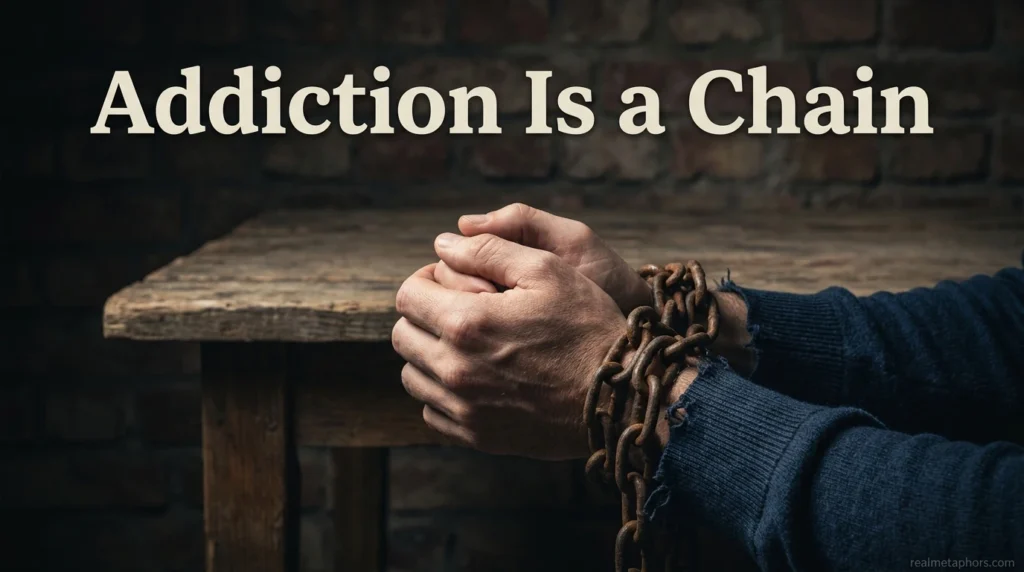
Meaning: Addiction holds someone in place and limits freedom.
Example: “Every time he tried to quit smoking, the chain pulled him back.”
Another way to say it: Addiction is a set of handcuffs.
Imagine it: Cold metal around your wrists. You can move—but only a little.
2. Addiction Is a Cage
Meaning: It traps a person inside a harmful pattern.
Example: “She felt like she was living inside a cage made of cravings.”
Another way: Addiction is a prison without visible bars.
Picture this: You can see the world outside. But you can’t reach it.
3. Addiction Is a Storm
Meaning: It feels overwhelming and out of control.
Example: “When the urge hit, it was like a storm crashing through his mind.”
Another way: Addiction is emotional turbulence.
Imagine: Dark clouds. Loud thunder. No clear sky.
4. Addiction Is a Shadow
Meaning: It follows someone everywhere.
Example: “No matter where she went, addiction followed like a shadow.”
Another way: Addiction is something that lingers.
Visual: You walk under bright sunlight, but something dark trails behind you.
5. Addiction Is a Monster
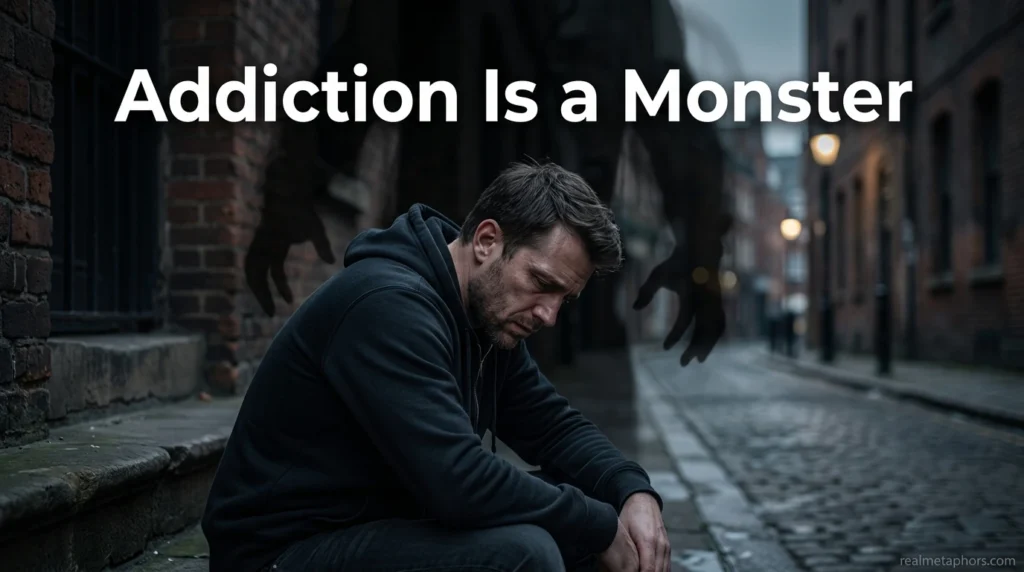
Meaning: It feels scary and powerful.
Example: “He said the bottle was feeding a monster inside him.”
Another way: Addiction is a beast that grows when fed.
Imagine: A creature that gets bigger every time you give it attention.
6. Addiction Is Quick Sand
Meaning: The more you struggle alone, the deeper you sink.
Example: “The harder he tried to hide it, the deeper he sank.”
Another way: Addiction is a trap that tightens.
Picture: Soft sand pulling you down inch by inch.
7. Addiction Is a Broken Record
Meaning: It repeats the same harmful behavior again and again.
Example: “Every weekend was the same broken record of promises and regret.”
Another way: Addiction is a loop.
Imagine: A song stuck on repeat.
8. Addiction Is a Thief
Meaning: It steals time, money, health, and relationships.
Example: “Addiction stole ten years of his life.”
Another way: Addiction robs your future.
Visual: An invisible hand taking things you love.
9. Addiction Is a Fire
Meaning: It spreads and grows if not controlled.
Example: “What started as a spark turned into a wildfire.”
Another way: Addiction is a flame that feeds on fuel.
Imagine: A tiny spark becoming a raging blaze.
10. Addiction Is a Puppet Master
Meaning: It controls a person’s actions.
Example: “He felt like a puppet, and addiction pulled the strings.”
Another way: Addiction controls the show.
Picture: Strings attached to your hands and feet.
11. Addiction Is a Black Hole
Meaning: It pulls everything into darkness.
Example: “Her gambling habit became a black hole for her savings.”
Another way: Addiction swallows everything.
Imagine: Light disappearing into darkness.
12. Addiction Is a Virus
Meaning: It spreads and affects many areas of life.
Example: “The addiction infected his work and family life.”
Another way: Addiction spreads like a disease.
Visual: Something small multiplying quietly.
13. Addiction Is a Roller Coaster
Meaning: It brings extreme highs and lows.
Example: “Using gave him a high, but the crash was brutal.”
Another way: Addiction is an emotional ride.
Picture: Climbing high—then dropping fast.
14. Addiction Is a Maze
Meaning: It’s confusing and hard to escape.
Example: “She felt lost in a maze of bad choices.”
Another way: Addiction is a confusing path.
Imagine: Walls around you. No clear exit.
15. Addiction Is a Chain Reaction
Meaning: One action leads to many problems.
Example: “One drink led to ten more.”
Another way: Addiction triggers a domino effect.
Visual: One domino knocking down the next.
16. Addiction Is a Weight
Meaning: It feels heavy and exhausting.
Example: “He carried his addiction like a heavy backpack.”
Another way: Addiction is a burden.
Picture: Trying to walk uphill with stones on your back.
17. Addiction Is a Fog
Meaning: It clouds judgment.
Example: “In the fog of addiction, she couldn’t think clearly.”
Another way: Addiction blurs reality.
Imagine: Driving but barely seeing the road.
18. Addiction Is a Snake
Meaning: It can be sneaky and dangerous.
Example: “It slithered back into his life when he least expected it.”
Another way: Addiction hides and strikes.
Visual: Something silent in the grass.
19. Addiction Is a False Friend
Meaning: It promises comfort but causes harm.
Example: “The drink felt like comfort—but it betrayed him.”
Another way: Addiction pretends to help.
Imagine: A smiling face hiding bad intentions.
20. Addiction Is Glue
Meaning: It sticks to you and is hard to remove.
Example: “The habit clung to her like glue.”
Another way: Addiction sticks tight.
Picture: Trying to pull your hands apart.
21. Addiction Is a Stormy Sea
Meaning: It makes life unstable.
Example: “His life felt like a boat in rough water.”
Another way: Addiction is emotional chaos.
22. Addiction Is a Locked Door
Meaning: It blocks opportunities.
Example: “Every relapse felt like another locked door.”
Another way: Addiction closes paths.
23. Addiction Is a Hungry Wolf
Meaning: It always wants more.
Example: “No matter how much he gave, it wasn’t enough.”
Another way: Addiction has endless appetite.
24. Addiction Is a Tightrope
Meaning: Recovery feels risky and fragile.
Example: “Early sobriety felt like walking a tightrope.”
Another way: Recovery is delicate balance.
25. Addiction Is a Mirror
Meaning: It reflects pain someone may be avoiding.
Example: “His addiction showed the hurt he never faced.”
Another way: Addiction reveals hidden wounds.
26. Addiction Is a Battle
Meaning: It requires strength and support.
Example: “She fought her addiction one day at a time.”
Another way: Recovery is a daily fight.
Fun Exercises and Writing Prompts
1. Fill in the Blank
“Addiction is like a ______ because ______.”
Try three different answers.
2. Create a Positive Twist
Turn a negative metaphor into hope. Example: “If addiction is a storm, recovery is the sunrise.”
3. Social Media Challenge
Write a short post using one metaphor: “Addiction is a cage—but every day in recovery bends the bars.”
4. Story Starter
Write 5–10 sentences about a character escaping a maze. Let the maze represent addiction.
Extra Tips for Using Metaphors for Addiction
- Keep them simple and clear.
- Don’t mix too many metaphors at once.
- Match the metaphor to your audience.
- Use sensory details (sight, sound, touch).
- Balance darkness with hope when possible.
Metaphors help people talk about addiction without shame. They create understanding and empathy.
FAQs
1. What is addiction in simple words?
Addiction is a strong, repeated urge to use something or do something—even when it causes harm.
2. Why use metaphors for addiction?
Because addiction is complex. Metaphors make it easier to understand and explain feelings.
3. How do I create my own metaphor?
Compare addiction to something with similar qualities. Ask: “What does it feel like?” Then build from there.
4. Are metaphors helpful in recovery?
Yes. They help people express emotions, share experiences, and feel understood.
5. What is a common mistake when using metaphors?
Mixing too many images. For example, calling addiction a storm, a monster, and a maze in one sentence.
6. Can metaphors be positive?
Yes. You can say, “Recovery is a sunrise” or “Hope is a key.”
7. Where can I use these metaphors?
In stories, essays, therapy, journaling, speeches, and social media posts.
Final Thoughts
Addiction can feel confusing and overwhelming. But words have power. When we say addiction is a chain, a storm, or a shadow, we turn something invisible into something visible.