

The alarm rings at 6:30 a.m. You roll over, reach for your backpack, and there it is—another stack of homework, waiting silently like a quiet storm. You groan. It feels heavier than your bag, more stubborn than a locked door. But what if we could look at homework in a new way—not just as a chore, but as a universe of metaphors, a playground for words and imagination?
Homework is more than pages of exercises—it’s a canvas for creative expression. By using metaphors, we can transform the ordinary into something extraordinary. This article explores 25+ metaphors for homework, each explained with examples, alternative expressions, and mini-practical exercises. Whether you are a student, teacher, writer, or content creator, these metaphors can make communication lively, writing vivid, and thinking imaginative.
1. Homework as a Mountain
Meaning: Homework can feel like a towering obstacle—big, intimidating, and demanding effort.
Example: “I stared at my homework mountain, wondering if I’d ever reach the summit.”
Alternative expressions: A giant, an uphill battle, a steep climb.
Sensory details: Imagine the weight of your backpack, the height of each page stacked like rocks, the wind of stress at the peak.
Practice prompt: Describe a day when your homework felt like a mountain. How did you “climb” it?
2. Homework as a Puzzle
Meaning: Every problem or question is a piece of a larger picture.
Example: “Each math problem was a puzzle, waiting for the right piece to fit.”
Alternative expressions: A riddle, a labyrinth, a mystery to solve.
Mini-story: Picture Sherlock Holmes staring at a case; your homework is the clue-filled case you must solve.
Exercise: Take one assignment and break it down like puzzle pieces—what fits where?
3. Homework as a Workout
Meaning: Homework strengthens your brain like exercise strengthens muscles.
Example: “Every essay stretched my mind, like a morning jog stretches legs.”
Alternative expressions: Mental gym, brain training, intellectual push-ups.
Sensory details: Feel the burn of thinking hard, the sweat of concentration, the rush of completing it.
Prompt: Write about a homework “workout” session and how you felt afterward.

Meaning: Hidden knowledge and rewards lie in every page.
Example: “Solving the chemistry problems was like hunting for hidden treasure.”
Alternative expressions: A quest, a gold mine, a secret map.
Mini-story: Imagine pirates searching for gold. Every correct answer is a gleaming coin.
Exercise: Identify one “treasure” in your homework today. What did you discover?
5. Homework as a Journey
Meaning: Homework is an adventure, a step-by-step path of discovery.
Example: “Each chapter of reading took me further on the journey of history.”
Alternative expressions: Voyage, odyssey, road trip of learning.
Sensory details: Hear footsteps echoing in a library, see roads lined with words.
Prompt: Map out your homework journey for one week. Where do you start, and where do you end?
6. Homework as a Storm
Meaning: Homework can feel chaotic, overwhelming, or intense.
Example: “A storm of assignments blew across my desk, papers scattering everywhere.”
Alternative expressions: Tempest, whirlwind, hurricane of tasks.
Emotional details: The roar of stress, the lightning of last-minute panic, the calm after completing it.
Exercise: Describe a “stormy” homework day using at least three sensory details.
7. Homework as a Garden
Meaning: Homework is a place where ideas grow if nurtured.
Example: “Each paragraph I wrote planted seeds in the garden of my mind.”
Alternative expressions: A field, a greenhouse, fertile soil.
Sensory details: Smell ink like soil, see ideas sprouting like seedlings.
Prompt: Illustrate your homework garden. What ideas are flourishing?
8. Homework as a Ladder

Meaning: Homework helps you climb higher in knowledge and skill.
Example: “Every solved problem was a rung on the ladder of success.”
Alternative expressions: Stairway, steps, ascending path.
Mini-story: Imagine a library tower with each floor unlocking new abilities.
Exercise: Draw a ladder showing your progress in a subject this week.
9. Homework as a Key
Meaning: Homework unlocks doors to understanding and opportunity.
Example: “Her diligence with homework was the key to her scholarship.”
Alternative expressions: Unlock, passcode, gateway.
Sensory detail: Feel the cold metal of a key turning, hear the click of understanding.
Prompt: Identify one assignment that unlocked a new skill for you.
10. Homework as a Shadow
Meaning: Homework can feel ever-present, following you everywhere.
Example: “The homework shadow stretched across my evening like a silent companion.”
Alternative expressions: Constant companion, echo, lingering presence.
Emotional detail: Feel the weight of its presence, the stretching across time.
Exercise: Write a short poem about your homework shadow.
11. Homework as a Mirror
Meaning: Homework reflects your effort, understanding, and growth.
Example: “My essay was a mirror, showing me what I had truly learned.”
Alternative expressions: Reflection, looking glass, echo of effort.
Mini-story: Think of Narcissus gazing into a pool; your work reflects your dedication.
Prompt: Reflect on one assignment and write what it shows about you.
12. Homework as a Bridge
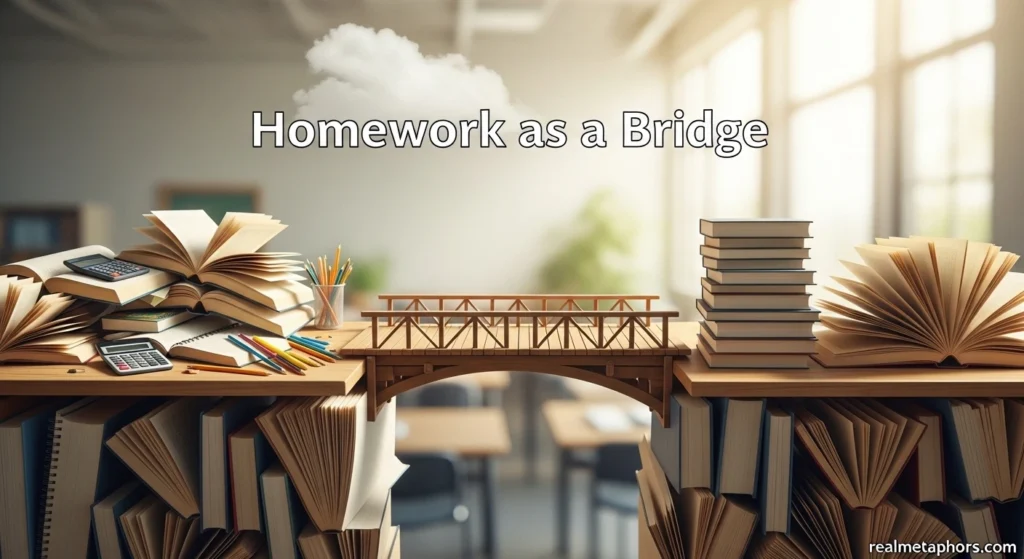
Meaning: Homework connects what you know to what you don’t know.
Example: “Each solved problem was a bridge to the next level of understanding.”
Alternative expressions: Pathway, link, stepping stone.
Sensory detail: Hear footsteps on wooden planks, feel the sway of learning under your feet.
Exercise: Draw a “knowledge bridge” connecting your current skills to your goal.
13. Homework as Fire
Meaning: Homework can ignite curiosity or pressure you intensely.
Example: “The burning questions in my mind set my homework ablaze with excitement.”
Alternative expressions: Spark, flame, wildfire of thought.
Emotional detail: Feel warmth or the stress-induced heat of deadlines.
Prompt: Write a scene where your homework sets your imagination on fire.
14. Homework as a Maze
Meaning: Sometimes, homework can be confusing and tricky.
Example: “Algebra problems twisted like a maze in my notebook.”
Alternative expressions: Labyrinth, puzzle path, winding road.
Mini-story: Imagine Theseus with a ball of string; each hint helps you find the exit.
Exercise: Draw a maze representing a challenging assignment and your path through it.
15. Homework as a Recipe
Meaning: Homework combines ingredients (facts, skills, and ideas) to create knowledge.
Example: “I followed the essay recipe carefully, mixing research with my own thoughts.”
Alternative expressions: Formula, blueprint, potion.
Sensory detail: Smell the paper like spices, taste the sweetness of completed work.
Prompt: Write your own “homework recipe” for a subject you enjoy.
16. Homework as a Sword

Meaning: Homework can be a weapon to fight ignorance or defend knowledge.
Example: “My pencil was a sword, cutting through the fog of confusion.”
Alternative expressions: Shield, weapon, tool of conquest.
Mini-story: Imagine a knight armed with knowledge; every solved problem is a victory.
Exercise: Describe your “weapon” and what battles it helps you win.
17. Homework as Music
Meaning: Homework has rhythm, flow, and harmony.
Example: “Each paragraph sang in the melody of my essay.”
Alternative expressions: Symphony, tune, composition.
Sensory detail: Hear the tapping of a pen like drumbeats, the swoosh of pages like strings.
Prompt: Write a short paragraph where homework is a song.
18. Homework as a Ladder
(Reinforcing the idea with a slightly different angle)
Meaning: Step-by-step effort in homework leads to higher achievements.
Example: “Homework rungs elevated my skills inch by inch.”
Alternative expressions: Staircase, climbing path, ascending steps.
Mini-story: Think of a mountain climber; each problem solved is one step closer to the peak.
Exercise: Visualize your week’s homework as a staircase and describe your climb.
19. Homework as a Keyhole
Meaning: Homework lets you peek into the world of knowledge.
Example: “Peering through the keyhole of my physics assignment, I glimpsed the universe’s secrets.”
Alternative expressions: Window, peephole, opening.
Sensory detail: Feel the small reveal, the curiosity, the spark of insight.
Prompt: Describe what you “see” through your keyhole assignment today.
20. Homework as a Compass
Meaning: Homework guides your learning and decisions.
Example: “The exercises were my compass, pointing me toward understanding.”
Alternative expressions: Map, guide, North Star.
Mini-story: Imagine explorers in a forest; your homework keeps you on course.
Exercise: Draw your own “homework compass” for the next week.
21. Homework as Seeds

Meaning: Each task plants the foundation for future knowledge.
Example: “Every solved question was a seed that would grow into wisdom.”
Alternative expressions: Sprout, sapling, foundation.
Sensory detail: Visualize roots spreading, tiny sprouts pushing through soil.
Prompt: Reflect on which assignments have grown your knowledge garden this month.
22. Homework as a Window
Meaning: Homework opens a view into new ideas and perspectives.
Example: “My history homework was a window into another era.”
Alternative expressions: Lens, doorway, viewpoint.
Sensory detail: Feel the breeze of imagination, the sunlight of insight.
Exercise: Describe a subject as a “window” to a world you love.
23. Homework as a Lighthouse
Meaning: Homework can guide you through confusion or challenges.
Example: “Even in tough subjects, my homework shone like a lighthouse.”
Alternative expressions: Beacon, guide, signal.
Mini-story: Picture sailors in a storm, your homework keeps you safe.
Prompt: Write about a time homework guided you out of a tough spot.
24. Homework as a Mirror Maze

Meaning: Homework reflects your abilities but can also confuse and challenge.
Example: “I wandered through the mirror maze of equations, seeing myself in every reflection.”
Alternative expressions: Echo chamber, reflection puzzle.
Sensory detail: Feel disoriented, see your reflection multiply, find your way to clarity.
Exercise: Write about a challenging assignment as a mirror maze.
25. Homework as a Time Machine
Meaning: Homework transports you to the past, future, or different worlds through learning.
Example: “Reading my history assignment, I traveled back to medieval castles.”
Alternative expressions: Portal, voyage through time, learning machine.
Mini-story: Imagine sitting in class and suddenly walking through ancient streets.
Prompt: Write a short story where homework is your time machine.
Bonus Tips for Using Metaphors Effectively
- Mix literal and figurative: Don’t just say “homework is hard”—say “homework is a mountain I climb each evening.”
- Use sensory details: Smell, sight, sound, taste, and touch make metaphors vivid.
- Adapt for social media: Short, punchy metaphors work well for captions.
- Combine metaphors: “Homework is a stormy sea, but my pencil is the steady boat.”
- Practice daily: Write one metaphor a day for each assignment.
Conclusion
Homework is more than a stack of papers—it is a universe of metaphors waiting to be explored. Mountains, puzzles, storms, gardens, and time machines are all ways to understand, express, and even enjoy your assignments. By thinking metaphorically, you can make learning imaginative, writing vivid, and communication lively. Let these metaphors inspire you to approach homework creatively, turning every task into an adventure.
FAQs
1. Why use metaphors for homework?
Metaphors make homework relatable, fun, and memorable. They help express feelings, simplify complex ideas, and enhance writing.
2. Can metaphors improve writing skills?
Yes! Using metaphors improves imagination, descriptive skills, and emotional depth in essays, stories, or posts.
3. Are there cultural differences in metaphors?
Yes. Different cultures may see homework as a “journey,” “storm,” or “treasure” differently, enriching creativity.
4. How can I practice creating metaphors?
Pick one assignment daily and describe it as something imaginative: a mountain, storm, garden, or time machine.
5. Can metaphors make homework feel less stressful?
Absolutely. Viewing tasks as adventures, treasures, or workouts can turn stress into motivation and curiosity.