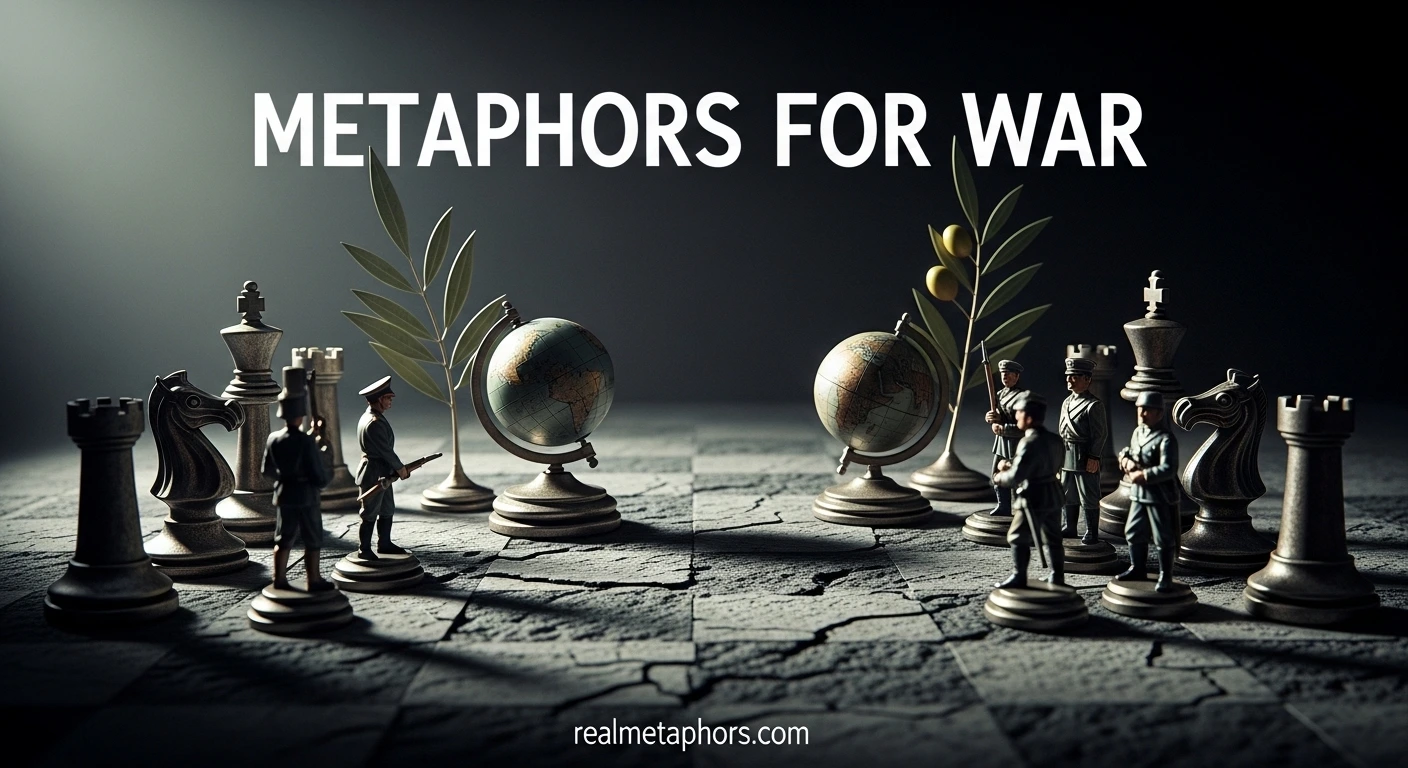
Imagine standing on a battlefield. Smoke curls into the sky. The ground trembles under heavy boots. You hear the clash of swords and the roar of cannons. This chaos, fear, and strategy is what “war” brings to mind. But war isn’t just literal fighting—it’s also in stories, debates, personal struggles, and even social media battles. Using metaphors helps us describe war in ways that spark imagination, emotion, and clarity.
In this article, we’ll explore 25+ easy metaphors for war. Each one will explain the metaphor, show an example, offer an alternative way to say it, and give details to help you picture it. By the end, you’ll also get exercises to practice using metaphors in your writing, everyday conversations, and social media posts.
1. War is a Storm
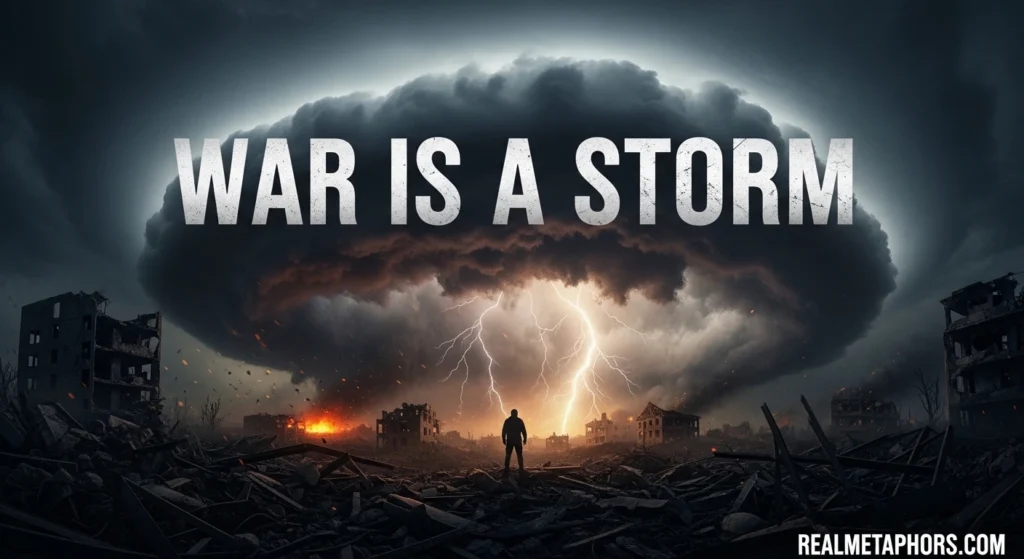
Meaning: Like a storm, war brings chaos, destruction, and uncontrollable forces.
Example: “The city descended into a storm of conflict, with families fleeing the streets.”
Alternative: War is a hurricane.
Visual Detail: You can imagine dark clouds rolling in, thunder booming, and rain lashing everything—much like the sudden violence of battle.
2. War is Fire
Meaning: War consumes, destroys, and spreads quickly.
Example: “The argument spread like fire, engulfing everyone in its path.”
Alternative: War is a blaze.
Visual Detail: Flames licking houses or forests, smoke rising—fire burns relentlessly, just like the consequences of war.
3. War is a Game of Chess
Meaning: War involves strategy, planning, and careful moves.
Example: “Negotiations turned into a game of chess, each side anticipating the other’s attack.”
Alternative: War is a strategic battle.
Visual Detail: Imagine pawns, knights, and queens moving across a board, each move carefully considered.
4. War is a Beast
Meaning: War is wild, untamed, and dangerous.
Example: “Once it started, the war became a beast that devoured reason.”
Alternative: War is a monster.
Visual Detail: Picture a roaring lion or dragon, eyes glowing, ready to strike anything in its path.
5. War is a River
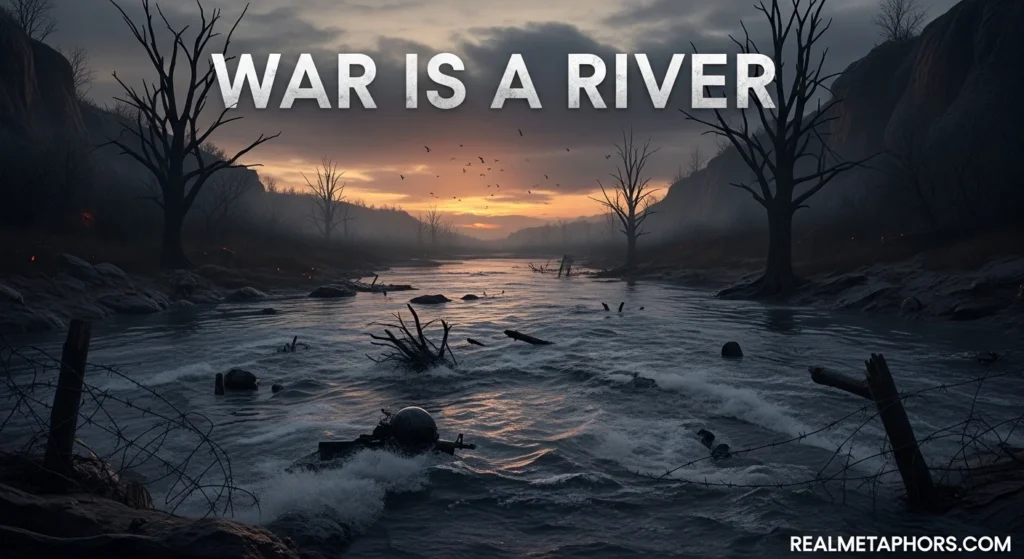
Meaning: War flows, sometimes calm, sometimes violent, and changes the landscape.
Example: “The conflict flowed through the region like a river, carving new paths of fear.”
Alternative: War is a raging stream.
Visual Detail: Waves crashing against rocks, currents dragging everything along, unstoppable and shaping the terrain.
6. War is a Dance
Meaning: Soldiers, strategies, and attacks move in rhythm—sometimes coordinated, sometimes chaotic.
Example: “The battle was a deadly dance, each side circling the other cautiously.”
Alternative: War is a deadly ballet.
Visual Detail: Movements in sync but dangerous, a mix of grace and threat.
7. War is a Tornado
Meaning: War sweeps through unexpectedly, leaving destruction in its wake.
Example: “The invasion hit like a tornado, flattening villages in hours.”
Alternative: War is a cyclone.
Visual Detail: Debris spinning in the wind, trees uprooted, a force you cannot escape.
8. War is a Volcano
Meaning: War builds tension and erupts violently.
Example: “Decades of tension erupted like a volcano, consuming cities in fire and ash.”
Alternative: War is an eruption.
Visual Detail: Molten lava spilling down slopes, clouds of smoke—pressure finally breaking free.
9. War is a Shadow
Meaning: War lingers over people, darkening lives and places.
Example: “The shadow of war haunted the villagers for years.”
Alternative: War is a dark cloud.
Visual Detail: Imagine a constant gray presence, dimming light and hope.
10. War is a Machine
Meaning: War is systematic, unstoppable, and often impersonal.
Example: “The army moved like a machine, precise and terrifying.”
Alternative: War is a relentless engine.
Visual Detail: Metal gears turning, pistons pumping, unstoppable momentum.
11. War is a Beast in a Cage
Meaning: War is controlled tension, ready to explode.
Example: “The political dispute was a beast in a cage, waiting to break free.”
Alternative: War is a restrained monster.
Visual Detail: A roaring animal pacing, muscles tensed, waiting for release.
12. War is a Forest Fire
Meaning: War spreads fast and destroys everything in its path.
Example: “The rebellion swept through the country like a forest fire.”
Alternative: War is wildfire.
Visual Detail: Trees burning, sparks flying, smoke everywhere.
13. War is a Stormy Sea
Meaning: War is unpredictable, dangerous, and exhausting.
Example: “The negotiations crashed against obstacles like a stormy sea.”
Alternative: War is turbulent waters.
Visual Detail: Waves slamming ships, lightning overhead, sailors struggling to survive.
14. War is a Wound
Meaning: War leaves pain, scars, and long-lasting damage.
Example: “The conflict was a wound on the nation’s heart.”
Alternative: War is a scar.
Visual Detail: Imagine a deep cut that heals slowly, leaving permanent marks.
15. War is a Labyrinth
Meaning: War is complex, confusing, and difficult to escape.
Example: “The peace talks felt like navigating a labyrinth of conflicting interests.”
Alternative: War is a maze.
Visual Detail: Twisting paths, dead ends, tension at every corner.
16. War is a Thunderstorm
Meaning: War is loud, sudden, and alarming.
Example: “The announcement of battle hit the city like a thunderstorm.”
Alternative: War is a lightning strike.
Visual Detail: Thunder shaking the air, lightning illuminating the sky, people scrambling for shelter.
17. War is a Poison
Meaning: War spreads harm slowly, corrupting societies and relationships.
Example: “Hatred in the region acted like a poison, igniting conflict.”
Alternative: War is venom.
Visual Detail: Imagine something invisible seeping through bodies, weakening everything from inside.
18. War is Ice
Meaning: War can be cold, cruel, and emotionless.
Example: “The soldiers’ standoff felt like ice, freezing all hope of compromise.”
Alternative: War is frost.
Visual Detail: Frost covering everything, freezing rivers, numb hands, and stiff movements.
19. War is a Spider’s Web
Meaning: War traps people and makes escape difficult.
Example: “The political crisis spread like a spider’s web, trapping everyone involved.”
Alternative: War is entanglement.
Visual Detail: Sticky threads, struggles to break free, an invisible trap all around.
20. War is a Volcano of Words
Meaning: War can also be verbal, with explosions of anger and conflict.
Example: “The debate erupted into a volcano of words, scorching friendships.”
Alternative: War is a verbal eruption.
Visual Detail: Heated words flying like lava, burning bridges and leaving ash.
21. War is a Storm in the Mind
Meaning: Mental or emotional battles feel chaotic and overwhelming.
Example: “He fought a storm in his mind, torn between loyalty and fear.”
Alternative: War is mental turbulence.
Visual Detail: Thoughts crashing, inner turmoil, flashes of anger or sadness.
22. War is a Knife Fight
Meaning: War is direct, dangerous, and personal.
Example: “The two sides clashed in a knife fight of politics and power.”
Alternative: War is a duel.
Visual Detail: Close proximity, tension, every movement matters for survival.
23. War is a Caged Lion
Meaning: War is powerful but restrained until unleashed.
Example: “The regime’s threats were like a caged lion, terrifying and ready to attack.”
Alternative: War is a restrained predator.
Visual Detail: A lion pacing its cage, muscles coiled, eyes sharp.
24. War is a Torn Flag
Meaning: War symbolizes loss, destruction, and division.
Example: “The nation’s pride lay like a torn flag after the civil war.”
Alternative: War is a tattered banner.
Visual Detail: Fabric ripped and fluttering, colors faded, pride and unity shattered.
25. War is a Broken Clock
Meaning: War disrupts normal life and makes time feel meaningless.
Example: “After the invasion, the village lived like a broken clock, unsure of day or night.”
Alternative: War is shattered time.
Visual Detail: Hands frozen, hours meaningless, life out of rhythm.
Fun Exercises & Challenges
- Metaphor Swap: Take any news story and describe the conflict using a metaphor. Example: “Trade war” → “a chess match on a global board.”
- Personal Struggle: Turn a small personal struggle into a metaphorical war. Example: cleaning your messy room → “a battlefield of laundry and dishes.”
- Social Media Mini-Stories: Post 2–3 sentence stories using a war metaphor to describe daily life.
- Creative Twist: Mix metaphors: “a stormy chessboard” or “a volcano of words” to make new expressions.
- Writing Prompt: Write a 200-word story starting with: “The war began in the kitchen…”.
Extra Tips:
- Use sensory words: sight, sound, and touch make metaphors vivid.
- Keep it relatable: use situations people recognize.
- Experiment: metaphors don’t have to be literal—imagine wild combinations.
FAQs
Q1: What is a metaphor?
A: A metaphor compares one thing to another to create a vivid picture, without using “like” or “as.”
Q2: Why use metaphors for war?
A: They make abstract ideas of conflict easier to understand, more emotional, and memorable.
Q3: How do I create a war metaphor?
A: Think of a force, object, or event that behaves like war—storm, fire, beast, etc. Then describe it in context.
Q4: Can metaphors be literal?
A: Not exactly—they illustrate ideas symbolically, not factually.
Q5: What are common mistakes?
A: Overcomplicating, mixing too many metaphors, or using one that doesn’t fit the situation.
Q6: How can I use war metaphors in writing?
A: In stories, poems, essays, or even daily conversation to make conflict more vivid.
Q7: Can metaphors apply to personal life?
A: Absolutely—arguments, work struggles, or emotional challenges can all be described using war metaphors.
Q8: How can I practice?
A: Observe events, emotions, or social conflicts, and try describing them with different metaphors from this list.