
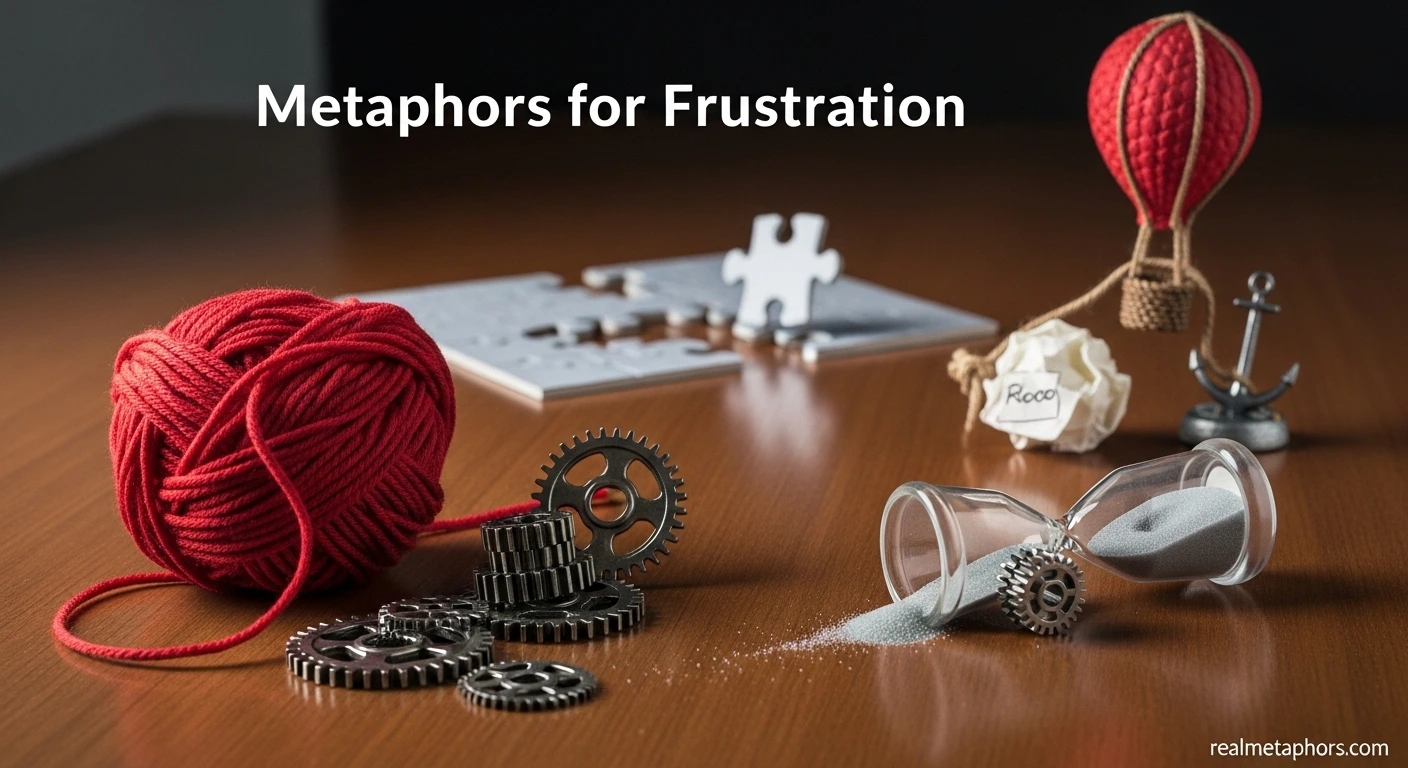
Imagine this: You’ve been trying to assemble a piece of furniture for hours. Every screw seems to fight you back, the instructions look like a secret code, and your patience is slipping away like sand through your fingers. That tight knot in your stomach, the urge to shout, the endless sighs—this is frustration. Frustration is that restless, restless feeling when things don’t go as planned. But what if we could describe it with vivid, memorable metaphors? That’s exactly what this article will do.
Below, you’ll find 25+ metaphors for frustration, each explained clearly, with examples and tips on how to use them in your writing, social media posts, or even conversations.
1. A Boiling Teapot
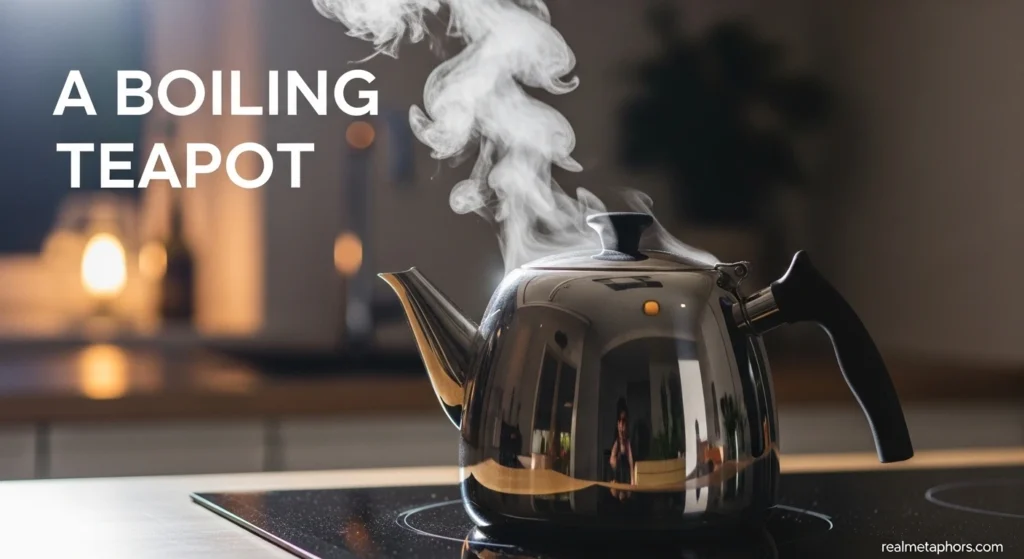
Meaning: Feeling ready to explode from irritation.
Example: “By the time the meeting ended, I felt like a boiling teapot, ready to whistle at any moment.” Alternative: “On the verge of blowing steam.”
Visual Detail: Imagine a teapot hissing and steam shooting out—your emotions are doing the same.
2. A Caged Bird
Meaning: Feeling trapped and powerless.
Example: “Waiting for the delayed train made me a caged bird, pacing back and forth.”
Alternative: “Like a trapped animal in a small cage.”
Visual Detail: Wings fluttering, desperate to fly, but stuck inside.
3. A Knotted Rope
Meaning: Confusion and tension.
Example: “Trying to solve that math problem left me like a knotted rope, tight and tangled.”
Alternative: “All twisted up inside.”
Visual Detail: You try to pull it, but the knots hold fast—like your thoughts.
4. A Stormy Sea
Meaning: Turbulent emotions and inner chaos.
Example: “After hearing the news, my mind was a stormy sea, waves crashing in every direction.”
Alternative: “Emotions in turmoil.”
Visual Detail: Imagine waves tossing a small boat—your mind is that boat.
5. A Pressure Cooker
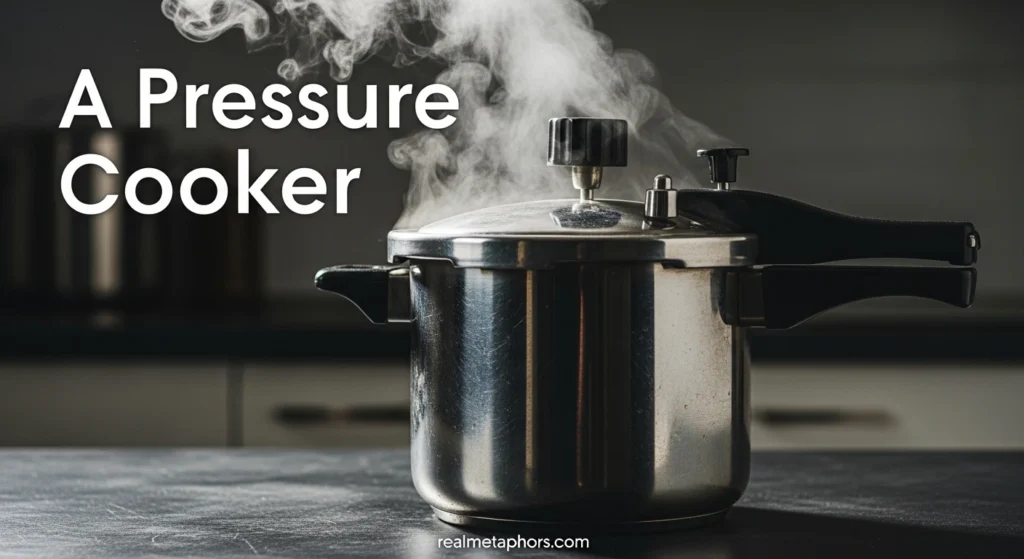
Meaning: Built-up tension waiting to explode.
Example: “Every delay made me feel like a pressure cooker about to blow.”
Alternative: “Tightly wound and ready to burst.”
Visual Detail: Steam hissing from the lid, warning that something will give soon.
6. A Spinning Wheel in Mud
Meaning: Efforts going nowhere.
Example: “I was like a spinning wheel in mud, trying to move forward but stuck.”
Alternative: “Running in circles.”
Visual Detail: Tires dig into mud, splattering but not moving—frustration is like that.
7. An Unfinished Puzzle
Meaning: Incomplete or confusing tasks causing stress.
Example: “His instructions were so unclear; I felt like an unfinished puzzle missing pieces.”
Alternative: “Everything scattered and confusing.”
Visual Detail: Pieces lying around, some upside down—you can’t see the whole picture.
8. A Broken Record
Meaning: Repeated mistakes or repetitive problems.
Example: “Every time I corrected her, she made the same error—like a broken record.”
Alternative: “Going over the same issue endlessly.”
Visual Detail: Imagine a vinyl record stuck in a groove, playing the same note.
9. A Bubbling Volcano
Meaning: Anger or frustration building up.
Example: “He clenched his fists, a bubbling volcano ready to erupt.”
Alternative: “On the brink of exploding.”
Visual Detail: Molten lava churning inside, waiting for the moment to break free.
10. A Stuck Key in a Lock
Meaning: Feeling blocked or unable to progress.
Example: “I tried to fix the project, but every approach was a stuck key in a lock.”
Alternative: “Nothing works no matter how hard you try.”
Visual Detail: The key won’t turn no matter how you jiggle it.
11. A Torn Page
Meaning: Feeling ruined or disrupted.
Example: “Her harsh words left me like a torn page in my favorite book.”
Alternative: “Shattered or damaged inside.”
Visual Detail: A page ripped from a story, incomplete and jagged.
12. A Rainy Day Without an Umbrella
Meaning: Unprepared and overwhelmed.
Example: “Facing all those problems felt like a rainy day without an umbrella.”
Alternative: “Exposed and drenched by circumstances.”
Visual Detail: Cold rain soaking you, making you miserable and helpless.
13. A Traffic Jam in Your Mind
Meaning: Overthinking and mental block.
Example: “I wanted to focus, but my thoughts were a traffic jam in my mind.”
Alternative: “Crowded with thoughts.”
Visual Detail: Cars honking, moving slowly, and you just can’t advance.
14. A Balloon About to Pop
Meaning: Extreme tension or stress.
Example: “I was like a balloon about to pop after hours of work and interruptions.”
Alternative: “Overstretched and fragile.”
Visual Detail: The skin is thin, stretched tight—one more poke could burst it.
15. A Broken Compass
Meaning: Feeling lost or directionless.
Example: “Without guidance, I felt like a broken compass in a dense forest of tasks.”
Alternative: “Confused and unable to find a path.”
Visual Detail: The needle spins aimlessly—you don’t know which way to go.
16. A Stuck Elevator
Meaning: Trapped in a situation with no progress.
Example: “I felt like a stuck elevator during that endless meeting.”
Alternative: “Going nowhere fast.”
Visual Detail: Trapped between floors, with nothing to do but wait.
17. A Tangled Headphones
Meaning: Annoying complications and small frustrations.
Example: “Untangling my thoughts was like untangling a pair of headphones.”
Alternative: “Small but irritating obstacles.”
Visual Detail: Knots twist and pull, slowing you down.
18. A Flickering Light
Meaning: Unreliable situations causing irritation.
Example: “The internet kept cutting off, a flickering light in my day.”
Alternative: “Inconsistent and frustrating.”
Visual Detail: Light that barely holds on, leaving you in partial darkness.
19. A Snapped Pencil
Meaning: Small setbacks causing annoyance.
Example: “I snapped my pencil mid-exam—so much frustration in that tiny moment.”
Alternative: “A small disaster.”
Visual Detail: Lead broken, frustration immediate and sharp.
20. A Leaky Faucet
Meaning: Persistent, nagging irritation.
Example: “His constant questions were a leaky faucet, dripping annoyance all day.”
Alternative: “Slow, endless irritation.”
Visual Detail: Tiny drops, but enough to drive you crazy over time.
21. A Jammed Door
Meaning: Obstacles blocking progress.
Example: “No matter how hard I pushed, the project was a jammed door.”
Alternative: “Blocked and stuck.”
Visual Detail: You push, tug, wiggle—the door won’t budge.
22. A Shaky Ladder
Meaning: Unstable, stressful situations.
Example: “Trying to finish the presentation with missing data felt like climbing a shaky ladder.”
Alternative: “Precarious and nerve-wracking.”
Visual Detail: Each step threatens to wobble or collapse.
23. A Misfiring Engine
Meaning: Efforts that fail to produce results.
Example: “Every plan misfired like a faulty engine.”
Alternative: “Not firing on all cylinders.”
Visual Detail: Engine sputters, backfires, refuses to start.
24. A Rolling Snowball of Problems
Meaning: Small issues growing bigger.
Example: “Ignoring the issue only made it a rolling snowball of problems.”
Alternative: “Troubles multiplying fast.”
Visual Detail: Snowball grows as it rolls, unstoppable and heavy.
25. A Fading Candle
Meaning: Energy or patience running out.
Example: “After hours of work, I was like a fading candle, barely holding on.”
Alternative: “Running out of steam.”
Visual Detail: Flame shrinking, flickering—soon to be gone.
Bonus: Creative Exercises to Practice Metaphors for Frustration
- Write Your Own Metaphor: Pick a frustrating experience and describe it with an object, animal, or natural phenomenon.
- Social Media Challenge: Share a daily frustration using a metaphor—see who understands it best.
- Story Prompt: Write a short story where a character’s frustration is described using three different metaphors.
- Compare and Contrast: Take two metaphors (e.g., “boiling teapot” vs. “caged bird”) and explain subtle differences in meaning.
- Visual Exercise: Draw your metaphor literally to better feel and describe frustration in words.
Extra Tip: Mix metaphors with senses—sight, sound, touch, even taste—to make frustration feel real in writing.
FAQs
Q1: What is a metaphor?
A metaphor is a figure of speech where you describe something by saying it is something else, to create vivid images.
Q2: Why use metaphors for frustration?
Metaphors make emotions easier to understand, relatable, and memorable.
Q3: How do I create a metaphor?
Think of something familiar (a storm, animal, object) and connect it to your feeling. Ask: “Frustration is like…?”
Q4: Can I use multiple metaphors together?
Yes! Layering metaphors can add depth, but avoid overloading—clarity matters.
Q5: What are common mistakes?
- Using clichés without meaning
- Mixing metaphors that don’t match
- Overcomplicating the description
Q6: Where can I use these metaphors?
Stories, social media, speeches, daily conversations, or journaling.
Q7: How do metaphors improve writing?
They add imagery, emotion, and help readers connect to your experience.
Q8: Can metaphors change depending on culture?
Yes! Some symbols work differently in different cultures, so choose ones your audience understands.
Conclusion
With these 25+ metaphors, your descriptions of frustration will never feel flat or boring again. Use them, tweak them, and let your emotions paint pictures that readers can almost touch, hear, and feel.