

Ali worked hard to start his small online business. He dreamed of success every night. But after six months, sales were low, and customers were few. He felt sad but not broken.
Later, his friend told him, “Failure is not the end. It is just a lesson wearing a sad mask.”
Ali smiled. He realized something important — failure is part of learning. It is not a wall. It is a step.
That is what metaphors for failure help us understand. They make a hard feeling easy to imagine.
Now let’s explore 25+ simple and useful metaphors for failure.
1. Failure is a Shadow
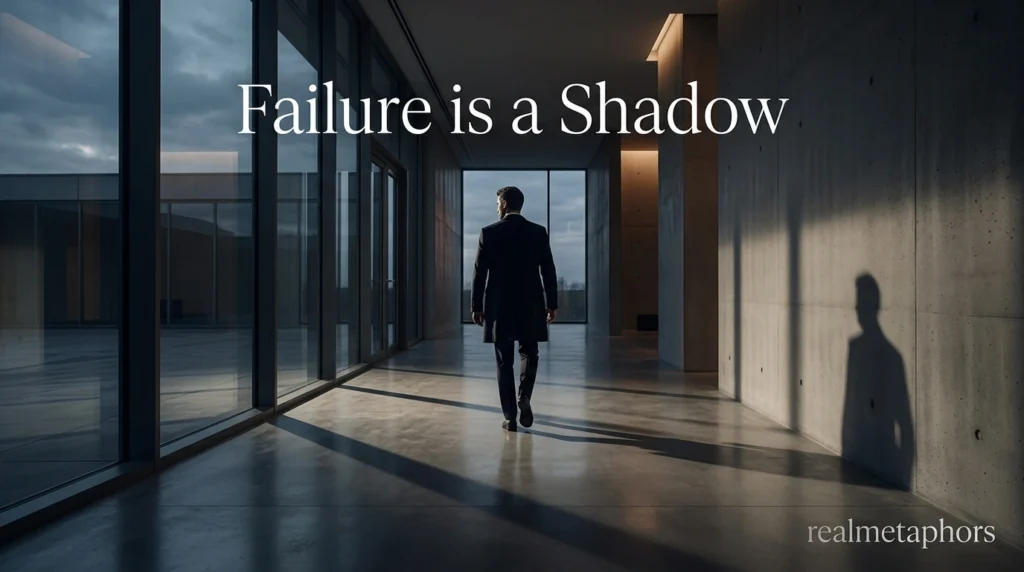
Meaning: Failure follows you but doesn’t stop your life.
Example: “Don’t fear failure; it is just a shadow behind success.”
Another way to say it: Dark companion, silent follower.
Imagine: Like a shadow that appears when there is light.
2. Failure is a Broken Bridge
Meaning: Something didn’t work, but you can build a new path.
Example: “That business was a broken bridge, not the end of the road.”
Another way to say it: Failed connection.
Detail: You can rebuild a bridge if you try again.
3. Failure is a Rough Stone
Meaning: Failure shapes you like a stone shaped by tools.
Example: “His failure became the rough stone that made him stronger.”
Another way to say it: Raw material of success.
Imagine: A stone being polished slowly.
4. Failure is a Closed Door
Meaning: One opportunity ended.
Example: “When one door closes, another opens.”
Another way to say it: Locked opportunity.
Detail: Closed doors are not the end of a house.
5. Failure is a Dark Night
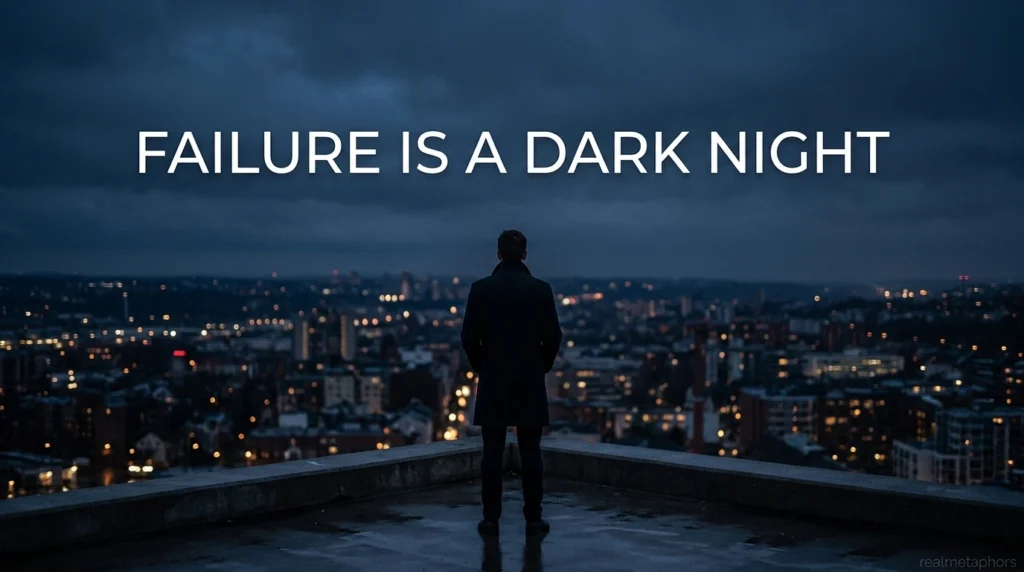
Meaning: Hard times feel lonely and confusing.
Example: “She passed through a dark night of failure.”
Another way to say it: Stormy time.
Imagine: Night is temporary because morning comes.
6. Failure is a Falling Leaf
Meaning: Loss is natural and part of life.
Example: “His startup fell like a leaf in autumn.”
Another way to say it: Gentle loss.
Detail: Leaves fall but trees stay alive.
7. Failure is a Heavy Backpack
Meaning: Failure feels like emotional weight.
Example: “He carried failure like a heavy backpack.”
Another way to say it: Burden of disappointment.
Imagine: Walking uphill with a heavy bag.
8. Failure is a Broken Mirror
Meaning: Plans or dreams were damaged.
Example: “Her dream looked like a broken mirror after the accident.”
Another way to say it: Shattered hope.
Detail: A mirror reflects life, so breaking it feels painful.
9. Failure is a Stormy Sea
Meaning: Life becomes chaotic and unpredictable.
Example: “His career was sailing through a stormy sea.”
Another way to say it: Emotional hurricane.
Imagine: Waves hitting a small boat.
10. Failure is a Training Ground
Meaning: Failure teaches skills.
Example: “School failure became his training ground.”
Another way to say it: Practice field.
Detail: Athletes train before winning.
11. Failure is a Dusty Road
Meaning: Progress is slow and tiring.
Example: “She walked the dusty road of failure.”
Another way to say it: Hard journey.
Imagine: Walking in hot, dry weather.
12. Failure is a Broken Pencil
Meaning: Work stopped before finishing.
Example: “My first novel felt like a broken pencil.”
Another way to say it: Interrupted creation.
Detail: You can sharpen or replace a pencil.
13. Failure is a Faded Painting
Meaning: Dream lost its brightness.
Example: “His success story looked like a faded painting.”
Another way to say it: Dull memory.
Imagine: Colors becoming soft and weak.
14. Failure is a Closed Book
Meaning: One chapter of life is finished.
Example: “Her old job was a closed book.”
Another way to say it: Finished story.
Detail: You can open a new book.
15. Failure is a Broken Seed
Meaning: Growth was stopped early.
Example: “The project was like a broken seed.”
Another way to say it: Unborn success.
Imagine: A seed that cannot grow.
16. Failure is a Cold Wind
Meaning: Failure feels emotionally cold.
Example: “The rejection email was a cold wind.”
Another way to say it: Heartless moment.
Detail: Cold wind makes people uncomfortable.
17. Failure is a Slow Poison
Meaning: Negative thoughts grow slowly.
Example: “Fear of failure became a slow poison.”
Another way to say it: Silent damage.
Imagine: Something harmful but not visible.
18. Failure is a Missing Puzzle Piece
Meaning: Something important was missing.
Example: “Confidence was the missing puzzle piece.”
Another way to say it: Incomplete picture.
Detail: A puzzle is not beautiful without all parts.
19. Failure is a Tired Horse
Meaning: Energy or motivation is lost.
Example: “He felt like a tired horse after the exam.”
Another way to say it: Exhausted traveler.
Imagine: A horse stopping after a long ride.
20. Failure is a Sinking Ship
Meaning: Situation is getting worse.
Example: “The company felt like a sinking ship.”
Another way to say it: Collapsing system.
Detail: People try to escape a sinking ship.
21. Failure is a Locked Box
Meaning: Success was hidden or unreachable.
Example: “Opportunities felt like a locked box.”
Another way to say it: Hidden treasure.
Imagine: Gold inside but no key.
22. Failure is a Broken Wing
Meaning: Someone cannot move forward easily.
Example: “His confidence was like a broken wing.”
Another way to say it: Weak flight.
Detail: Birds need wings to fly.
23. Failure is a Dry Well
Meaning: Effort did not produce results.
Example: “The project became a dry well.”
Another way to say it: Empty source.
Imagine: A well without water.
24. Failure is a Shadowed Mountain
Meaning: Success looks far away.
Example: “The goal was a shadowed mountain.”
Another way to say it: Hard climb.
Detail: Mountains look bigger from far.
25. Failure is a Burning Paper
Meaning: Plans were destroyed quickly.
Example: “The contract felt like burning paper.”
Another way to say it: Instant loss.
Imagine: Paper turning into ashes.
26. Failure is a Learning Teacher
Meaning: Failure teaches life lessons.
Example: “Failure is my strict but honest teacher.”
Another way to say it: Hard mentor.
Detail: Teachers sometimes correct mistakes.
Fun Exercises and Writing Challenges
Try these simple activities:
- Write 3 metaphors for your last mistake.
- Finish this sentence: “My failure felt like ______.”
- Describe failure using weather words.
- Make a metaphor using food, nature, or animals.
- Share your metaphor in a story of 5 lines.
Tips for Using Failure Metaphors
- Use metaphors in stories and speeches.
- Keep them simple for social media.
- Match the metaphor with the feeling you want.
- Avoid mixing too many metaphors together.
- Choose images that people can easily imagine.
FAQs
1. Why are metaphors useful?
Metaphors help explain emotions and ideas in a simple and creative way.
2. How do I create my own metaphor?
Think of failure as something in nature, objects, or daily life and compare feelings.
3. Are metaphors only for writing?
No. You can use them in speaking, teaching, or social media.
4. What are common mistakes?
Using confusing comparisons, mixing too many ideas, or making metaphors too long.
5. Can failure metaphors be positive?
Yes. Many metaphors show failure as a teacher or lesson.
6. Where can I use these metaphors?
In stories, motivational posts, poetry, and conversations.
7. Do famous writers use failure metaphors?
Yes. Many writers use nature and life images to describe failure.
8. Is failure always bad?
Not always. Failure often helps people learn and grow.