Ali forgot his best friend’s birthday. Not just the party—he forgot the day completely. When he finally remembered, two days later, it felt like something heavy had dropped inside his chest. He smiled and laughed as usual, but inside, it was as if he was carrying a backpack filled with stones.
That heavy, uncomfortable feeling? That’s guilt.
Guilt is the emotion we feel when we believe we’ve done something wrong—or failed to do something right. It can help us grow. But it can also weigh us down. Because guilt is invisible, we often use metaphors for guilt to describe it. Metaphors help us “see” feelings in a clearer way.
Let’s explore 25+ powerful, easy metaphors for guilt you can use in writing, conversations, or social media.
1. Guilt Is a Heavy Backpack
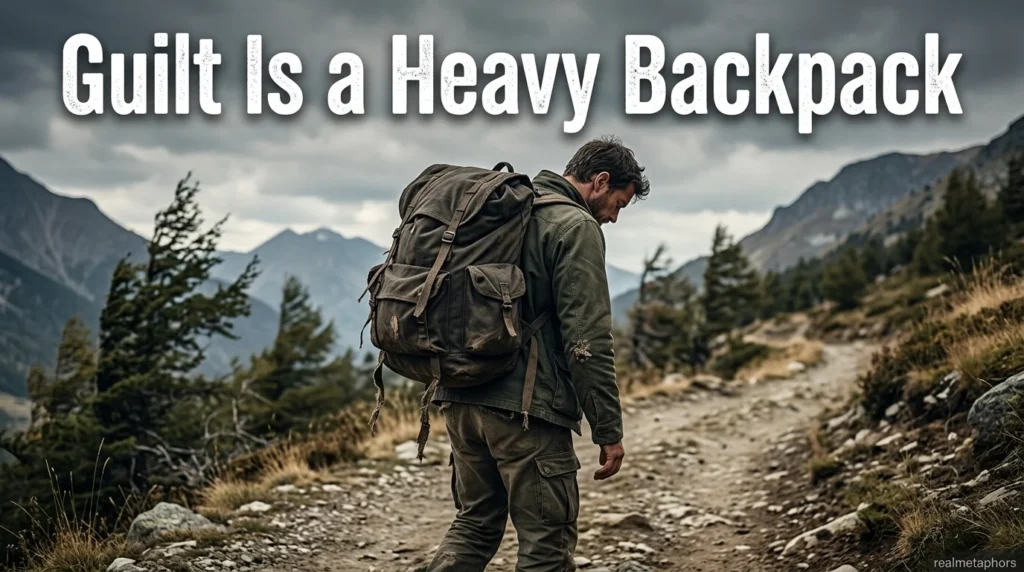
What it means: Guilt feels like carrying extra weight everywhere you go.
Example: “I’ve been carrying a heavy backpack of guilt since I lied.”
Another way to say it: “I feel weighed down by regret.”
Imagine: Thick straps digging into your shoulders, filled with rough stones.
2. Guilt Is a Shadow
What it means: It follows you quietly and constantly.
Example: “My mistake followed me like a shadow.”
Another way: “I couldn’t escape the feeling.”
Imagine: A dark shape behind you, always there in sunlight.
3. Guilt Is a Stain
What it means: It feels like a mark that won’t wash away.
Example: “The lie left a stain on my conscience.”
Another way: “It marked me deeply.”
Imagine: A dark ink spot on a white shirt.
4. Guilt Is a Thorn in the Heart
What it means: It causes small but constant pain.
Example: “Every time I see her, it’s like a thorn in my heart.”
Another way: “It hurts every time I think about it.”
Imagine: A tiny sharp thorn pressing gently but persistently.
5. Guilt Is a Storm Inside
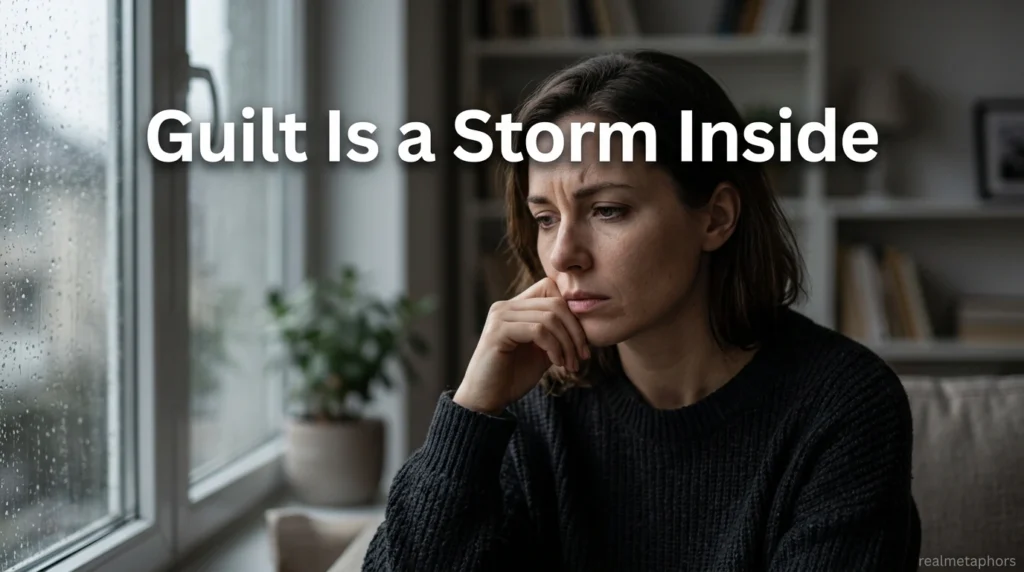
What it means: It creates emotional chaos.
Example: “There was a storm of guilt raging inside me.”
Another way: “I felt emotionally shaken.”
Imagine: Thunder rumbling in your chest.
6. Guilt Is a Prison
What it means: It traps you mentally.
Example: “He lived in a prison of guilt for years.”
Another way: “He couldn’t forgive himself.”
Imagine: Cold metal bars made of your own thoughts.
7. Guilt Is a Whisper in the Dark
What it means: It quietly reminds you of your mistake.
Example: “At night, guilt whispered in my ear.”
Another way: “My conscience wouldn’t stay quiet.”
Imagine: A soft voice when everything else is silent.
8. Guilt Is a Mirror
What it means: It forces you to see yourself honestly.
Example: “Guilt held up a mirror to my actions.”
Another way: “I had to face the truth.”
Imagine: Looking at your reflection and seeing more than your face.
9. Guilt Is a Chain
What it means: It restricts your freedom.
Example: “She felt chained by her guilt.”
Another way: “She felt emotionally trapped.”
Imagine: Cold metal wrapped around your wrists.
10. Guilt Is a Burning Fire
What it means: It feels hot and intense.
Example: “His guilt burned inside him.”
Another way: “He felt intense remorse.”
Imagine: A slow flame glowing in your chest.
11. Guilt Is a Weight on the Chest
What it means: It makes it hard to breathe or relax.
Example: “There was a weight on my chest all day.”
Another way: “I felt heavy-hearted.”
Imagine: A thick stone pressing down gently but firmly.
12. Guilt Is an Unpaid Debt
What it means: You feel like you owe something.
Example: “I felt like I owed her an apology.”
Another way: “I needed to make things right.”
Imagine: A bill sitting on your desk, unpaid.
13. Guilt Is a Broken Record
What it means: The same thought keeps repeating.
Example: “My mistake played like a broken record in my mind.”
Another way: “I kept replaying it.”
Imagine: A scratched CD skipping again and again.
14. Guilt Is a Dark Cloud
What it means: It ruins your mood.
Example: “A cloud of guilt hung over me.”
Another way: “I felt gloomy.”
Imagine: Gray skies even on a sunny day.
15. Guilt Is a Scar
What it means: It leaves a lasting mark.
Example: “The experience left a scar of guilt.”
Another way: “I’ll never forget it.”
Imagine: A faint line on your skin that tells a story.
16. Guilt Is a Ticking Clock
What it means: It creates urgency to fix things.
Example: “The ticking clock of guilt pushed me to apologize.”
Another way: “I couldn’t wait any longer.”
Imagine: Tick… tick… tick… getting louder.
17. Guilt Is a Knot in the Stomach
What it means: It causes anxiety and tension.
Example: “I had a knot in my stomach all morning.”
Another way: “I felt nervous and uneasy.”
Imagine: A tight rope twisted inside.
18. Guilt Is a Ghost
What it means: It haunts you from the past.
Example: “Old mistakes haunted him like ghosts.”
Another way: “He couldn’t escape the past.”
Imagine: A pale figure appearing in memory.
19. Guilt Is a Locked Door
What it means: It prevents emotional progress.
Example: “Her guilt was a locked door to happiness.”
Another way: “She couldn’t move on.”
Imagine: A door with no key.
20. Guilt Is Poison
What it means: It slowly harms your well-being.
Example: “Holding onto guilt was like drinking poison.”
Another way: “It damaged me emotionally.”
Imagine: A bitter liquid spreading slowly.
21. Guilt Is a Teacher
What it means: It helps you learn.
Example: “Guilt became my greatest teacher.”
Another way: “I learned from my mistake.”
Imagine: A strict but wise instructor.
22. Guilt Is a Compass
What it means: It guides you toward better behavior.
Example: “My guilt pointed me in the right direction.”
Another way: “I knew I had to correct it.”
Imagine: A needle pointing north.
23. Guilt Is a Crack in Glass
What it means: It damages trust.
Example: “One lie created a crack in our friendship.”
Another way: “Trust was broken.”
Imagine: A thin line spreading across a window.
24. Guilt Is an Anchor
What it means: It holds you back.
Example: “His guilt was an anchor keeping him stuck.”
Another way: “He couldn’t move forward.”
Imagine: A heavy metal anchor sinking into water.
25. Guilt Is a Fog
What it means: It clouds your thinking.
Example: “I couldn’t think clearly through the fog of guilt.”
Another way: “My mind felt unclear.”
Imagine: Thick mist hiding the road ahead.
26. Guilt Is a Tight Mask
What it means: You hide it, but it feels uncomfortable.
Example: “He wore his guilt like a tight mask.”
Another way: “He pretended everything was fine.”
Imagine: A mask pressing against your skin.
Fun Exercises to Practice Metaphors for Guilt
1. Fill-in-the-Blank Challenge
Complete this sentence: “Guilt is like a ______ because ______.”
Example: “Guilt is like wet cement because it traps you if you stand still too long.”
2. Memory to Metaphor
Think of a time you felt guilty. Describe the feeling using weather, objects, or animals.
3. Social Media Practice
Write a short post: “Today I learned that guilt is not a prison—it’s a compass.”
4. Story Starter
Write a 100-word story beginning with: “The ghost of guilt knocked on his door again.”
Tips for Using Metaphors for Guilt
- Keep them simple and relatable.
- Use sensory details (weight, sound, heat, texture).
- Don’t mix too many metaphors in one sentence.
- Match the metaphor to the mood (storm for chaos, scar for long-term regret).
- Use them in journaling, poetry, speeches, or even captions.
FAQs
1. What is guilt in simple words?
Guilt is the feeling you get when you think you did something wrong or hurt someone.
2. Why are metaphors for guilt useful?
They help describe invisible emotions in a clear, visual way.
3. How can I create my own metaphor for guilt?
Ask: What does guilt feel like? Heavy? Hot? Loud? Then compare it to something similar.
4. Can guilt be positive?
Yes. Healthy guilt can guide you to apologize, improve, and grow.
5. What’s the difference between guilt and shame?
Guilt says, “I did something bad.” Shame says, “I am bad.”
6. Are metaphors good for essays and stories?
Absolutely. They make writing more emotional and memorable.
7. What is a common mistake when using metaphors?
Overusing them or mixing different images too quickly.
Final Thoughts
Guilt is a complex emotion. Sometimes it feels like a storm. Sometimes like a strict teacher guiding us toward better choices.
By using these metaphors for guilt, you can better understand your emotions and express them clearly in writing and everyday life. When feelings are hard to explain, metaphors give them shape, color, and voice.