
One quiet morning, a single leaf drifted down from a tall tree. It spun in the air like a tiny dancer before landing softly on the ground. You’ve probably seen that happen many times. But have you ever stopped to think about what a leaf means?
Leaves are more than just green parts of a tree. They grow, change color, fall, and return again. Because of this, writers often use metaphors for leaves to talk about life, change, hope, growth, and even endings.
In this article, you’ll discover 25+ easy metaphors for leaves, each explained in simple language. You’ll also find examples, alternative phrases, and small details to help you imagine them clearly. Let’s begin.
1. Leaves Are Nature’s Confetti
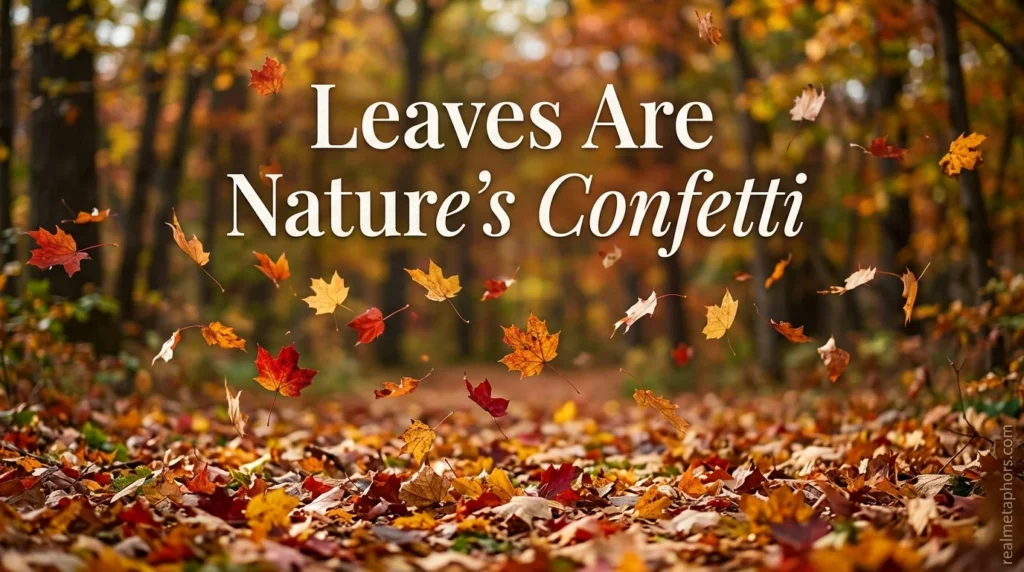
Meaning: Leaves celebrate the seasons, especially autumn.
Example: The golden leaves were nature’s confetti at the wedding in the park.
Another way to say it: Leaves are seasonal decorations.
Imagine this: A gust of wind sends red and yellow leaves flying like paper pieces at a party.
2. Leaves Are Pages in a Book
Meaning: Each leaf tells part of a story.
Example: Every leaf on the old oak was a page in the book of summer.
Another way: Leaves are chapters of the seasons.
Picture it: A tree flipping through its leafy pages as the wind blows.
3. Leaves Are Tiny Solar Panels
Meaning: Leaves collect sunlight to help the tree grow.
Example: The tree spread its tiny solar panels to drink in the sun.
Another way: Leaves are sunlight catchers.
Detail: Imagine thousands of small green hands reaching toward the sky.
4. Leaves Are Whispering Tongues
Meaning: The sound of leaves in the wind feels like quiet talking.
Example: The leaves were whispering secrets above our heads.
Another way: Leaves murmur in the breeze.
Imagine: A soft rustling sound like gentle conversation.
5. Leaves Are Green Feathers
Meaning: Leaves look light and soft, like feathers.
Example: The branches were covered in green feathers.
Another way: Leaves are the tree’s plumage.
Picture: A tree dressed like a giant bird.
6. Leaves Are Coins of Gold
Meaning: In autumn, yellow leaves look valuable and shiny.
Example: Golden leaves covered the ground like scattered coins.
Another way: Leaves are autumn treasure.
Detail: Sunlight makes them glow like real gold.
7. Leaves Are Timekeepers
Meaning: Leaves show the passing of seasons.
Example: The falling leaves reminded us that time was moving on.
Another way: Leaves are seasonal clocks.
Imagine: Each leaf falling like a ticking second.
8. Leaves Are Dancers
Meaning: Leaves move gracefully in the wind.
Example: The leaves danced in the afternoon breeze.
Another way: Leaves sway like ballerinas.
Picture: A slow, spinning performance in the air.
9. Leaves Are Umbrellas
Meaning: Big leaves protect from sun or rain.
Example: We stood under the wide leaves, our natural umbrellas.
Another way: Leaves are leafy shields.
Imagine: Large tropical leaves blocking raindrops.
10. Leaves Are Letters from the Tree
Meaning: Leaves show the tree’s health and emotions (in a poetic sense).
Example: The bright leaves were cheerful letters from the tree.
Another way: Leaves are messages of growth.
Picture: Each leaf like an envelope sent by nature.
11. Leaves Are Butterflies at Rest
Meaning: Leaves look delicate and still.
Example: The leaves clung to branches like butterflies at rest.
Another way: Leaves are quiet wings.
Imagine: A branch full of folded wings.
12. Leaves Are Carpets
Meaning: Fallen leaves cover the ground.
Example: The forest floor wore a carpet of red and gold.
Another way: Leaves are autumn blankets.
Detail: Crunching sounds under your shoes.
13. Leaves Are Little Hearts
Meaning: Many leaves are heart-shaped.
Example: The tree was full of little green hearts.
Another way: Leaves are nature’s valentines.
Picture: Heart shapes fluttering in sunlight.
14. Leaves Are Shimmering Mirrors
Meaning: Leaves reflect sunlight beautifully.
Example: The wet leaves became shimmering mirrors after the rain.
Another way: Leaves sparkle like glass.
Imagine: Tiny flashes of light everywhere.
15. Leaves Are Flags of the Forest
Meaning: Leaves show life and movement.
Example: The leaves waved like flags in the wind.
Another way: Leaves signal life.
Picture: A forest cheering silently.
16. Leaves Are Breathing Lungs
Meaning: Leaves help trees “breathe” through photosynthesis.
Example: The leaves acted as the lungs of the tree.
Another way: Leaves are life-givers.
Detail: Quietly working all day in sunlight.
17. Leaves Are Confetti of Change
Meaning: Falling leaves show transformation.
Example: The swirling leaves were confetti of change.
Another way: Leaves celebrate transformation.
Picture: Autumn as a farewell party.
18. Leaves Are Nature’s Paintbrush
Meaning: Leaves color the landscape.
Example: Autumn leaves were nature’s paintbrush across the hills.
Another way: Leaves are seasonal artists.
Imagine: The hills painted red, orange, and gold.
19. Leaves Are Blankets of Memory
Meaning: Leaves remind us of past seasons.
Example: The fallen leaves felt like blankets of memory.
Another way: Leaves hold the past.
Picture: Childhood walks through crunchy piles.
20. Leaves Are Fire Without Heat
Meaning: Red and orange leaves look like flames.
Example: The maple tree burned with fire without heat.
Another way: Leaves are cool flames.
Imagine: A tree glowing like a sunset.
21. Leaves Are Tiny Boats
Meaning: Leaves float on water.
Example: The leaves sailed like tiny boats down the stream.
Another way: Leaves drift like paper ships.
Detail: A leaf spinning gently in moving water.
22. Leaves Are Applause
Meaning: Rustling leaves sound like clapping.
Example: The wind made the leaves applaud loudly.
Another way: Leaves clap in the breeze.
Picture: Nature cheering after a storm.
23. Leaves Are Guardians
Meaning: Leaves protect fruit and branches.
Example: The leaves stood as guardians over the apples.
Another way: Leaves are leafy protectors.
Imagine: A shaded apple hidden safely.
24. Leaves Are Confessions of the Seasons
Meaning: Their color reveals seasonal change.
Example: Yellow leaves were autumn’s confession.
Another way: Leaves reveal the truth of time.
Picture: The first red leaf as a quiet announcement.
25. Leaves Are Falling Stars
Meaning: Falling leaves look magical.
Example: The leaves drifted down like falling stars.
Another way: Leaves are earthbound comets.
Imagine: Golden sparks floating from the sky.
26. Leaves Are Soft Footsteps
Meaning: Falling leaves land quietly.
Example: Leaves touched the ground like soft footsteps.
Another way: Leaves arrive gently.
Detail: Barely a sound as they settle.
Fun Exercises and Writing Prompts
Want to practice using metaphors for leaves? Try these:
1. The One-Tree Challenge
Look at one tree. Write five new metaphors for its leaves.
2. Social Media Caption Game
Post a fall photo and use one metaphor. Example: “Walking on a carpet of golden memories.”
3. Sound Focus
Close your eyes and listen to leaves in the wind. What do they remind you of?
4. Mini Story Prompt
Write a short story that begins with: “The leaves were letters I never opened…”
5. Change the Season
How would your metaphor change in spring versus autumn?
Extra Tips for Using Metaphors for Leaves
- Keep them simple.
- Match the mood (happy, sad, peaceful).
- Avoid mixing too many metaphors at once.
- Use sensory details—color, sound, touch.
- Practice observing real leaves outside.
Metaphors work best when they feel natural and easy to imagine.
FAQs
1. What is a metaphor for leaves?
A metaphor for leaves compares leaves to something else without using “like” or “as,” such as “Leaves are nature’s confetti.”
2. Why are leaves common in metaphors?
Leaves change with seasons. They represent growth, life, time, and transformation.
3. How can I create my own leaf metaphor?
Think about how leaves look, move, or sound. Then ask, “What else feels like that?”
4. What is the difference between a metaphor and a simile?
A metaphor says something is something else. A simile uses “like” or “as.”
5. Can I use leaf metaphors in everyday life?
Yes! Use them in stories, poems, captions, speeches, or even conversations.
6. What are common mistakes when using metaphors?
Making them too complicated. Mixing too many ideas. Or choosing comparisons that don’t match the mood.
7. Are leaf metaphors only for autumn?
No. Spring leaves can symbolize new beginnings. Summer leaves can show fullness and strength.
Conclusion
Leaves may seem simple, but they carry powerful meaning. Through these metaphors for leaves, we see that a single leaf can become a dancer, a coin of gold, a page in a book, or even a falling star. With just a small shift in imagination, ordinary nature turns into poetry.
Leaves remind us that change is natural. They grow in spring, shine in summer, transform in autumn, and rest in winter. Because of this cycle, leaf metaphors are perfect for writing about life, time, growth, hope, memory, and new beginnings. They help us express big emotions in simple, beautiful ways.
The best part? You don’t need to be a professional writer to use them. Just observe. Notice the colors, the sounds, the way a leaf moves in the wind. Then ask yourself: What does this remind me of? That question is the beginning of every great metaphor.