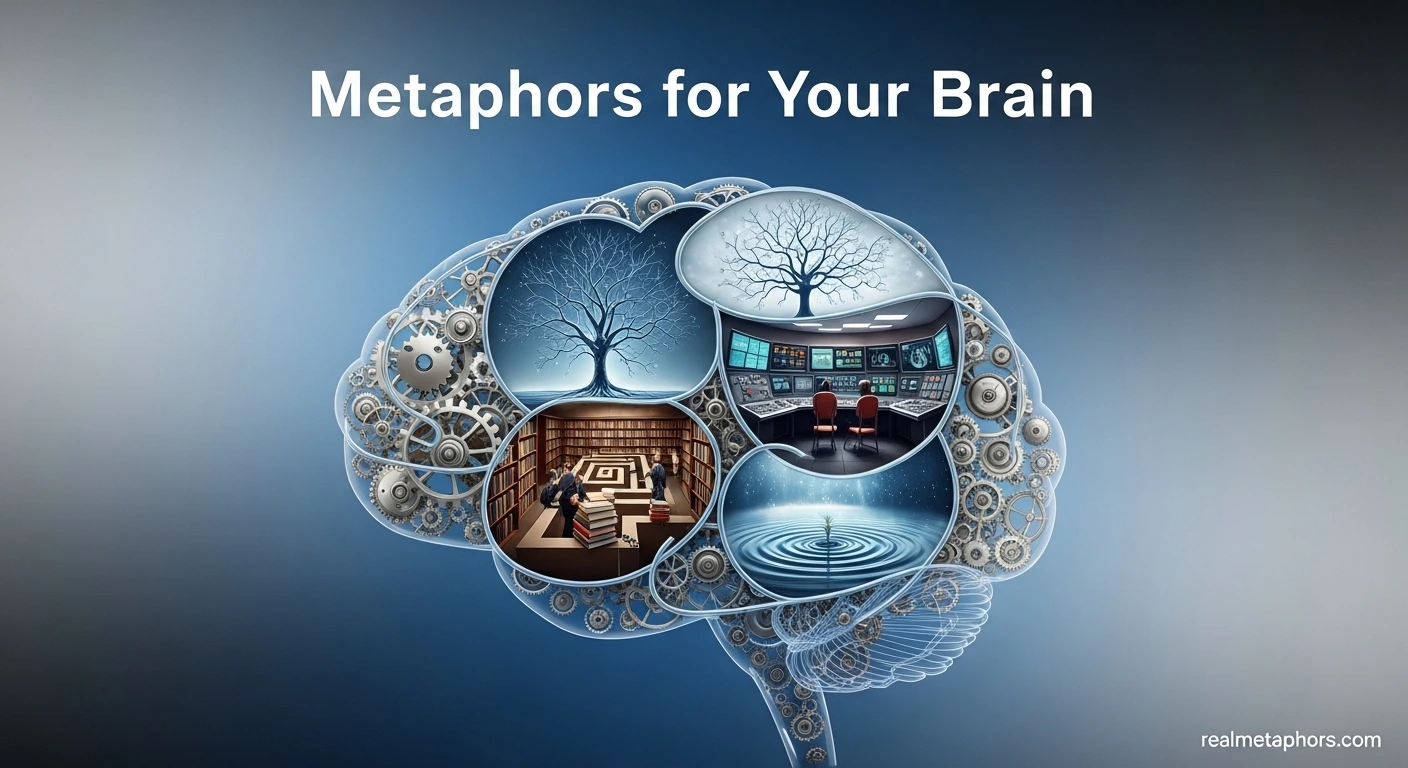
The brain is a world unto itself, a dense forest of thoughts, memories, and ideas. Imagine walking into a library where every book writes itself, or a bustling city where every street is a neuron connecting you to experiences and insights. Our brains are endlessly fascinating, mysterious, and powerful. Yet, to truly grasp how they work, it often helps to see them through metaphors—comparisons that transform the abstract into something tangible, relatable, and even poetic. Using metaphors for the brain not only sparks creativity but also improves understanding, communication, and personal insight.
Here are 25+ powerful metaphors for your brain, each explained with examples, alternative expressions, and sensory or imaginative details to deepen connection.
1. The Brain as a Computer
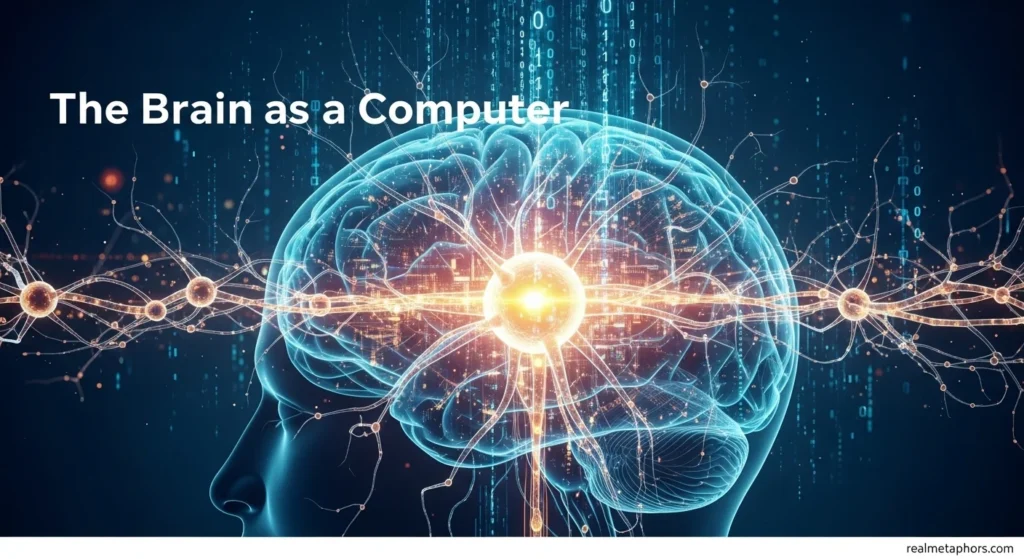
Meaning: The brain processes information, stores data, and executes decisions like a sophisticated computer. Example: “After studying all night, her brain felt like a computer running too many programs at once.” Alternative Expression: Neural network, CPU of consciousness.
Sensory Detail: Overheating, buzzing, or slow-loading evoke fatigue or cognitive overload.
2. The Brain as a Garden
Meaning: Thoughts and ideas grow like plants; some bloom while others are weeds.
Example: “He tended his mind like a garden, weeding out negativity and planting seeds of curiosity.” Creative Expansion: Pruning old beliefs, cultivating creativity.
Imagery: Rich soil, sunlight on leaves, fresh growth—evokes mindfulness.
3. The Brain as a Muscle
Meaning: Mental capacity strengthens with use, challenges, and exercise.
Example: “Solving puzzles regularly made her brain feel like a well-trained muscle.”
Alternative Expression: Mental gym, cognitive strength.
Sensory Detail: Feeling of soreness after learning—a sign of growth.
4. The Brain as a Library
Meaning: A repository of knowledge, memories, and stories.
Example: “His brain was a library of childhood tales, each shelf dusty but treasured.”
Alternative Expression: Archive of experiences, memory vault.
Imagery: Whispering books, flickering lanterns, and endless corridors.
5. The Brain as a Storm
Meaning: Ideas can surge unpredictably, sometimes chaotic and intense.
Example: “During brainstorming, her brain became a storm of lightning-fast thoughts.”
Creative Expansion: Calm after the storm, storms of inspiration.
Sensory Detail: Thunderous thoughts, flashes of insight, wind whipping through neurons.
6. The Brain as a City

Meaning: Neurons are streets and highways, constantly buzzing with activity.
Example: “Every idea traveled through his brain city like cars on a midnight freeway.”
Alternative Expression: Urban sprawl of thought, mental metropolis.
Imagery: Neon lights, traffic jams (overthinking), open boulevards (clarity).
7. The Brain as a Treasure Chest
Meaning: A storehouse of valuable ideas, memories, and hidden talents.
Example: “She unlocked a treasure chest of forgotten memories while journaling.”
Creative Expansion: Hidden gems of creativity, unlocking wisdom.
Sensory Detail: Glittering gold, antique locks, the thrill of discovery.
8. The Brain as a Puzzle
Meaning: Thoughts and experiences interlock to form complex understanding.
Example: “Solving the problem felt like piecing together a thousand-piece puzzle in his mind.”
Alternative Expression: Mental mosaic, cognitive jigsaw.
Imagery: Frustration and satisfaction of fitting pieces together.
9. The Brain as a River
Meaning: Ideas flow continuously, sometimes calm, sometimes turbulent.
Example: “Her brain was a river of consciousness, carrying ideas downstream.”
Creative Expansion: Rapids of inspiration, tributaries of memory.
Sensory Detail: Flowing water, eddies, and the rush of a waterfall.
10. The Brain as a Laboratory
Meaning: Constant experimentation and testing of ideas.
Example: “He treated his thoughts like chemicals in a laboratory, mixing possibilities.”
Alternative Expression: Mind as a workshop, mental experimentation chamber.
Imagery: Beakers bubbling with insight, sparks flying in imagination.
11. The Brain as a Spider Web
Meaning: Connections form intricate networks of understanding.
Example: “Her memories were like a spider web, delicate yet resilient.”
Creative Expansion: Tangled thoughts, catching ideas like insects.
Sensory Detail: Silken threads, sticky intersections, delicate patterns.
12. The Brain as a Lighthouse
Meaning: It guides decisions and illuminates paths through uncertainty.
Example: “Even in stress, his brain was a lighthouse, showing him a safe route.”
Alternative Expression: Beacon of reason, guiding light of consciousness.
Imagery: Bright light cutting through fog, steady beam amidst darkness.
13. The Brain as a Machine
Meaning: Efficient, precise, and sometimes mechanical in thought processing.
Example: “Her brain was a finely tuned machine, solving problems systematically.”
Alternative Expression: Cognitive engine, thought processor.
Sensory Detail: Gears turning, rhythmic humming, clicking switches.
14. The Brain as a Kaleidoscope
Meaning: Thoughts and perspectives shift, creating constantly changing patterns.
Example: “Looking at the issue again, his brain was a kaleidoscope of possibilities.”
Creative Expansion: Shards of perception, colorful mental patterns.
Imagery: Twisting mirrors, sparkling shapes, kaleidoscopic shifts.
15. The Brain as a Garden of Fireflies
Meaning: Ideas flicker and illuminate sporadically, moment by moment.
Example: “In the quiet night, her brain lit up like a garden of fireflies with tiny ideas.”
Alternative Expression: Sparks of genius, dancing neurons.
Sensory Detail: Gentle glow, night air, fleeting sparks of insight.
16. The Brain as a Computer Virus Scanner
Meaning: It filters harmful thoughts and unwanted distractions.
Example: “Meditation made his brain a virus scanner, removing toxic ideas.”
Creative Expansion: Mental antivirus, cleaning the mind’s hard drive.
Imagery: Flashing alerts, scanning progress bars, digital cleansing.
17. The Brain as a Constellation
Meaning: Memories and ideas connect like stars forming patterns.
Example: “Each thought was a star, and his brain a constellation of creativity.”
Alternative Expression: Cosmic network, starry mental map.
Sensory Detail: Twinkling points of light, infinite night sky.
18. The Brain as a Theater
Meaning: It stages emotions, ideas, and memories for conscious awareness.
Example: “His mind was a theater, replaying childhood dramas on the mental stage.”
Creative Expansion: Curtains of consciousness, spotlight of focus.
Imagery: Red velvet seats, dramatic lighting, echoing applause.
19. The Brain as a Compass
Meaning: It provides direction in decision-making and life navigation.
Example: “Even in confusion, her brain acted like a compass, pointing her true north.”
Alternative Expression: Internal guide, moral GPS.
Imagery: Needle trembling, magnetic pull, steady orientation.
20. The Brain as a Camera Lens
Meaning: Focuses attention, captures moments, and filters perception.
Example: “He zoomed in on the details, his brain a camera lens capturing the essence.”
Creative Expansion: Adjusting focus, mental snapshots, aperture of attention.
Sensory Detail: Click of a shutter, depth of field, vivid colors.
21. The Brain as a Volcano
Meaning: Emotions or ideas can erupt suddenly and powerfully.
Example: “Anger boiled until his brain erupted like a volcano.”
Alternative Expression: Lava of thought, molten emotions.
Imagery: Glowing magma, rumbling tremors, explosive energy.
22. The Brain as a Network of Roads
Meaning: Ideas travel like cars along neural pathways.
Example: “Memory recall was like driving on an intricate network of roads in his brain.”
Creative Expansion: Highway of thoughts, traffic jam of overthinking.
Imagery: Intersections, detours, scenic mental routes.
23. The Brain as a Symphony
Meaning: Thoughts and feelings harmonize or clash like musical instruments.
Example: “Her ideas blended like a symphony, each note resonating perfectly.”
Alternative Expression: Orchestra of consciousness, melodic cognition.
Sensory Detail: Crescendos of inspiration, gentle harmonies, dissonance.
24. The Brain as a Vault
Meaning: Protects memories, secrets, and personal knowledge.
Example: “He opened the vault of his brain, revealing hidden memories of childhood.”
Creative Expansion: Locked safes of thought, treasure chambers.
Imagery: Heavy doors, golden locks, secret passages.
25. The Brain as a Magic Box
Meaning: Capable of creating unexpected ideas, solutions, or dreams.
Example: “Her brain was a magic box, producing brilliant ideas out of nowhere.”
Alternative Expression: Mental wonder box, imagination factory.
Sensory Detail: Sparkling light, surprise, and delight with each idea.
26. The Brain as a Network of Rivers and Lakes
Meaning: Flowing and storing knowledge, connecting ideas in natural pathways.
Example: “His thoughts moved through rivers and pooled in lakes of memory.”
Imagery: Calm lakes of reflection, winding streams of curiosity, waterfalls of inspiration.
Reader Engagement: Exercises to Spark Metaphorical Thinking
- Mind Mapping: Draw your brain as a metaphor (garden, city, river, etc.) and map out how thoughts flow.
- Metaphor Journaling: Each day, write one thought using a metaphor for your brain. Example: “Today, my brain is a kite, soaring in windy ideas.”
- Story Challenge: Create a short story where the protagonist’s brain is an object or place (e.g., a theater or volcano) and show how it affects their day.
- Social Media Caption Exercise: Describe a feeling, idea, or memory using a brain metaphor creatively for Instagram or Twitter.
Bonus Tips:
- Use metaphors to explain abstract ideas in teaching or writing.
- Enhance personal creativity by visualizing your thoughts as tangible objects.
- Experiment with combining metaphors for layered meanings (“My brain is both a garden and a storm”).
Conclusion
Metaphors for the brain are not just literary tools—they are keys to understanding, expressing, and exploring the mind. They allow us to capture complexity, spark imagination, and communicate ideas in relatable ways. Whether you see your brain as a garden, a storm, or a library, these images deepen your connection to yourself and others. Embrace metaphors to fuel creativity, clarity, and cognitive exploration.
FAQs
1. What does it mean to use a metaphor for the brain?
Using a metaphor compares the brain to something else (like a garden or computer) to simplify or enrich understanding of its functions, processes, and emotions.
2. Why are metaphors useful for understanding the brain?
Metaphors make abstract concepts tangible, spark creativity, and improve communication by linking familiar images to complex mental processes.
3. How can metaphors improve creativity?
Metaphors encourage seeing connections between unrelated ideas, stimulate imagination, and help generate original perspectives in writing, art, and problem-solving.
4. Can anyone create effective metaphors for the brain?
Yes! Start by observing your own thoughts and feelings, then connect them to familiar objects, places, or phenomena. Practice strengthens skill.
5. What are common mistakes when creating brain metaphors?
Overcomplicating metaphors, mixing too many ideas, or using unclear references can confuse readers. Keep metaphors relatable and clear.
6. How can I use brain metaphors in daily life?
Use them in storytelling, journaling, teaching, social media captions, or simply to explain how you think or feel to others.
7. Do metaphors help with memory?
Yes. Visualizing the brain through metaphors (like a library or network of rivers) can make information easier to remember and retrieve.
8. How do metaphors connect to personal growth?
Metaphors encourage reflection, self-awareness, and a playful approach to thinking, helping you understand and reshape your mental habits creatively.