
Imagine waking up one morning and feeling like the sun forgot your house.
Outside, people are laughing. Cars are moving. Birds are singing. But inside, everything feels heavy and gray. You try to get out of bed, but it’s like your body is glued to the mattress. You can’t explain it. Nothing “big” happened. Yet everything feels hard.
That feeling is often called depression.
Depression is more than sadness. It can feel like emptiness, tiredness, hopelessness, or numbness. Sometimes it’s loud and painful. Other times it’s quiet and dull.
Because depression can be hard to explain, people often use metaphors. A metaphor compares one thing to another to make it easier to understand. Instead of saying “I feel depressed,” someone might say, “I feel like I’m carrying a heavy backpack full of bricks.”
In this article, you’ll discover 25+ easy metaphors for depression, along with meanings, examples, and creative ways to use them.
1. Depression Is a Dark Cloud
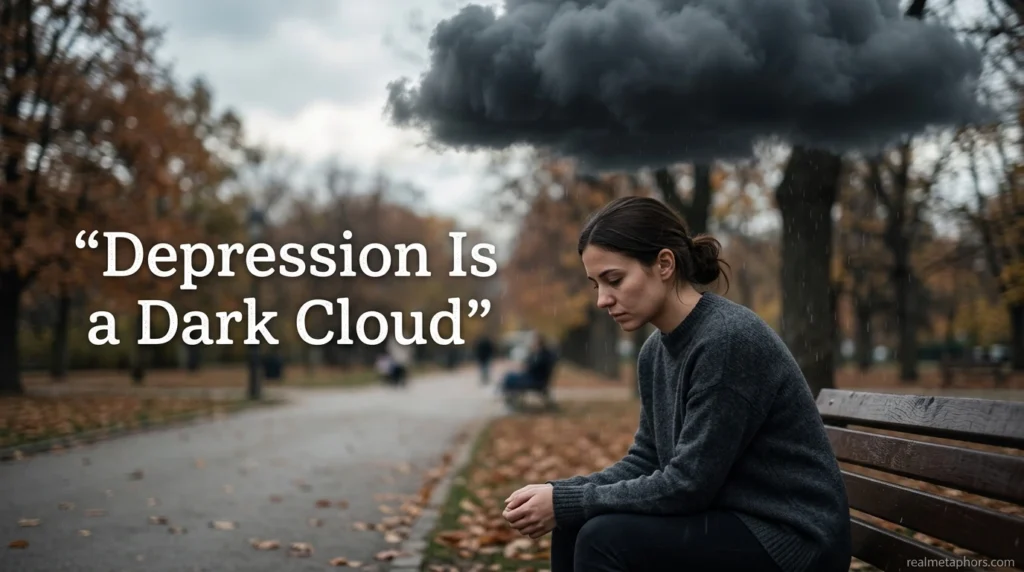
What it means: Depression feels like a cloud blocking the sun. It makes everything seem gloomy.
Example sentence: “A dark cloud has been hanging over me all week.”
Another way to say it: “I feel overshadowed by sadness.”
Imagine this: Even on a sunny day, the light doesn’t reach you. The world looks gray.
2. Depression Is a Heavy Backpack
What it means: It feels like carrying extra emotional weight everywhere.
Example: “Every small task feels like I’m climbing stairs with a heavy backpack.”
Another way: “I feel weighed down.”
Small detail: The straps dig into your shoulders, even when you’re standing still.
3. Depression Is a Deep Hole
What it means: You feel stuck and far from everyone else.
Example: “I feel like I’ve fallen into a deep hole and can’t climb out.”
Another way: “I feel trapped.”
Picture it: The walls are steep. You shout, but your voice echoes back.
4. Depression Is a Storm Inside
What it means: Strong emotions swirl around, even if you look calm outside.
Example: “There’s a storm inside me that won’t calm down.”
Another way: “My emotions feel chaotic.”
Imagine: Thunder in your chest. Lightning in your thoughts.
5. Depression Is Walking Through Mud

What it means: Everything feels slow and exhausting.
Example: “Getting ready for work feels like walking through mud.”
Another way: “I feel drained.”
Detail: Each step sticks. It takes effort just to move forward.
6. Depression Is a Broken Compass
What it means: You feel lost and unsure of direction.
Example: “My life feels like a broken compass—I don’t know where I’m headed.”
Another way: “I feel directionless.”
Picture: The needle spins. North disappears.
7. Depression Is a Locked Room
What it means: You feel isolated and alone.
Example: “It’s like I’m stuck in a locked room while everyone else is outside.”
Another way: “I feel shut off.”
Detail: You can hear laughter outside the door, but you can’t join in.
8. Depression Is an Empty Battery
What it means: You have no energy, even after resting.
Example: “My battery is always at 1%.”
Another way: “I feel completely drained.”
Imagine: The charging cable is plugged in, but nothing happens.
9. Depression Is a Fog
What it means: Your thoughts feel unclear or slow.
Example: “My brain feels wrapped in fog.”
Another way: “I can’t think clearly.”
Detail: You squint, but the path ahead stays blurry.
10. Depression Is a Shadow
What it means: It follows you everywhere.
Example: “Depression is like a shadow I can’t shake.”
Another way: “It’s always there in the background.”
Imagine: Even in bright rooms, the shadow stays.
11. Depression Is a Heavy Blanket
What it means: It presses down and makes it hard to move.
Example: “It feels like a heavy blanket is holding me down.”
Another way: “I feel smothered.”
Detail: You try to push it off, but it doesn’t budge.
12. Depression Is a Black Hole
What it means: It pulls in energy, joy, and motivation.
Example: “It’s like a black hole swallowing my happiness.”
Another way: “My joy disappears.”
Picture: Light goes in, but nothing comes out.
13. Depression Is Drowning Slowly
What it means: You feel overwhelmed and helpless.
Example: “I feel like I’m drowning, but no one sees it.”
Another way: “I’m overwhelmed.”
Detail: You wave quietly, hoping someone notices.
14. Depression Is a Long Winter
What it means: It feels cold, dark, and endless.
Example: “I’ve been stuck in a long winter.”
Another way: “Life feels cold and joyless.”
Imagine: Bare trees. Gray skies. No sign of spring.
15. Depression Is a Cracked Mirror
What it means: You see yourself in a negative or distorted way.
Example: “When I look at myself, it’s like looking into a cracked mirror.”
Another way: “My self-image feels broken.”
Detail: The reflection looks sharp and unfamiliar.
16. Depression Is a Silent Alarm
What it means: Something feels wrong inside, even if others don’t notice.
Example: “It’s like an alarm ringing that no one else can hear.”
Another way: “I feel inner distress.”
Picture: Bright red lights flashing in a quiet room.
17. Depression Is a Broken Record
What it means: Negative thoughts repeat over and over.
Example: “My mind plays the same sad thoughts like a broken record.”
Another way: “I can’t stop overthinking.”
Detail: The needle keeps skipping back.
18. Depression Is an Unseen Weight
What it means: Others can’t see your struggle, but you feel it strongly.
Example: “I carry an unseen weight every day.”
Another way: “My struggle is invisible.”
Imagine: You smile outside but strain inside.
19. Depression Is a Fading Light
What it means: Hope feels dim.
Example: “It feels like my inner light is fading.”
Another way: “I’m losing hope.”
Detail: A candle flickering in a dark room.
20. Depression Is a Maze
What it means: It’s confusing and hard to escape.
Example: “I feel stuck in a maze with no exit.”
Another way: “I don’t see a way out.”
Picture: Tall walls. Dead ends. No map.
21. Depression Is a Slow Leak
What it means: Your energy drains little by little.
Example: “It’s like a slow leak in my motivation.”
Another way: “I’m gradually running out of energy.”
Detail: A tire losing air without you noticing at first.
22. Depression Is a Gray Filter
What it means: Everything looks dull and colorless.
Example: “It feels like someone put a gray filter over my life.”
Another way: “Nothing feels exciting.”
Imagine: Bright flowers turning pale.
23. Depression Is a Cage
What it means: You feel restricted and powerless.
Example: “I feel trapped in a cage of my own thoughts.”
Another way: “I feel mentally stuck.”
Detail: The door seems locked from the inside.
24. Depression Is a Broken Engine
What it means: You want to move forward, but can’t.
Example: “My engine won’t start.”
Another way: “I can’t get going.”
Picture: Turning the key. Silence.
25. Depression Is a Long Night
What it means: It feels dark, but it may not last forever.
Example: “This feels like a very long night.”
Another way: “I’m going through a dark time.”
Detail: Stars hidden behind clouds.
26. Depression Is an Echoing Room
What it means: Your thoughts feel loud and lonely.
Example: “My mind feels like an empty room filled with echoes.”
Another way: “I feel alone with my thoughts.”
Imagine: Each word bouncing back louder.
Fun Exercises and Writing Prompts
1. Fill in the Blank
“Depression feels like ______ because ______.”
Try to use a new image each time.
2. Weather Report Exercise
Write a “weather forecast” for your emotions: “Today’s forecast: 90% chance of emotional fog…”
3. Social Media Challenge
Share a gentle metaphor like: “Today feels like walking through mud—but I’m still walking.”
4. Object Metaphor Game
Pick an everyday object (a clock, a window, a phone). Ask: “If depression were this object, how would it act?”
Tips for Using Metaphors for Depression
- Keep them simple.
- Use images people can see or feel.
- Avoid overcomplicating.
- Match the metaphor to your audience.
- Remember: metaphors explain feelings—they don’t replace professional help.
If you or someone you know is struggling deeply, reaching out to a trusted person or a mental health professional can make a real difference.
FAQs
1. Why use metaphors for depression?
Metaphors make complex emotions easier to explain. They help others understand what words like “sad” cannot fully describe.
2. Can metaphors help in therapy or journaling?
Yes. Many therapists encourage using metaphors to express feelings. It can make emotions clearer and less overwhelming.
3. How do I create my own metaphor?
Ask yourself: “What does this feeling remind me of?” Then compare it using “is” or “like.”
4. Are metaphors always negative?
Not at all. Some metaphors can include hope, like “a long night before sunrise.”
5. What mistakes should I avoid?
Don’t overuse too many metaphors at once. And avoid images that are confusing or unrelated.
6. Can I use these metaphors in stories or social media?
Absolutely. They work well in poems, captions, journals, and personal essays.
7. Do metaphors cure depression?
No. They help express it. Healing often involves support, care, and sometimes professional treatment.
Conclusion
Metaphors for depression help us speak about what often feels unspeakable. They turn invisible pain into visible images. And sometimes, putting a feeling into words is the first small step toward understanding it.