
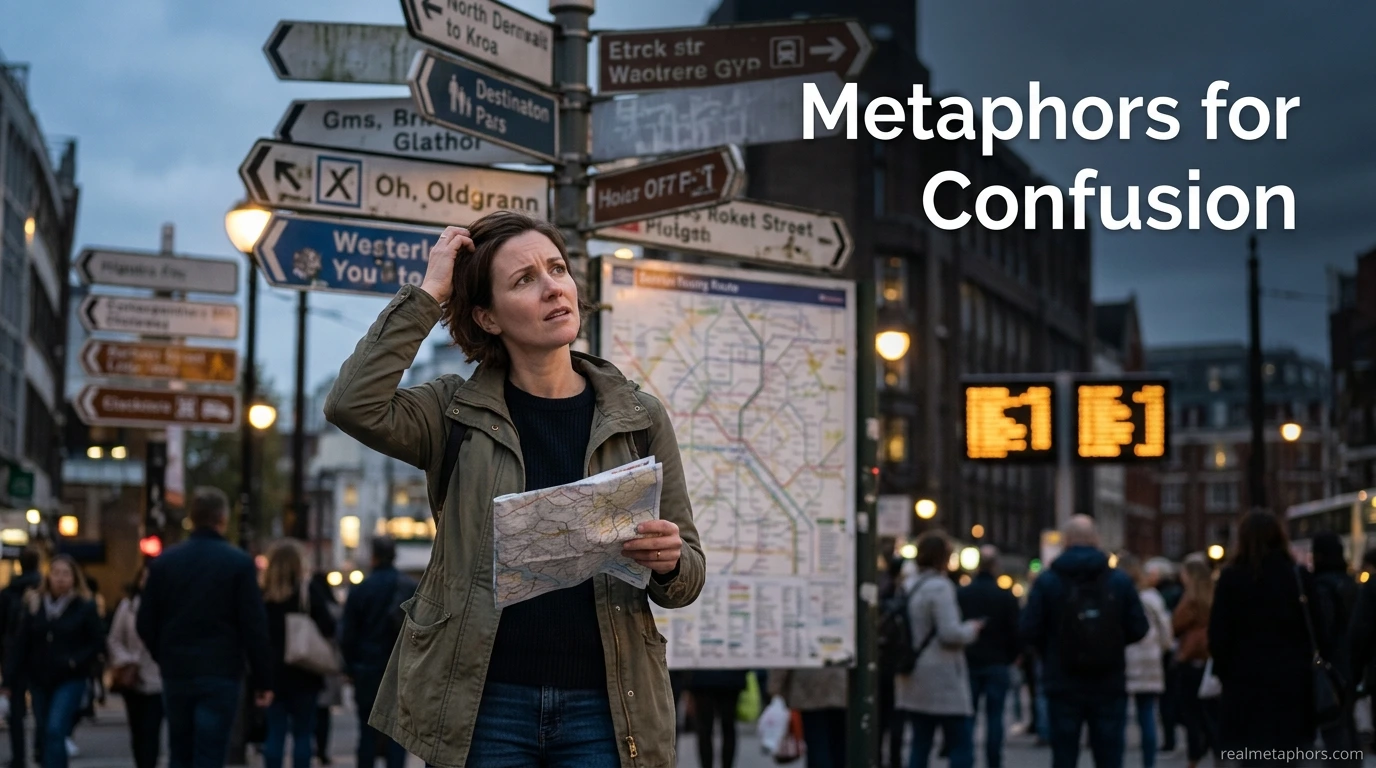
Imagine waking up in a dark room where the lights suddenly go off. You hear voices but cannot see anyone. You try to move forward but bump into something soft and something hard at the same time. Your thoughts feel the same way — mixed, messy, and unclear.
That is confusion.
Confusion is when your mind feels lost, tangled, or unsure. Sometimes you cannot decide, understand, or think clearly. People often use metaphors for confusion to describe this feeling in a more creative and emotional way.
Let’s explore 25+ easy metaphors for confusion that you can use in writing, stories, or daily conversation.
1. A Foggy Mind

Meaning: Your thoughts are unclear, just like seeing through thick fog.
Example: “I tried to study, but my mind was a foggy mind.”
Another way to say it: Clouded thinking, mental mist.
Imagine: Walking in a cold morning where you can barely see the road.
2. A Tangled Web
Meaning: Confusion feels like threads twisted together.
Example: “The story was a tangled web of lies.”
Another way to say it: Knotted thoughts.
Small detail: Like headphones getting twisted inside your pocket.
3. Lost in the Maze
Meaning: Not knowing which direction to choose.
Example: “I felt lost in a maze of problems.”
Another way to say it: Stuck in a mental labyrinth.
Imagine: Walking inside a huge stone maze with many dead ends.
4. Swimming in Circles
Meaning: Trying hard but making no progress.
Example: “My thoughts were swimming in circles.”
Another way to say it: Going nowhere mentally.
Detail: Like a fish trapped in a small bowl.
5. A Broken Compass
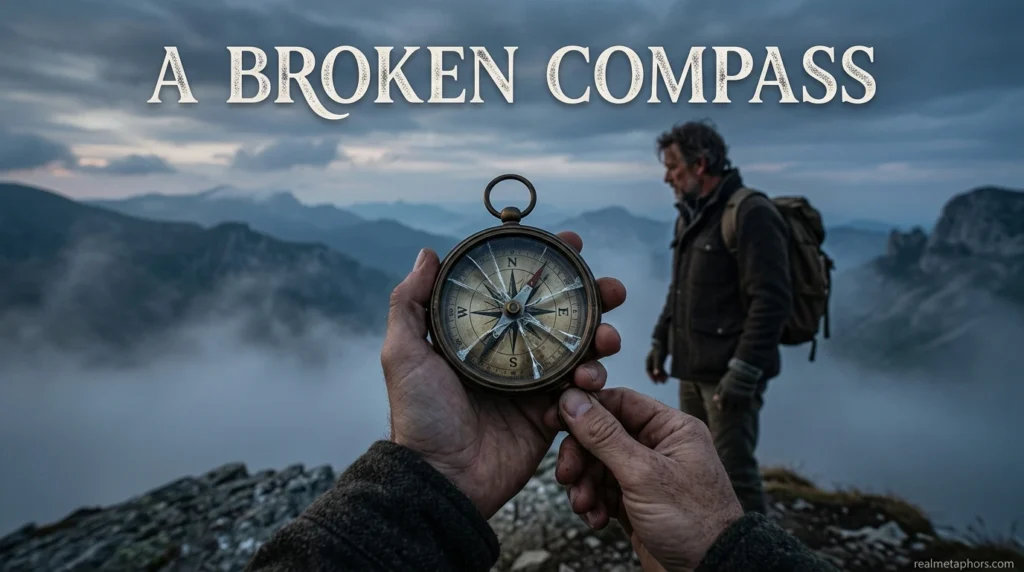
Meaning: You cannot find the right direction.
Example: “Without guidance, I felt like a broken compass.”
Another way to say it: Directionless heart or mind.
Picture: A compass needle spinning randomly.
6. A Jumbled Puzzle
Meaning: Information is mixed and not arranged.
Example: “The instructions were a jumbled puzzle.”
Another way to say it: Mixed-up pieces of thought.
Imagine: Trying to solve a puzzle with missing pieces.
7. Walking in the Dark
Meaning: Not understanding a situation.
Example: “I was walking in the dark about the plan.”
Another way to say it: In the shadows of uncertainty.
Small detail: Like moving slowly without a flashlight.
8. A Storm Inside the Head
Meaning: Confusion mixed with emotional chaos.
Example: “My brain felt like a storm inside my head.”
Another way to say it: Mental thunder and lightning.
Imagine: Waves of thoughts crashing loudly.
9. A Torn Map
Meaning: Missing information causes confusion.
Example: “The plan felt like a torn map.”
Another way to say it: Broken guidance.
Detail: Trying to travel using a map with missing corners.
10. Butterflies in the Brain
Meaning: Nervous, confused, and excited at the same time.
Example: “I had butterflies in my brain before the interview.”
Another way to say it: Mental fluttering.
Imagine: Tiny wings moving inside your head.
11. A Cloud of Questions
Meaning: Too many doubts inside the mind.
Example: “A cloud of questions filled her thoughts.”
Another way to say it: Rainy thinking.
Small detail: Like dark clouds covering the sky.
12. Standing at a Crossroads
Meaning: Having to choose but feeling unsure.
Example: “I was standing at a crossroads in life.”
Another way to say it: Decision paralysis.
Picture: Two or more roads pointing different ways.
13. A Spinning Room
Meaning: Confusion feels dizzy and unstable.
Example: “My ideas were spinning like a room.”
Another way to say it: Mental dizziness.
Imagine: Feeling like the world is turning slowly.
14. A Box of Mixed Toys
Meaning: Ideas are mixed without order.
Example: “The lecture left my mind like a box of mixed toys.”
Another way to say it: Mental clutter.
Detail: Like children’s toys after playtime.
15. Walking on Shifting Sand
Meaning: No mental stability.
Example: “My understanding felt like shifting sand.”
Another way to say it: Unsteady thinking ground.
Picture: Sand moving under your feet.
16. A Locked Door Without a Key
Meaning: You cannot understand or access information.
Example: “The meaning was a locked door.”
Another way to say it: Mental blockage.
Small detail: Standing outside while answers stay inside.
17. A Broken Radio Signal
Meaning: Information comes but is unclear.
Example: “The explanation was like a broken radio.”
Another way to say it: Distorted message.
Imagine: Noise mixing with speech.
18. Fogged Glasses
Meaning: You cannot see clearly.
Example: “I tried to focus, but it was like fogged glasses.”
Another way to say it: Blurred understanding.
Detail: Warm breath on cold glasses.
19. A Swarm of Thoughts
Meaning: Many thoughts moving quickly.
Example: “A swarm of thoughts attacked me before sleep.”
Another way to say it: Buzzing mind.
Picture: Like bees flying everywhere.
20. A Maze Inside the Skull
Meaning: Very deep confusion.
Example: “The problem built a maze inside my skull.”
Another way to say it: Inner mental labyrinth.
Small detail: Endless twisting corridors.
21. Pages Written in Invisible Ink
Meaning: Meaning is hidden.
Example: “The instructions felt like invisible ink.”
Another way to say it: Hidden message.
Imagine: Trying to read blank paper.
22. A Knotted Rope of Ideas
Meaning: Thoughts are tangled and hard to separate.
Example: “My plan was a knotted rope.”
Another way to say it: Mental knots.
Detail: Pulling one end makes the knot tighter.
23. Walking on Broken Bridges
Meaning: Fear and uncertainty together.
Example: “Trusting him felt like walking on broken bridges.”
Another way to say it: Risky thinking path.
Picture: A bridge with missing planks.
24. A Storm of Mixed Voices
Meaning: Too much conflicting information.
Example: “The advice was a storm of mixed voices.”
Another way to say it: Noise of opinions.
Small detail: Everyone talking at once.
25. A Shattered Mirror of Thoughts
Meaning: Thinking is broken into many pieces.
Example: “After the news, my mind felt like a shattered mirror.”
Another way to say it: Fragmented thinking.
Imagine: Seeing yourself in many broken reflections.
26. A Floating Leaf in the Wind
Meaning: No control over direction.
Example: “I felt like a floating leaf in the wind.”
Another way to say it: Carried by confusion.
Detail: Moving wherever the air pushes.
Fun Exercises to Practice Metaphors for Confusion
Try these simple challenges:
- Write a sentence using “foggy mind” about school or work.
- Describe confusion as an animal. What animal would it be? Why?
- Imagine confusion as weather and write a short 3-line story.
- Create your own metaphor using “maze,” “cloud,” or “storm.”
- Explain a confusing day using only one metaphor.
Tips for Using Confusion Metaphors
- Use simple images readers can imagine.
- Match the metaphor with the emotion of the story.
- Don’t overuse too many metaphors in one paragraph.
- Use metaphors in social media captions to express feelings.
- Combine confusion metaphors with feelings like fear, surprise, or curiosity.
FAQs
1. What is a metaphor for confusion?
It is a comparison that describes confusion using a different but related image.
2. Why are metaphors useful in writing?
They make emotions clearer, more interesting, and easier to imagine.
3. How do I create my own confusion metaphor?
Think about how confusion feels, then compare it with nature, objects, or actions.
4. What are common mistakes when using metaphors?
Using too many metaphors together or choosing images that are hard to understand.
5. Can metaphors help in daily communication?
Yes. They help express feelings in a creative and simple way.
6. Are confusion metaphors used in poetry?
Yes. Many poets use them to show emotional or mental uncertainty.
7. How can I improve my metaphor writing?
Read more examples, practice daily, and use familiar images.
Final Thought
Confusion is a natural part of life. Sometimes our minds feel foggy, tangled, or lost in a maze. Using metaphors helps us express this feeling in a beautiful and simple way. Try using these metaphors in stories, chats, or personal writing.