
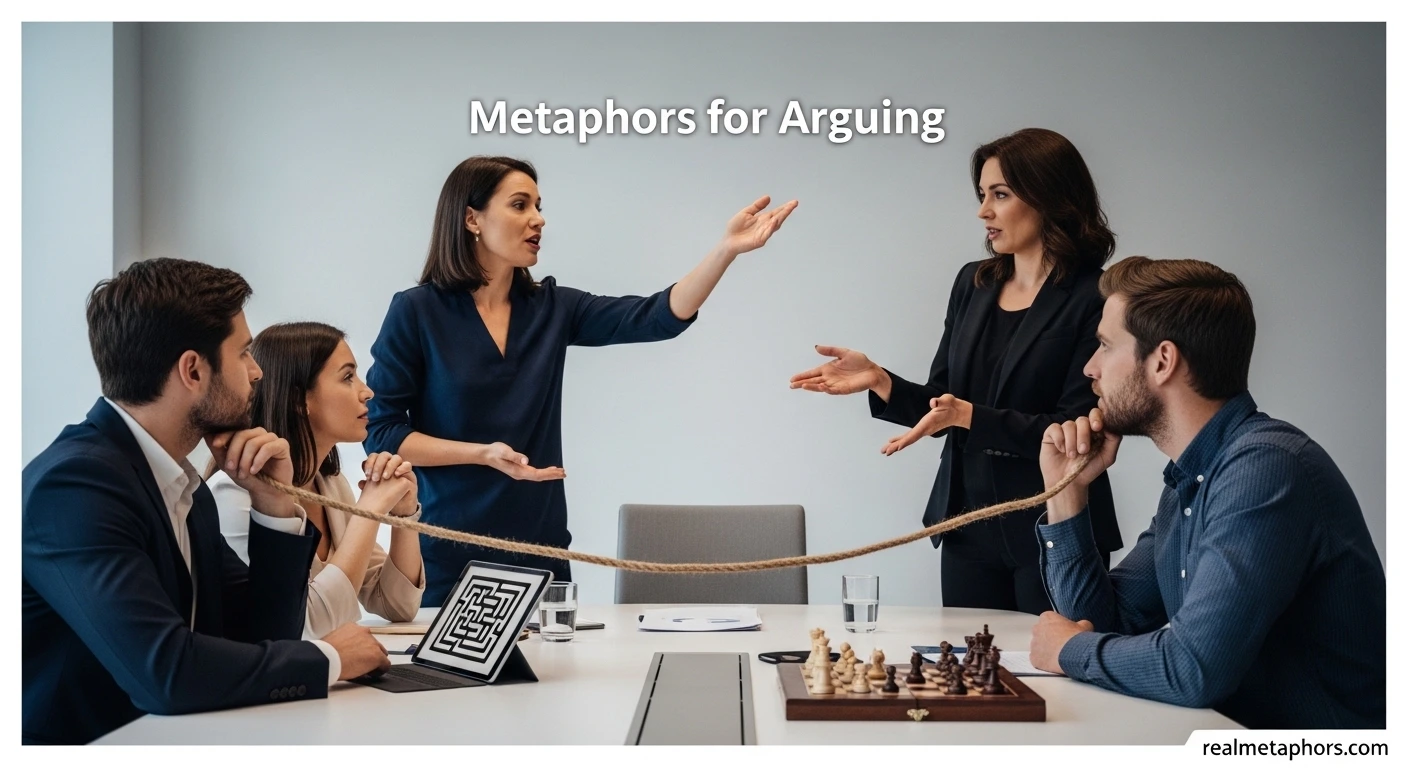
You know that electric tingle in the air when two friends clash over something trivial, yet suddenly, it feels monumental? Or the sudden chill when someone sharply disagrees with your opinion at the dinner table? That’s arguing—the age-old human dance of conflicting ideas. But what if we could see arguments not just as clashes or confrontations, but as vivid, imaginative experiences through metaphors?
Metaphors transform abstract experiences into tangible, relatable imagery. By understanding arguing through metaphors, we don’t just describe conflict—we feel it, explore it, and even navigate it more creatively. They illuminate the mechanics of persuasion, the emotional weight of disagreements, and the drama of debate, helping us communicate with flair and insight.
Here’s a journey through 25+ metaphors for arguing, each designed to deepen your understanding and ignite your creative spark.
1. Arguing as a Chess Game
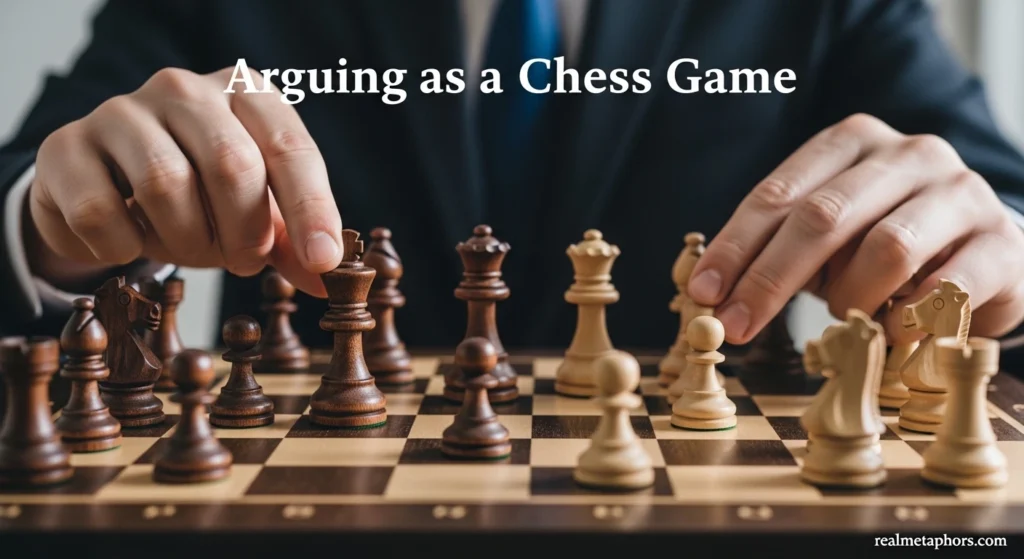
Meaning: Strategic, calculated, with moves and counter-moves.
Example: “Their discussion felt like a chess game; every statement was a calculated move aiming to checkmate the other.”
Creative expansion: Visualize arguments as opening gambits, midgame maneuvers, and inevitable endgames.
Sensory/emotional detail: Tension like the quiet before a critical chess move.
2. Arguing as a Storm
Meaning: Emotional, intense, and sometimes destructive.
Example: “The argument erupted like a summer storm, drenching everyone in heated words.”
Creative expansion: Add lightning flashes for sharp retorts or rolling thunder for deep tension.
Emotional detail: Feeling powerless under the gusts of someone’s anger.
3. Arguing as a Tug-of-War
Meaning: A struggle for dominance, control, or agreement.
Example: “It was a tug-of-war over the project’s direction, each side pulling with all its strength.”
Creative expansion: Emphasize the rope fraying under pressure, representing strained relationships.
Sensory detail: The strain in your arms mirrors the strain in your mind.
4. Arguing as a Dance
Meaning: A rhythmic exchange, sometimes harmonious, sometimes awkward.
Example: “Their debate was like a waltz; missteps caused momentary imbalance, but rhythm persisted.” Creative expansion: Include fast-paced jigs for heated debates or slow tangos for tense negotiations. Emotional detail: Feel the push-and-pull of ego and understanding.
5. Arguing as a Battlefield
Meaning: Combat, tactics, and defending territory.
Example: “The discussion became a battlefield where words were swords and logic was armor.”
Creative expansion: Include trenches for stubborn positions and flags of surrender.
Sensory detail: The clash of ideas echoing like marching boots.
6. Arguing as a Volcano
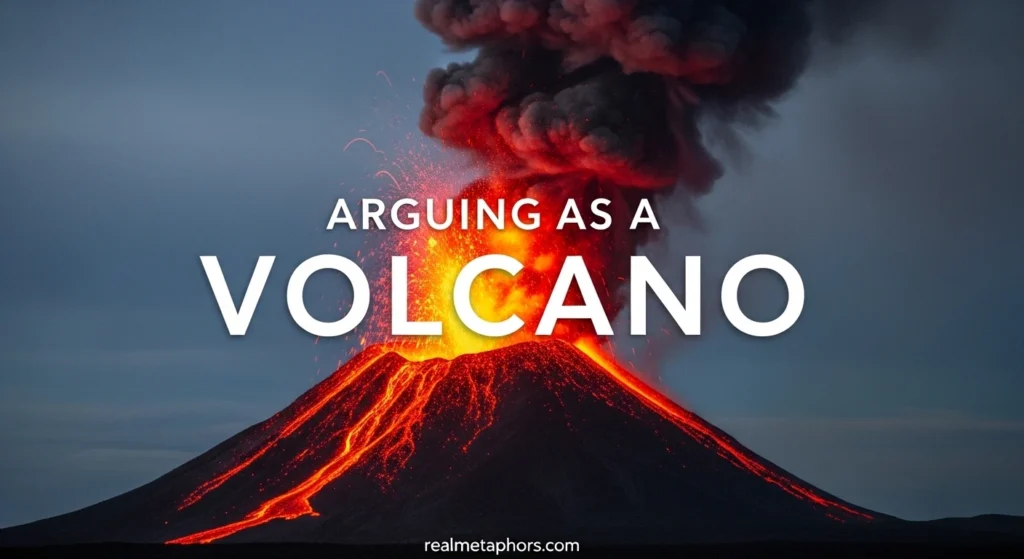
Meaning: A slow buildup leading to an explosive outburst.
Example: “Months of frustration finally erupted like lava from a volcano.”
Creative expansion: Smoke for simmering tension, molten lava for heated accusations.
Emotional detail: Watching emotions spill uncontrollably, both frightening and mesmerizing.
7. Arguing as a Tug-of-War Between Light and Shadow
Meaning: Moral or ethical debate; right vs. wrong.
Example: “Their ethical debate was a tug-of-war between light and shadow, with neither side yielding.” Creative expansion: Add shades of gray to show compromise or ambiguity.
Sensory detail: Shadows creeping over bright ideas.
8. Arguing as a Fire
Meaning: Passionate, consuming, and potentially transformative.
Example: “The discussion ignited like dry kindling, flames spreading from one word to the next.”
Creative expansion: Sparks for quick insults, embers for lingering grudges.
Sensory detail: Heat licking your skin as words ignite tension.
9. Arguing as a River Rapids
Meaning: Fast, chaotic, and unstoppable flow of ideas.
Example: “Their argument rushed like river rapids, ideas tumbling over one another.”
Creative expansion: Include rocks for obstacles and eddies for moments of reflection.
Sensory detail: The sound of roaring water mirrors escalating voices.
10. Arguing as a Tug-of-War Over a Throne
Meaning: Struggle for authority, influence, or dominance.
Example: “It was a tug-of-war over the throne of decision-making in the office.”
Creative expansion: Thrones, crowns, and scepters can symbolize power dynamics.
Emotional detail: Desire and pride clashing visibly.
11. Arguing as a Duel
Meaning: One-on-one confrontation, quick and decisive.
Example: “Their debate was a duel; each word a precise strike aimed to wound.”
Creative expansion: Swords, pistols, or fencing foils as verbal instruments.
Sensory detail: The sharpness of language like steel against steel.
12. Arguing as a Puzzle
Meaning: Trying to fit pieces together or uncover hidden truths.
Example: “Each person tried to place their ideas into the puzzle of understanding.”
Creative expansion: Missing pieces represent incomplete arguments or hidden knowledge.
Emotional detail: Satisfaction in finally aligning the pieces.
13. Arguing as a Tug-of-War in Fog
Meaning: Confusion, miscommunication, and obscured intentions.
Example: “The debate felt like a tug-of-war in dense fog, each pull uncertain and blind.”
Creative expansion: Mist can thicken, making even simple points hard to see.
Sensory detail: Cold dampness creeping through the conversation.
14. Arguing as a Volcano Under Ice
Meaning: Hidden anger or tension that might erupt unexpectedly.
Example: “She had been quiet for months, but her argument came like a volcano under ice.”
Creative expansion: Ice cracking as tempers rise.
Emotional detail: Surprising force from a seemingly calm person.
15. Arguing as a Tug-of-War Between Two Titans
Meaning: Epic clash of egos or intellects.
Example: “It was a tug-of-war between two titans of logic, neither giving an inch.”
Creative expansion: Visualize giants straining against each other with cosmic energy.
Sensory detail: The ground trembles under the weight of disagreement.
16. Arguing as a Web of Lies and Truth
Meaning: Complicated, entangled, sometimes deceptive.
Example: “Their discussion spun a web of lies and truth, each thread connecting in unpredictable ways.” Creative expansion: Insects caught in the web symbolize manipulated perspectives.
Sensory detail: Sticky tension that traps participants in complexity.
17. Arguing as a Tug-of-War With Words
Meaning: Struggle over language, phrasing, or interpretation.
Example: “They engaged in a tug-of-war with words, twisting meanings to gain advantage.”
Creative expansion: Strings of letters snapping or weaving tighter.
Sensory detail: The sting of a sharp retort.
18. Arguing as a Forest Fire
Meaning: Rapidly spreading conflict affecting everyone around.
Example: “Their fight started over a comment but spread like a forest fire through the team.”
Creative expansion: Smoke represents misunderstandings; ash represents residual resentment.
Sensory detail: Smell of burning, fear of destruction.
19. Arguing as a Tightrope Walk
Meaning: Balanced negotiation, careful steps to avoid disaster.
Example: “He navigated the disagreement like a tightrope walker, each word carefully chosen.”
Creative expansion: Wind represents outside pressures; balance poles symbolize careful reasoning.
Sensory detail: Heart racing, arms stretched for equilibrium.
20. Arguing as a Tug-of-War With Time
Meaning: Disagreement that persists, prolonged conflict.
Example: “The debate dragged on, a tug-of-war with time itself.”
Creative expansion: Clocks ticking aggressively, deadlines pressing.
Emotional detail: Fatigue and frustration as minutes turn to hours.
21. Arguing as a Volcano of Words
Meaning: A sudden eruption of verbal intensity.
Example: “When he finally spoke, it was a volcano of words, unstoppable and forceful.”
Creative expansion: Magma representing unspoken resentment.
Sensory detail: Heat, pressure, and unstoppable flow.
22. Arguing as a Tug-of-War Over the Truth
Meaning: A struggle to establish reality or facts.
Example: “They were in a tug-of-war over the truth, each pulling toward their perspective.”
Creative expansion: Facts as weights on each side; credibility as leverage.
Sensory detail: Mental strain and emotional frustration.
23. Arguing as a Storm at Sea
Meaning: Turbulent emotions in a relationship or negotiation.
Example: “Their conversation churned like a storm at sea, waves of frustration crashing.”
Creative expansion: Ships navigating through waves represent careful diplomacy.
Sensory detail: Salty spray stinging, wind tearing at sails.
24. Arguing as a Tug-of-War With Shadows
Meaning: Internal conflict projected outward.
Example: “She argued not just with him, but with her own shadow of doubt.”
Creative expansion: Shadows growing larger, pulling in multiple directions.
Emotional detail: Introspection, guilt, or unresolved tension.
25. Arguing as a Tug-of-War With Fire
Meaning: Dangerous conflict that can cause damage.
Example: “Their debate was a tug-of-war with fire, exhilarating but potentially harmful.”
Creative expansion: Sparks for small provocations; flames for full-blown confrontation.
Sensory detail: Smoke stinging eyes, adrenaline coursing through veins.
26. Arguing as a Tug-of-War With Gravity
Meaning: The weight of stubbornness or inevitability dragging down progress.
Example: “Every attempt to resolve the issue felt like a tug-of-war with gravity itself.”
Creative expansion: Visualize heavy weights pulling ideas down.
Emotional detail: Frustration and exhaustion under the invisible force.
Reader Engagement: Exercises & Prompts
- Metaphor Mapping: Take a recent argument you had. Write 3 metaphors that describe it and explain why.
- Creative Expansion: Pick one metaphor from above and write a short story around it.
- Sensory Layering: Describe an argument using at least 3 senses—sight, sound, touch.
- Social Media Challenge: Post a metaphorical description of a debate without naming it. Ask followers to guess the scenario.
- Daily Reflection: Journal arguments as metaphors for one week to uncover emotional patterns.
Bonus Tips:
- Use metaphors in storytelling to heighten tension or emotion.
- Sprinkle them in content writing or social media captions to engage readers creatively.
- Practice with friends—describe disagreements metaphorically instead of literally.
FAQs
What does “arguing” really mean?
Arguing is a verbal or cognitive exchange of differing viewpoints. It can range from friendly debate to heated conflict, depending on context and emotional involvement.
Why use metaphors to describe arguing?
Metaphors provide vivid, relatable ways to understand abstract or emotional experiences. They make arguments more memorable and highlight dynamics, emotions, and stakes.
How can metaphors improve communication?
Metaphors clarify complex ideas, evoke emotion, and create shared understanding. They can soften conflict or make your point more compelling.
What are tips for creating effective metaphors?
Think visually and emotionally. Compare the abstract concept to something tangible, dynamic, and familiar. Layer sensory details for added impact.
What are common mistakes to avoid with metaphors?
Avoid clichés, mixing incompatible images, or making metaphors overly complicated. Keep them clear, relevant, and emotionally resonant.
How can I use metaphors for arguing in daily life?
Use them to describe disagreements creatively in conversations, storytelling, journaling, teaching, or writing content. They can make your ideas more vivid and persuasive.
Can metaphors help in conflict resolution?
Yes! By framing arguments metaphorically, you can gain perspective, reduce tension, and explore solutions in imaginative ways.
Conclusion
Metaphors transform the dry mechanics of arguing into living, breathing narratives. Whether a storm, a dance, or a volcanic eruption, every metaphor invites you to step inside the argument, feel its energy, and understand its nuances. The next time you face a clash of ideas, try seeing it through metaphorical eyes—you might just discover a new path to resolution, creativity, and insight.