Ali stood at the bottom of a steep hill, staring at the road that twisted upward. His backpack felt heavy. His legs already ached. For a moment, he thought about turning back. But then he took one step. Then another.
Life’s challenges are like that hill. They look big. They feel heavy. he test our strength. But step by step, we move forward.
A challenge is something difficult that requires effort, courage, or skill. It can be a tough exam, a new job, a broken relationship, or even learning to speak in public. Metaphors for challenges help us understand these hard moments in simple, powerful ways. They turn abstract struggles into images we can see and feel.
Let’s explore 25+ easy metaphors for challenges you can use in writing, speaking, and everyday life.
1. A Mountain to Climb

Meaning: A big, difficult task that requires time and effort.
Example: “Starting my own business felt like climbing a mountain.”
Another Way to Say It: A steep hill to conquer.
Imagine This: Cold wind, rocky paths, slow progress—but a beautiful view at the top.
2. A Storm to Weather
Meaning: A temporary but intense difficulty.
Example: “We just need to weather this financial storm.”
Another Way to Say It: Ride out the storm.
Imagine This: Dark clouds, heavy rain, but knowing the sun will return.
3. A Rocky Road
Meaning: A journey full of problems.
Example: “Their relationship has been a rocky road.”
Another Way to Say It: A bumpy ride.
Imagine This: Walking on uneven stones, stumbling but continuing forward.
4. A Wall in the Way
Meaning: An obstacle blocking progress.
Example: “I hit a wall while writing my book.”
Another Way to Say It: A roadblock.
Imagine This: A tall brick wall standing right in front of you.
5. A Puzzle to Solve
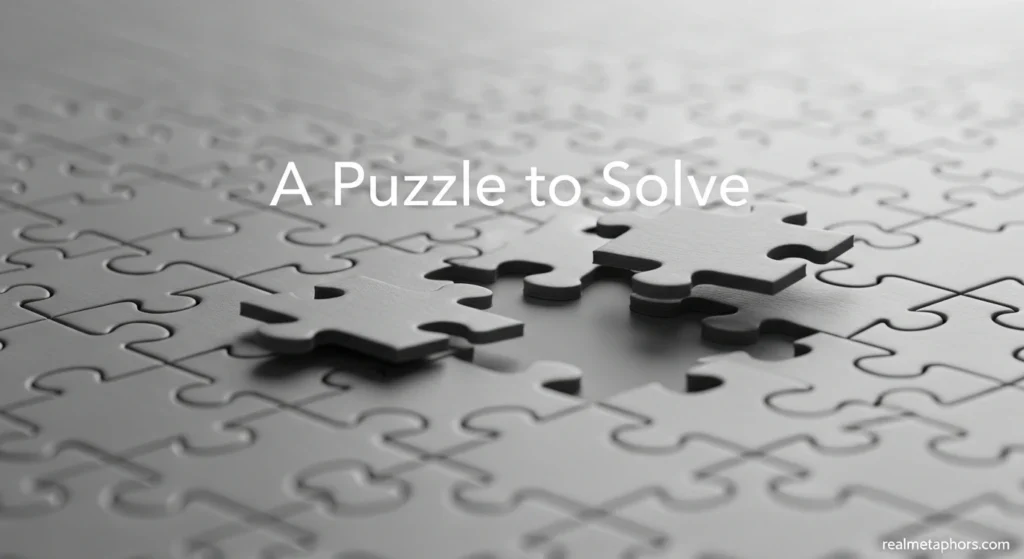
Meaning: A complex problem needing careful thought.
Example: “Managing time is a puzzle I’m still solving.”
Another Way to Say It: A brain teaser.
Imagine This: Scattered pieces slowly forming a clear picture.
6. A Battlefield
Meaning: A situation requiring courage and strength.
Example: “The courtroom became a battlefield.”
Another Way to Say It: A fight to win.
Imagine This: Loud noise, pressure, and the need for bravery.
7. A Tightrope Walk
Meaning: A risky or delicate situation.
Example: “Balancing work and family is a tightrope walk.”
Another Way to Say It: Walking a fine line.
Imagine This: A rope high above the ground, careful steps, steady breath.
8. A Maze
Meaning: A confusing and complicated problem.
Example: “The paperwork felt like a maze.”
Another Way to Say It: A confusing path.
Imagine This: High walls, wrong turns, and searching for the exit.
9. A Heavy Backpack
Meaning: Emotional or mental burdens.
Example: “Grief is a heavy backpack you carry every day.”
Another Way to Say It: A weight on your shoulders.
Imagine This: Straps digging into your shoulders as you keep walking.
10. A Test of Fire
Meaning: A trial that proves strength or ability.
Example: “His first project was a test of fire.”
Another Way to Say It: A trial by fire.
Imagine This: Intense heat shaping metal into something stronger.
11. A Locked Door
Meaning: An opportunity that seems unreachable.
Example: “College admission felt like a locked door.”
Another Way to Say It: A closed gate.
Imagine This: Searching your pockets for the right key.
12. A Roller Coaster
Meaning: An emotional or unpredictable experience.
Example: “This year has been a roller coaster.”
Another Way to Say It: Ups and downs.
Imagine This: Fast climbs, sudden drops, screaming and laughter.
13. A Thorn in the Side
Meaning: A constant small irritation.
Example: “That minor issue became a thorn in my side.”
Another Way to Say It: A nagging problem.
Imagine This: A tiny thorn stuck in your finger.
14. A Deep Valley
Meaning: A period of sadness or hardship.
Example: “After losing his job, he entered a deep valley.”
Another Way to Say It: A low point.
Imagine This: Shadows between tall mountains.
15. A Steep Learning Curve
Meaning: A fast and difficult learning process.
Example: “Coding has a steep learning curve.”
Another Way to Say It: Hard to master quickly.
Imagine This: A sharp upward line on a graph.
16. A Broken Bridge
Meaning: Lost connection or damaged trust.
Example: “Their friendship became a broken bridge.”
Another Way to Say It: A damaged bond.
Imagine This: A river with no safe way across.
17. A Jungle
Meaning: A chaotic, competitive situation.
Example: “The job market is a jungle.”
Another Way to Say It: Survival of the fittest.
Imagine This: Thick trees, loud sounds, unknown dangers.
18. A Giant Shadow
Meaning: Fear or worry that feels bigger than reality.
Example: “Failure cast a giant shadow over her dreams.”
Another Way to Say It: A looming fear.
Imagine This: A dark shape stretching across the ground.
19. A Knot to Untangle
Meaning: A complicated issue.
Example: “Family conflicts can be a knot to untangle.”
Another Way to Say It: A tangled mess.
Imagine This: Twisted rope slowly straightened.
20. A Fire to Walk Through
Meaning: A painful but necessary experience.
Example: “Healing required walking through fire.”
Another Way to Say It: Endure the heat.
Imagine This: Flames that hurt but don’t destroy.
21. A Race Against Time
Meaning: Urgent pressure to finish quickly.
Example: “It was a race against time to meet the deadline.”
Another Way to Say It: Beat the clock.
Imagine This: A ticking clock echoing loudly.
22. A Blank Page
Meaning: The fear of starting something new.
Example: “The new project was a blank page.”
Another Way to Say It: Starting from scratch.
Imagine This: White paper waiting for your first word.
23. A Cracked Foundation
Meaning: Weak support or unstable beginnings.
Example: “Their business failed due to a cracked foundation.”
Another Way to Say It: Built on shaky ground.
Imagine This: A house slowly tilting.
24. A Dark Tunnel
Meaning: A long, difficult time with hope at the end.
Example: “Depression can feel like a dark tunnel.”
Another Way to Say It: A hard phase.
Imagine This: Walking toward a small light far ahead.
25. A Climbing Ladder
Meaning: Slow, step-by-step progress.
Example: “Career growth is like climbing a ladder.”
Another Way to Say It: Moving up step by step.
Imagine This: Careful hands gripping each rung.
26. A Game of Chess
Meaning: A challenge requiring strategy.
Example: “Negotiation is a game of chess.”
Another Way to Say It: A strategic battle.
Imagine This: Thinking several moves ahead.
Fun Exercises and Writing Prompts
1. Create Your Own Metaphor
Think about a current challenge in your life. Ask: What does it look like? Feel like? Sound like?
Write: “My challenge is like __________ because __________.”
2. Turn Complaints into Metaphors
Instead of saying, “Work is stressful,” say: “Work feels like juggling flaming torches.”
3. Social Media Practice
Post a short motivational line: “Every mountain has a peak. Keep climbing.”
4. Story Prompt
Write a short story where a character faces a “storm” and discovers strength.
Extra Tips for Using Metaphors for Challenges
- Keep them simple and relatable.
- Use sensory details (sight, sound, touch).
- Don’t mix too many metaphors at once.
- Match the metaphor to the tone of your story.
- Use them in speeches, essays, journaling, or captions.
Metaphors make writing emotional, vivid, and memorable.
FAQs
1. What is a metaphor for challenges?
A metaphor for challenges compares a difficult situation to something familiar, like a mountain or a storm, to make it easier to understand.
2. Why are metaphors useful?
They make ideas clearer, more emotional, and more memorable.
3. How do I create my own metaphor?
Think about what your challenge feels like. Compare it to something physical or visual.
4. What are common mistakes?
Mixing too many images. Or choosing metaphors that don’t fit the situation.
5. Can I use metaphors in everyday life?
Yes. In conversations, writing, speeches, and even text messages.
6. Are metaphors good for motivation?
Absolutely. Saying “climb the mountain” feels stronger than “try hard.”
7. How many metaphors should I use in writing?
Use them wisely. One strong metaphor is often better than five weak ones.
Final Thoughts
Challenges are part of life. They test us. Shape us. Strengthen us.
When we describe them as mountains, storms, or puzzles, we make them easier to face. Metaphors for challenges turn fear into something we can see—and something we can overcome.