When Sara looked at her math homework, she sighed. The numbers seemed cold and strict, like tiny robots marching across the page. But then her teacher said, “Math isn’t a monster. It’s more like a map. It helps you find your way.”
Suddenly, something changed. If math was a map, then each problem was just a path. Each answer was a destination. Math didn’t feel scary anymore. It felt useful.
That’s the power of metaphors for math. They turn abstract ideas into pictures we can see and feel. In this article, you’ll discover 25+ easy metaphors to understand and use. Each one includes a meaning, example, alternative phrase, and small details to help you imagine it clearly.
Let’s begin.
1. Math Is a Puzzle
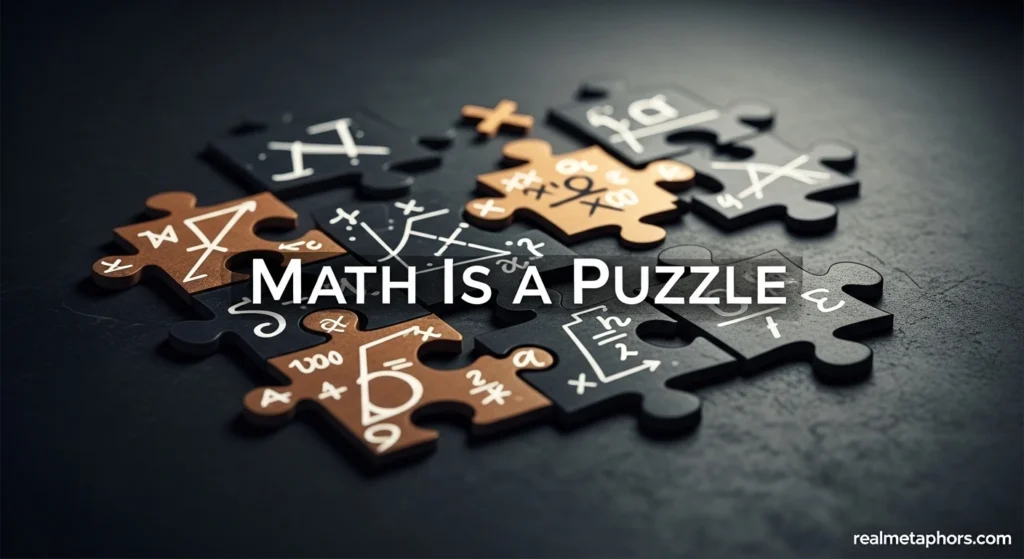
Meaning: Math problems are like puzzles that need solving.
Example: “This algebra question is a puzzle waiting to be solved.”
Another way to say it: Math is like a brain teaser.
Imagine: Pieces scattered on a table. Slowly clicking together.
2. Math Is a Map
Meaning: Math guides you step by step to a solution.
Example: “Geometry is a map that shows us how shapes fit together.”
Another way: Math is a guidebook.
Imagine: A folded paper map opening to show a clear route.
3. Math Is a Language
Meaning: Numbers and symbols communicate ideas.
Example: “Equations are sentences in the language of math.”
Another way: Math speaks through symbols.
Imagine: Plus and minus signs talking to each other.
4. Math Is a Toolbox
Meaning: Math gives you tools to solve real-life problems.
Example: “Percentages are tools in my math toolbox.”
Another way: Math is a set of problem-solving tools.
Imagine: A metal box filled with rulers, calculators, and formulas.
5. Math Is a Workout for the Brain
Meaning: Math strengthens thinking skills.
Example: “Doing fractions is like lifting weights for my brain.”
Another way: Math builds mental muscles.
Imagine: Your brain doing push-ups.
6. Math Is a Recipe
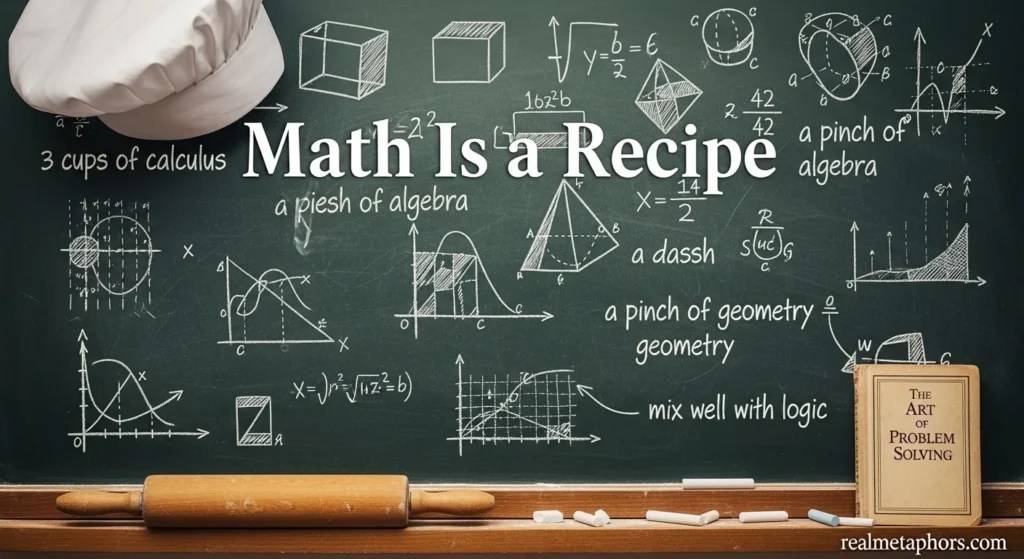
Meaning: You must follow steps carefully.
Example: “Solving equations is like following a recipe.”
Another way: Math is step-by-step cooking.
Imagine: Mixing ingredients in the right order.
7. Math Is a Bridge
Meaning: Math connects ideas together.
Example: “Algebra is a bridge between numbers and unknowns.”
Another way: Math links concepts.
Imagine: A strong bridge over a river of confusion.
8. Math Is a Key
Meaning: Math unlocks opportunities and understanding.
Example: “Learning math is the key to engineering.”
Another way: Math opens doors.
Imagine: Turning a golden key in a lock.
9. Math Is a Game
Meaning: Math can be fun and strategic.
Example: “Statistics feels like a strategy game.”
Another way: Math is playful problem-solving.
Imagine: Moving pieces carefully on a board.
10. Math Is a Mountain
Meaning: Math can feel challenging but rewarding.
Example: “Calculus is a mountain I’m learning to climb.”
Another way: Math is a tough climb.
Imagine: Reaching the top and seeing a wide view.
11. Math Is a Compass
Meaning: Math helps you make decisions.
Example: “Budgeting uses math as a compass.”
Another way: Math gives direction.
Imagine: A compass needle pointing north.
12. Math Is a Building
Meaning: Math concepts build on each other.
Example: “Multiplication is the foundation of algebra.”
Another way: Math is layered like bricks.
Imagine: Stacking blocks carefully.
13. Math Is Music
Meaning: Math has patterns and rhythm.
Example: “Patterns in math are like beats in a song.”
Another way: Math has harmony.
Imagine: Repeating rhythms echoing like drumbeats.
14. Math Is a Detective Story
Meaning: You search for clues to find answers.
Example: “Word problems feel like solving a mystery.”
Another way: Math is an investigation.
Imagine: A detective with a magnifying glass.
15. Math Is a Garden
Meaning: Skills grow with care and practice.
Example: “Practice helps my math skills bloom.”
Another way: Math needs watering.
Imagine: Tiny number-seeds sprouting.
16. Math Is a Staircase
Meaning: You move step by step upward.
Example: “Each lesson is another stair.”
Another way: Math progresses gradually.
Imagine: Climbing steady steps.
17. Math Is a Machine
Meaning: When used correctly, it produces results.
Example: “An equation is like a machine: input and output.”
Another way: Math runs on logic.
Imagine: Gears turning smoothly.
18. Math Is a Treasure Hunt
Meaning: The answer is a hidden prize.
Example: “Solving for x feels like finding treasure.”
Another way: Math hides rewards.
Imagine: Digging and discovering gold.
19. Math Is a Shield
Meaning: Math protects you from mistakes.
Example: “Checking calculations is my shield against errors.”
Another way: Math guards accuracy.
Imagine: A shiny shield blocking wrong answers.
20. Math Is a Story
Meaning: Numbers tell a narrative.
Example: “Graphs tell the story of data.”
Another way: Math explains events.
Imagine: A line graph rising like a plot twist.
21. Math Is a Toolbox for Life
Meaning: It helps in daily decisions.
Example: “I used math to compare prices at the store.”
Another way: Math helps in real life.
Imagine: Choosing the best deal confidently.
22. Math Is a Maze
Meaning: You must find the right path.
Example: “This problem feels like a maze.”
Another way: Math can be tricky pathways.
Imagine: Turning corners carefully.
23. Math Is a Telescope
Meaning: Math helps you see far into the future.
Example: “Interest rates show future savings.”
Another way: Math gives foresight.
Imagine: Looking through a lens at tomorrow.
24. Math Is a Clock
Meaning: Math keeps life organized and timed.
Example: “Time management depends on math.”
Another way: Math measures time.
Imagine: Clock hands ticking steadily.
25. Math Is a Dance
Meaning: Numbers move in patterns together.
Example: “Fractions and decimals dance together.”
Another way: Math flows rhythmically.
Imagine: Graceful steps across a floor.
26. Math Is a Safety Net
Meaning: Math gives confidence and security.
Example: “Knowing percentages protects me from scams.”
Another way: Math provides protection.
Imagine: A net catching you before you fall.
Fun Exercises and Writing Prompts
1. Create Your Own Metaphor
Finish this sentence: “Math is like ______ because ______.”
2. Daily Life Challenge
Look around your room. Pick one object. Compare it to math.
3. Social Media Post Idea
Write a short caption using one metaphor: “Math is a mountain, but I’m climbing it step by step.”
4. Story Starter
Write a short story where math becomes a character—maybe a detective or a gardener.
5. Reverse Metaphor Game
Take something simple (like cooking) and explain it using math words.
Extra Tips for Using Metaphors for Math
- Keep them simple and visual.
- Use everyday objects.
- Avoid mixing too many metaphors at once.
- Make sure the comparison makes sense.
- Use them in essays, teaching, speeches, or even Instagram captions.
Metaphors make math friendly. They turn fear into curiosity.
FAQs
1. Why use metaphors for math?
Metaphors make abstract ideas easier to understand. They turn numbers into pictures in your mind.
2. How do I create a math metaphor?
Compare math to something familiar. Ask: “What does this feel like?”
3. Are metaphors useful in teaching math?
Yes. Teachers often use them to explain complex topics in simple ways.
4. What is a common mistake when using metaphors?
Mixing too many ideas at once. Keep one clear comparison.
5. Can metaphors improve math confidence?
Yes. They reduce fear and make math feel less intimidating.
6. Are metaphors only for students?
No. Writers, teachers, speakers, and even business professionals use them.
7. Can I use math metaphors in everyday life?
Absolutely. Use them in conversations, presentations, or journaling.
Conclusion
Math doesn’t have to feel cold or distant. With the right metaphors for math, it becomes a puzzle, a bridge, a dance, even a treasure hunt.